Sunday, October 8, 2017

All That Could Go Wrong When Jihadists Return Home — to China

By Colin P. Clarke and Paul Rexton Kan

Defense One – September 28, 2017

Once separatists, now jihadists, some Uighurs returning from the ISIS battlefield could threaten — and test — Beijing. 
Most of the foreign fighters that flooded into in Syria during the past few years came from the West, but some jihadists also arrived from the Far East, including as many as 300 of Western China’s Uighurs, the Sunni Muslim indigenous ethnic minority. Now that the Islamic State’s caliphate is collapsing, it seems inevitable that some will return to China, bringing with them more of the jihadist ideology and influence that has leaders in Beijing worried.
The Uighurs come from China’s western province of Xinjiang that borders Afghanistan and Pakistan. China cannot afford further instability in Xinjiang. With its abundant natural resources, and rampant arms smuggling, Beijing has begun shoring up its border patrol there.

Fake News Reports About China & Muslims Exposed As US Infowar

by Andrew KORYBKO 

ORIENTAL REVIEW - 07/10/2017

Radio Free Asia, a media organization publicly funded by the US government through the Broadcasting Board of Governors, alleged in a now-viral report last week that China was forcing Uighur Muslims in Xinjiang to hand over their Qurans and prayer mats under the threat of punishment. They also quoted the so-called “World Uighur Congress” which allegedly confirmed this as well. China struck back over the weekend, however, when Deputy Chief of Mission at the Chinese Embassy in Islamabad Zhao Lijian wrote on Twitter that “This is totally baseless. Muslims in China enjoy good life. Radio Free Asia is anti-China. World Uyghur Congress is a separatist group”. The diplomat was right on all four counts, as the only basis for this fake news report was the separatist “World Uyghur Congress” whose claims were disseminated to global media by means of the anti-China Radio Free Asia, thus making the accusation totally baseless and refuting the Mainstream Media-driven assertion that Muslims don’t enjoy a good life in China.

China bans use of anti-Islam words on social media

THE TIMES OF INDIA - Sep 21, 2017

BEIJING: "Islamophobic" terms used by Chinese internet users to stigmatize Muslims have been blocked by authorities to prevent bias against Islam, official media reported on Thursday.  China has over 21 million Muslims mostly the Uyghurs in Xinjiang and Hui community in Ningxia province, according to unofficial accounts.  "The Islamophobic terms invented by Chinese Internet users to stigmatize Muslims have been blocked by authorities on Chinese social media despite criticism from the netizens that such a ban overtly favourable to Muslim minorities," state-run Global Times reported.  China is currently carrying out massive crackdown against the East Turkistan Islamic Movement (ETIM) in the volatile Xinjiang province where Uygurs who formed majority were restive over the increasing settlements of Han community, the majority ethnic group constituting over 90 per cent of the country's population.

READ MORE....

Instrument makers dance to a traditional tune

Cui Jia and Mao Weihua 

THE TELEGRAPH -  4 October 2017

Uyghur artisans in villages across western China are eager to maintain age-old instrument making skills and keep their culture alive  Rehman Abdula is a quiet man, so when he speaks people know his words are important.  “It sounds good,” he said, after listening to Memet Ali play a satar, a traditional Uyghur instrument that resembles an Indian sitar. When Memet visited, Rehman was in the process of making the instrument at his house in Tuowankewukusake village, Shufu county, Xinjiang Uyghur Autonomous Region.  Memet, 30, is a Uyghur musician who plays in a local band that specialises in muqam, a popular and well-known genre in the music of the mainly Muslim ethnic group. A few weeks before his visit he had commissioned Rehman to make him a new satar.  The craftsman, 65, had asked Memet to call on him to see if he was happy with the half-finished satar before he started to paint and decorate the instrument. It usually takes about a month to make a satar.

READ MORE...

Pakistan rejects US objection on CPEC route

THE NEWS - October 7, 2017 

 ISLAMABAD: Pakistan has strongly rejected US objections on China’s ‘One Belt, One Road’, in which China-Pakistan Economic Corridor (CPEC) is a flagship project.  Reacting to US Defence Secretary James Mattis reservations over CPEC route, Foreign Office spokesman Nafees Zakaria said, “CPEC is a project for development and prosperity of the region and welfare of the people.”  The spokesman went on to say, “India is severely violating human rights in occupied Kashmir. Indian army has been committing atrocities against innocent Kashmiris there.”  He called upon international community to take notice of Indian atrocities in occupied Kashmir.  Earlier, Senator Mushahid Hussain Syed, Chairman China-Pakistan Economic Corridor (CPEC) Parliamentary Committee, also strongly rejected US objections.

READ MORE....

5 Things You Need to Know About China’s National Party Congress

By Wu Gang

CAIXIN - SEPTEMBER 1, 2017

The Communist Party of China (CPC), the country’s ruling party since the end of the civil war in 1949, will begin its once-every-five-year National Congress on Oct. 18, at which time a new slate of party leaders will be elected.
In the major party reshuffle, some officials will stay in their posts; others will be elevated; and some will retire. The nation will closely watch, as the new mixture of leadership will help shape China’s future political and economic landscapes.
Here are five things to know:
What will happen?
A total of 2,300 delegates to the 19th party congress, or the elites of the more than 89 million party members nationwide, will gather in Beijing to vote for members of the party’s Central Committee and the Central Commission for Disciplinary Inspection, a powerful anti-corruption body. The current, 18th Central Committee has more than 370 members and alternate members, and the anti-corruption commission has 130 members.
Based on previous experience, right after the weeklong National Congress meeting ends, the party’s Central Committee will hold its first plenary meeting to elect a Politburo and its Standing Committee, which comprises the nation’s top leadership.

READ MORE...

Six Decades of CCP Congress Reports

China Media project -  Oct 5, 2017

We are now just two weeks from the 19th National Congress of the Chinese Communist Party. And while it is difficult to know what to expect from the meeting’s political report, a highly formalized document that will outline the priorities and accomplishments of General Secretary Xi Jinping and the Party he leads, we can familiarize ourselves with the political reports of China’s past — and the stilted discourse therein.
With that in mind, here are downloadable links to each political report since the 8th National Congress of the CCP in September 1956, spanning more than 60 years. Of the English-language reports at left, all are Word files with the exception of the file for the 13th National Congress, which is available only in PDF. We have so far not found easily accessible versions of the reports for the 8th and 9th congresses, for which we welcome input.
Good luck fishing through those CCP buzzwords!

8th CCP Congress Report

9th CCP Congress Report

10th CCP Congress Report       [CHINESE]

11th CCP Congress Report       [CHINESE]

12th CCP Congress Report       [CHINESE]

13th CCP Congress Report       [CHINESE]

14th CCP Congress Report       [CHINESE]

15th CCP Congress Report       [CHINESE]

16th CCP Congress Report       [CHINESE]

17th CCP Congress Report       [CHINESE]

18th CCP Congress Report       [CHINESE]

Sunday, October 1, 2017

Egypt signs memo with China on $739 mln for rail link to new capital

ANALYSIS: How ‘superpower’ China entered Palestine-Israel peace fray

By Adil Rasheed

Al Arabiya English Tuesday, 26 September 2017

For a long time China shied away from it, but it seems to be slowly easing into the role of an incipient superpower.  With the US seemingly turning protectionist under the Trump administration – backing away from the climate accords and Trans Pacific trade deals – an OBOR-buoyed globalist China seems to be shedding its geopolitical stage fright and is throwing its political weight beyond its near abroad.  Also read: China to host peace meet on Israel, Palestinians this year  In fact, it is a leap that many Western strategists had themselves desired China to take as opposed to being a “free rider” of peace and stability that US has been providing in most critical regions of the world.  For instance, Scottish historian Niall Fergusson had long waited for the time, “when China feels obliged to pivot to the Middle East and make more of a contribution in stabilizing the region”.

READ MORE....

Chinese millionaire to set up artificial intelligence lab in Haifa

By Max Schindler

JERUSALEM POST - September 23, 2017  

Zong Qinghou, the CEO of one of China’s largest companies, will provide the AI center with at least $10 million over five years.

Zong Qinghou, the CEO of one of China’s largest companies, announced plans to set up a research center at the University of Haifa focusing on artificial intelligence.  The Chinese Academy of Sciences will also be a research partner. Zong will provide the AI center with at least $10 million over five years, the research partners announced at a signing event on Tuesday, with much of the funding going to construct laboratories and obtain high-end equipment, the University of Haifa’s President Ron Robin said.  “For us, this is a game-changer. We get recognition by a major Chinese investor, that the work that we’re doing is significant,” Robin told The Jerusalem Post.  Zong, who heads the Hangzhou Wahaha Group, China’s largest beverage company, has visited the University of Haifa’s campus four times.  The research center will focus on improving the camera lens behind driverless cars – necessary for operating a vehicle when it’s raining or foggy – as major automobile companies and tech companies race to perfect the technology in the multi-billion dollar autonomous vehicle market.

READ MORE...

China makes massive investment in Israeli lab meat technology

$300 million deal sees Chinese partner with Israeli high-tech companies battling global warming

By Sue Surkes   

TIMES OF ISRAEL - September 17, 2017

China has signed a $300 million deal to partner with Israeli high-tech companies working to create laboratory-grown meat as the Asian giant looks to embrace technologies that will help it cut down on harmful emissions and pollution.
Israeli companies SuperMeat, Future Meat Technologies, and Meat the Future are three of only eight companies in the world growing meat from animal cells in laboratories, Quartz magazine reported.
The move potentially opens up the massive Asian economy for the Israeli companies. The Chinese market is potentially huge: China imported meat worth more than $10 billion in 2016, according to the International Trade Centre.
As the country modernized and the standard of living rose for the average Chinese, meat consumption has rocketed.

READ MORE...

Iran, China Sign $10 Billion Finance Deal

FINANCIAL TRIBUNE - Thursday, September 14, 2017 

China's CITIC Trust will extend $10 billion credit line for supporting projects in lran, based on an agreement signed between the company and five Iranian banks at CITIC Group headquarters in Beijing on Thursday.  Export Development Bank of Iran, Bank of Industry and Mine, Parsian Bank, Bank Pasargad Iran and Refah Bank are designated to act as the agent banks for using the Chinese finance on water management, energy, environment and transport projects in Iran, the official news portal of the Iranian government reported.  The Iranian delegation, headed by Valiollah Seif, the governor of the Central Bank of Iran, has traveled to China in an attempt to enhance bilateral banking relations.  The Iranian mission is scheduled to sign a memorandum of understanding with the Development Bank of China on financing construction and production projects worth €15 billion.

READ MORE...

New freight train service from China to Iran opens

Route cheaper and twenty days faster than sea freight

By Asia Unhedged

ASIA TIMES - September 16, 2017

A train loaded with more than 560 tonnes of machinery, household goods and ceramics left Yinchuan South Railway Station earlier this month, scheduled to reach Tehran in fifteen days, the Asset reports.  The new trade route comes with the lifting of sanctions as part of the nuclear deal, breathing new life into Iran’s economy. Big trade and investment deals have been signed since the agreement, and despite the Trump administration’s threats to backtrack on the deal, China, Russia and France are unlikely to take steps to further isolate Iran.  Deals include a contract signed between Iran and China National Petroleum Corp and French oil company Total for the development of the world’s largest natural gas field.

READ MORE...

China to expand maritime cooperation with Turkey

ALI UNAL

DAILY SABAH - SEPTEMBER 24, 2017

The Chinese coastal city Taizhou near the East China Sea is looking forward to expanded maritime cooperation with Turkey. "We are on the route of the 21st-Century Maritime Silk Road; therefore, we are looking forward to expanding our cooperation with countries and cities that are part of the same project," Ms. Lihui Wu, the vice mayor of Taizhou city in China's Zhejiang province, told a group of Turkish journalist who visited the city as part of China Radio International's (CRI) visit on Sept. 22-23. "Thus, we look forward to expanding our maritime cooperation with Turkey," Vice Mayor Wu added.  China's southeast Taizhou city has historically been on important trade routes. Italian voyager Marco Polo came to Taizhou more than 700 years ago along the Maritime Silk Road and described it as a city of creature comforts and happiness. Today, with a population over 6 million, the city is on the route of the 21st-Century Maritime Silk Road.

READ MORE....

Turkey says China to be important market in 2018

Turkey's Culture Minister says southeast Asia, particularly China, to be important markets next year

ANADOLU NEWS AGENCY - SEPT. 15, 2017

Turkey’s Culture Minister Numan Kurtulmus said Friday China will be an important market in the coming year.  Kurtulmus said the year 2018 will be favorable as it has been declared as the “Turkey Tourism Year” in China.  He was speaking to journalists from Anadolu Agency and TRT in Chengdu province of China, on the sidelines of a session of the UN World Tourism Organization.  He added to mark the year various events will be held in Beijing, Shanghai, Chengdu and other cities.  Kurtulmus, who met ministers from Indonesia, Azerbaijan and Iran during the session, said his talks with them were fruitful.  “Southeast Asia and particularly China will be new markets for us in the coming year,” he said, adding that this may bring millions of tourists to Turkey.  He expressed hopes that Turkey would come out as a more important member of the world tourism organization. “We will set head offices in Istanbul or other cities.”

READ MORE....

4th Confucius Institute opens in Turkey to enhance China-Turkey cultural exchanges, mutual understanding

Xinhua| 2017-09-28

ISTANBUL, Sept. 27 (Xinhua) -- A fourth Confucius Institute in Turkey was inaugurated on Wednesday at the Yeditepe University in Istanbul, with an aim to enhance cultural exchanges and better understanding between Turkey and China.
Addressing the opening ceremony, Rector of Yeditepe University Canan Aykut Bingol said the opening of the Confucius Institute is significant as it will contribute to more exchanges and contacts between Turkish and Chinese college students and societies.
She added that the two countries are just carrying on a tradition long being established along the ancient Silk Road.
Bedrettin Dalan, the university's founding president, said it is important for Turks to study Chinese to promote the mutual understanding between China and Turkey.
The Confucius Institute has been instructing everyone to be friends instead of enemies, he said, while voicing the hope that Confucius' philosophy and thoughts will spread even further.

READ MORE....

China robotics giant eyes cooperation, investment in Turkey

ALI UNAL

SABAH DAILY - SEPT. 25, 2017

As China looks to become a global leader in robotics and automation, Zhejiang Qianjiang Robot Co. Ltd., one of the country's leading industrial robot manufacturers, is looking to improve cooperation and increase investments in Turkey, company Chairman Helin Chen has said.  Speaking to a group of Turkish journalists on Sept. 24 at a China Radio International (CRI) event, Chen said: "We would like to increase our cooperation and investments in [Turkish] companies, in line with the One Belt One Road (OBOR) project."  "We are open to all kinds of cooperation and investment opportunities in Turkey."  He underlined that Zhejiang Qianjiang was also prepared for technology transfer to Turkish companies.

READ MORE....

China’s role in Turkey’s energy future

Temptation to invest in Turkey’s coal sector will test President Xi’s commitment to climate leadership

By Arif Cem Gündoğan and Ethemcan Turhan

Chinadialouge - SEPT. 28, 2017

China may be halting construction of coal-fired power at home but abroad it’s still investing in coal, even as it pushes aggressively into renewable energy markets.
In the years ahead, the kind of investments China makes in Turkey will prove an important test of its emerging leadership on energy and climate.
China has strengthened its bilateral relationship with Turkey in recent years. Chinese wind power companies MingYang and Goldwind were among eight international consortia that took part in a tender for a one gigawatt wind project in July, organised by the Turkish Ministry of Energy and Natural Resources.
Despite Turkey’s on-going national state of emergency and political instability following a coup attempt in July 2016, companies, including those from China, have not been put off bidding for a stake in Turkey’s future energy infrastructure.

READ MORE....

Chinese envoy believes Ankara, Beijing can further deepen collaboration

ÖZGENUR SEVINÇ

SABAH DAILY - SEPTEMBER 29, 2017

Chinese ambassador to Ankara Yu Hongyang highlighted the promising ties between China and Turkey, stressing the strengthening of political, economic and cultural relations.  Speaking at a reception on Thursday on the occasion of the 68th anniversary of the founding of the People's Republic of China, Yu said: "I have full faith that China and Turkey will go further by joining hands, gain mutual profit with cooperation and carry bilateral strategic cooperation to the next level, as a result of the efforts of both governments and people from all fields."  Prefacing that China is the world's second-biggest economy in the world with its gross domestic product (GDP) surpassing $11 trillion, Hongyang said that China would continue to offer opportunities and contribute to the world peace by increasing common interests with other countries.

READ MORE....

China eyes Syria rebuild

By Bai Tiantian

Global Times - 2017/9/24

After seeing the growing progress in Syria's peace process, Chinese entrepreneurs are showing greater interest in the country's reconstruction, despite the obstacles.  Since this past April, at least 30 Chinese have traveled to Syria looking for investment opportunities in the war-torn country, entering it from Lebanon. Their visit took them to Damascus and Homs where they were greeted by Syrian ministers and governors and could sit down and discuss possible projects.  Qin Yong, vice president of the Beijing-based non-profit China-Arab Exchange Association who visited Syria three times on business this year, told the Global Times that most of the Chinese entrepreneurs come from the private sector, including import-export goods, food, power equipment and construction.  "So far the Syrian government has controlled two-thirds of the country," Qin said. "Reconstruction already started in 2015 as the government battled opposition forces and the Islamic State on one front and began restoring infrastructure in safer areas. But while Russian and Iranian companies were already part of the reconstruction effort, Chinese enterprises had their doubts."  Qin went on to say, "Many had concerns before arriving in Syria but their impressions of the country were reversed by the end of the tour," then noted that a growing number of Chinese businesspeople are showing interest.

READ MORE.....

Friday, September 22, 2017

Conference: China’s Expanding Influence in the Middle East Trade, Energy, Security, and Multipolarity - AUB Sep. 28

China’s Expanding Influence in the Middle East  Trade, Energy, Security, and Multipolarity

September 28th, 2017
9:30AM - 3:30PM
Issam Fares Institute Auditorium
AUB (Green Oval)

Agenda
09:30 - 10:00
Registration and Coffee Reception
10:00 - 10:30
Welcoming words by Dr. Tarek Mitri, Director of the Issam Fares Institute for Public Policy and International Affairs and by Nils Wörmer, Head of the Konrad-Adenauer-Stiftung (KAS) Syria/Iraq Office
09:30 - 10:00
Panel 1: “One Belt, One Road”: China’s Interests, Goals, and Long-term Visions in the Middle East
Chair: Michael Winzer, Head of Office in Beijing, China, Konrad-Adenauer-Stiftung
Input 1:
China’s Vision of a Multipolar World: Challenging Western Dominance
Dr. Nadine Godehardt - German Institute for International and Security Affairs, Berlin
Input 2:
Trade Interests, Economic Approach, and Chinese Soft Power
Dr. Christina Lin - Center for Global Peace and Conflict Studies, University of California, Irvine
Input 3:
China’s Military Build-up and Security Interests in the Region
Dr. Bingbing Wu - Institute of International and Strategic Studies, Beijing University, Beijing

Questions and Answers
12:30 – 13:30
Lunch
13:30 - 15:00
Panel 2: China’s Policies on the Ground
Chair: Rayan El-Amine, Assistant Director, Issam Fares Institute
Input 1:
The Afghanistan-Pakistan Theatre
Dr. Alessandra Cappelletti - Research Center on Contemporary China, Milan
Input 2:
China in the Persian Gulf: Relations with Iran, Saudi Arabia, and Iraq
Dr. Moritz Pieper - School of Arts and Media, University of Salford, Manchester
Input 3:
China’s (Non-)intervention Policy Towards the Syrian Conflict
Dr. Imad Mansour - Department of International Affairs, Qatar University, Doha

Questions and Answers
15:00 - 15:30
Coffee Reception
The conference will address, but not exclusively, the following questions:
How does China visualize its long-term strategy of “One Belt, One Road” in the Middle East, in terms of interplay between its economic approach and goals in a multipolar world?
How do the relations between Chinese Soft Power, its trade interests and its economic vision unfold?
What are the regional security interests that reflect Chinese military build-up in terms of strategic choices and policy on the ground?
What is the nature and limit of China’s engagement in the Middle East, of its bilateral relations to regional powers (Saudi Arabia, Iran) and the resulting implications for countries such as Afghanistan, Pakistan and Iraq?
What are the motors of Chinese strategic choices regarding the Syrian conflict, and how may these choices vary in the future?

Note: This conference will be in English

Wednesday, September 20, 2017

Emperor Releases First Footage of Chinese Action Film ‘Operation Red Sea’ (EXCLUSIVE)

Patrick Frater Asia Bureau Chief

Variety - September 21, 2017

Emperor Motion Pictures has revealed the first footage from “Operation Red Sea,” one of the most ambitious Chinese action films ever made. Emperor is introducing it to buyers at the Cannes Market.
Directed by Hong Kong’s Dante Lam on a budget of $72 million (RMB500 million), “Red Sea” is about a Chinese army rescue mission in the Middle East.
“Red Sea” is a followup to Lam’s smash hit “Operation Mekong,” which grossed $173 million at the mainland Chinese box office last year. “Mekong” was a fictionalized retelling of the so-called Mekong River Massacre, in which the People’s Liberation Army intervened after two Chinese cargo ships were attacked between Thailand and Myanmar in 2011.
“Mekong” also confirmed Lam, previously best known for noir thrillers, as one of Asia’s top action movie directors.
“Red Sea,” which is still in production, required the collaboration of Bona Film Group, Emperor affiliate Emperor Film Production, Film Fireworks, Star Dream Studio, and the Chinese military’s P.L.A. Navy Government TV Art Central of China.
According to the official synopsis, “the Jiaolong Assault Team, one of the special forces of the world’s largest military force, People’s Liberation Army, is given a potentially fatal assignment, leading a small eight-man unit to evacuate Chinese residents from a North African republic in the throes of a coup d’état.
“The squad strategically makes a two-pronged rescue attempt but is tragically ambushed, resulting in heavy casualties. At the same time, the terrorist leader manages to steal the incriminating evidence against him along with essential material for the manufacture of nuclear arms. The Jiaolong Assault Team is fully aware of the importance of ensuring such material is forever removed from the terrorists’ hands.”
The screenplay was written by Lam and the film produced by Bona’s Yu Dong and executive produced by Candy Leung. The completed picture is currently scheduled for release in the fourth quarter of 2017.

Tuesday, September 19, 2017

Orientalism and Chinese Studies


Web Based News Organizations:
China Media Project  http://chinamediaproject.org/
China Digital Times http://chinadigitaltimes.net/  
Historical Photographs of China https://www.hpcbristol.net/

Academic Organizations:
PRC History - http://prchistory.org/
PRC Mailing List – Michigan State University
American Association for Chinese Studies https://aacs.ccny.cuny.edu/homepage.htm
Association for Asian Studies http://www.asian-studies.org/

Academic Centers and Programs in the US:
The Fairbank Center for Chinese Studies Harvard University http://fairbank.fas.harvard.edu/
Weatherhead East Asian Institute, Columbia University http://weai.columbia.edu/
China Studies at the University of Washington Jackson School https://jsis.washington.edu/china/
Center for Chinese Studies, UC Berkeley http://ieas.berkeley.edu/ccs/
China Studies | SAIS Johns Hopkisn University https://www.sais-jhu.edu/content/china-studies#overview
UCLA Center for Chinese Studies http://www.international.ucla.edu/ccs/home
Centre for China Studies, CUHK https://www.ccs.cuhk.edu.hk/en-gb/  ?

Think-Tanks Based Centers:
The China Research Center https://www.chinacenter.net/
EastWest Institute https://www.eastwest.ngo/
Kissinger Institute on China and the United States | Wilson Center https://www.wilsoncenter.org/program/kissinger-institute-china-and-the-united-states
Freeman Chair in China Studies CSIS https://www.csis.org/programs/freeman-chair-china-studies
United States Institute of Peace https://www.usip.org/regions/asia/china
American Enterprise Institute http://www.aei.org/tag/china/

Journals:
Journal of Contemporary China http://www.tandfonline.com/toc/cjcc20/current
China: An International Journal https://muse.jhu.edu/journal/267
Journal of Current Chinese Affairs http://journals.sub.uni-hamburg.de/giga/jcca/
American Journal of Chinese Studies https://www.utsa.edu/ajcs/

Others:
National Committee on U.S.-China Relations https://www.ncuscr.org/

Sunday, September 17, 2017

Non-Orientalist View on Chinese Society and Politics

In order to understand China, we must first explore four important Chinese historical novels:


WATER MARGIN 
It is also known as All Men are Brothers
Author: Shi Nai'an (Published in 14th century)

A 19th-century mural depicting Lu Zhishen uprooting a tree, a scene from the novel
The opening episode in the novel is the release of the 108 Spirits, imprisoned under an ancient stele-bearing tortoise.[9]  The next chapter describes the rise of Gao Qiu, one of the primary antagonists of the story. Gao abuses his status as a Grand Marshal by oppressing Wang Jin; Wang's father taught Gao a painful lesson when the latter was still a street-roaming ruffian. Wang Jin flees from the capital with his mother and by chance he meets Shi Jin, who becomes his apprentice. The next few chapters tell the story of Shi Jin's friend Lu Zhishen, followed by the story of Lu's sworn brother Lin Chong. Lin Chong is framed by Gao Qiu for attempting to assassinate him, and almost dies in a fire at a supply depot set by Gao's henchmen. He slays his foes and abandons the depot, eventually making his way to Liangshan Marsh, where he becomes an outlaw. Meanwhile, the "Original Seven", led by Chao Gai, rob a convoy of birthday gifts for the Imperial Tutor Cai Jing, another primary antagonist in the novel. They flee to Liangshan Marsh after defeating a group of soldiers sent by the authorities to arrest them, and settle there as outlaws with Chao Gai as their chief. As the story progresses, more people come to join the outlaw band, including military personnel and civil officials who grew tired of serving the corrupt government, as well as men with special skills and talents. Stories of the outlaws are told in separate sections in the following chapters. Connections between characters are vague, but the individual stories are eventually pieced together by chapter 40 when Song Jiang succeeds Chao Gai as the leader of the band after the latter is killed in a battle against the Zeng Family Fortress.  The plot further develops by illustrating the conflicts between the outlaws and the Song government after the Grand Assembly of the 108 outlaws. Song Jiang strongly advocates making peace with the government and seeking redress for the outlaws. After defeating the imperial army in a great battle at Liangshan Marsh, the outlaws eventually receive amnesty from Emperor Huizong. The emperor recruits them to form a military contingent and sends them on campaigns against invaders from the Liao dynasty and rebel forces led by Tian Hu, Wang Qing and Fang La within the Song dynasty's domain. Although the former outlaws eventually emerge victorious against the rebels and Liao invaders, the campaigns also led to the tragic dissolution of the 108 heroes. At least two-thirds of them died in battle while the surviving ones either return to the imperial capital to receive honours from the emperor and continue serving the Song government, or leave and spend the rest of their lives as commoners elsewhere. Song Jiang himself is eventually poisoned to death by the "Four Treacherous Ministers" – Gao Qiu, Yang Jian (楊戩), Tong Guan and Cai Jing.


ROMANCE OF THE THREE KINGDOMS
Author: Luo Guanzhong (Published in 14th century)
Download the novel: https://khmerbamboo.files.wordpress.com/2014/10/dw3k-comthe_new_three_kingdoms_ebook-part2of6.pdf

Three Heroes of Three Kingdoms, silk painting by Sekkan Sakurai (1715–1790), depicting Liu Bei, Guan Yu and Zhang Fei.
One of the greatest achievements of Romance of the Three Kingdoms is the extreme complexity of its stories and characters. The novel contains numerous subplots. The following consists of a summary of the central plot and some well-known highlights in the novel.

Introduction 
It is early in the third century and the once-glorious Han Dynasty is in its twilight. Those who would cast themselves as China’s next rulers have brought the empire to the brink of war. Court eunuchs scheme, rulers fall, and great heroes are born in epic combat. The people of China, longing for peace, wonder what will become of their lives as war rages across the land. The dynasty seems to have lost its “Mandate of Heaven”—what now?  This is the backdrop for the literary classic Romance of the Three Kingdoms, one of the four great pillars of Chinese literature (Journey to the West, Outlaws of the Marsh, and Dream of the Red Chamber are the others). Its fourteenth century author, Luo Guanzhong, draws upon history and folklore to create a colorful tale that showcases the era’s political and social affairs.  Moreover, it is considered a guidebook to military strategy that has been likened to Sun Tzu’s The Art of War. Through its pages, readers meet dozens of iconic characters from history, and witness battles of every scale. Three Kingdoms is at the core of Chinese cultural identity and, especially, the concept of yi—the essential glue that binds a harmonious society.  Shen Yun’s 2015 dance Capturing Arrows With Boats of Straw, tells of one of the brilliant stratagems employed in this mega-historical saga.
Three Kingdoms at War  
As lords and generals gather to vie for supremacy, three great leaders soon emerge. Their names are Liu Bei, Cao Cao, and Sun Quan. These are men of formidable character, prowess, and guile, each keen to see his ambition fulfilled. They are each rulers of their own kingdoms—Shu, Wei, and Wu, respectively—and each aspire to unite the empire, bringing together “All Under Heaven,” as they call it.  With the help of the most brilliant minds and bravest hearts of the time, these three rise to power and engage in an epic contest for the future of China.
Kingdom of Shu
Warlord Liu Bei is the founder of Kingdom of Shu. His claim to the imperial throne is that he is a descendant of the Han’s rulers and can thus continue the heritage if not the dynasty.  Liu is portrayed as the most legitimate and deserving contender. He is high of mind and kind of heart, but lacks the resources and raw power of his rivals. But his lofty character acts like a magnet that attracts to his cause some of the novel’s most unforgettable heroes—mind-boggling strategists and nearly infallible warriors. Together, they successfully establish their own state.  The alliance of these heroes begins in one of Three Kingdoms’ best-known scenes: “Oath of the Peach Garden.” Liu Bei and the two warriors Zhang Fei and Guan Yu become sworn brothers:  “We don’t ask to be born on the same day,” they vow, “but we ask that it be on the same year, same month, and same day that we together die.”  The bond between the three establishes a strong theme that wends throughout the tale. Later, Liu Bei's influence increases rapidly after obtaining the help of Taoist sage and expert strategist Zhuge Liang. Some of Three Kingdoms’ most fantastic stories, like “Capturing Arrows With Boats of Straw,” owe to Zhuge’s exploits.
Kingdom of Wei 
In Three Kingdoms, the ambitious general Cao Cao is Liu Bei’s and conniving rival. Here is an example of a dialogue between him and his loyal chef:  Cao Cao: I need to borrow something of yours. Loyal Chef: Sure, what is it? Cao Cao: Your head. Loyal Chef: What? Cao Cao: Don’t worry, I’ll make sure your family is taken care of.  Cao Cao (pronounced tsao tsao) has an enormous army and the loyalty of much of the realm. He is also an accomplished poet whose works go on to have a significant impact on the Chinese poetic style.
Kingdom of Wu
Meanwhile, the Sun clan controls most of southern China. At the age of 18, after his older brother is assassinated, the red-bearded Sun Quan steps into power. During the decisive "Battle of Red Cliffs," Sun Quan allies with Liu Bei to keep Cao Cao’s armies from advancing across the Yangtze River.
Their allegiance was short-lived, however, and the three kingdoms continued to maneuver and vie for the future of China, known as the Middle Kingdom. But in this riveting tale filled with both triumph and sacrifice, every episode comes back to the principle of yi.
The Meaning of Yi
The novel’s Chinese title, San Guo Yan Yi (三國演義), can also be translated as “Three Kingdoms Performing Yi.” Yi (pronounced ee) most exactly translates as “righteousness” or “duty.” However, the concept expands to encompass honor, benevolence, loyalty, selflessness, and brotherhood.
Yi explains the virtuous relationships between rulers and subjects, fathers and sons, husbands and wives, and among brothers and friends. In traditional Chinese society it was an accepted rule that no matter what happens, you must observe yi.
Perhaps the ultimate embodiment of yi can be seen in the character of General Guan Yu. Also known as Guan Gong, later generations erected temples in his memory and worshiped him as "the God of War." On one occasion, he agreed to duel with a fierce adversary. Poured a bowl of hot wine for good luck, Guan Yu refused to drink it, saying he would be back in just a moment. Minutes later, he returned with the adversary’s head before his wine had even chilled.
And yet, along with his flowing beard, it is his indomitable spirit of yi that makes him most memorable. Faced with likely defeat, the once unbeatable warrior uttered the immortal lines:
Should the city walls fall, it means death, that’s all. Jade can be shattered, but you cannot change its whiteness. Bamboo can be scorched, but its joint cannot be destroyed. The body might perish, but the name will live on for posterity.
In order to protect his lord Liu Bei’s family, Guan Yu once allowed himself to be captured by the merciless enemy, Cao Cao. Cao Cao, who had long admired Guan Yu’s abilities as a warrior, tried coaxing him to his side with gold, titles, and prized horses. A weaker man would have easily given in, but Guan Yu took the first chance to escape. He braved great danger and overcame injury to safely return his sworn brother’s family to him.
Still, he never forgot the generosity that, though an enemy, Cao Cao had shown him. Years later Cao Cao was defeated at the “Battle of Red Cliff” and was running for his life with what was left of his decimated army. Guan Yu was sent to finish him off and intercepted Cao Cao at a narrow mountain pass. Facing the mighty Guan Yu, the disheveled and exhausted Cao Cao did not stand a chance. Guan Yu let him go.
Guan Yu, who was torn, had chosen to face certain execution for disobeying orders rather than betray yi by killing his former benefactor. Of course, Guan Yu was not executed, because it turns out that the strategist Zhuge Liang had specifically sent him to kill Cao Cao precisely because he knew full well Guan Yu could not get himself to do it. The strategist did so because he knew that China still needed Cao Cao to maintain a balance of three equal kingdoms, but that is another story.
The much-maligned Cao Cao, on the other hand, is an example of a leader with a poor sense of yi. He is known for the quote, “I’d rather betray the world than let the world betray me.” His personal philosophy becomes apparent in one scene where a pursued Cao Cao takes refuge with his father’s sworn brother. While his friend is out on an errand, Cao Cao overhears servants sharpening knives and discussing a kill. Cao Cao’s paranoia is piqued and he murders the entire family. He then discovers they were only preparing to slaughter a pig for his grand welcome dinner. When his old friend, the lord of the house, returns Cao Cao realizes he will be held accountable. So he uses the who’s-that-behind-you trick and stabs his host.
The Tale Lives On
With protagonists shining with yi and antagonists sorely lacking yi, Three Kingdoms, like Guan Yu, leaves a most important lesson for posterity. Not only has it has had a profound impact on Chinese culture and society, the novel offers a glimpse into an ancient world of moral courage and righteousness, with the glue of yi that held it together.
* * *
Three Kingdoms author, Luo Guanzhong, believed that the fate of every nation is etched in the stars, and that humans are very limited in their ability to affect the grand flow of history. However, he also believed that if people are upright and virtuous, we are able to accomplish tremendous things, bringing glory to ourselves and our families, leaving a shining legacy that transcends the ages.
FROM: http://www.shenyun.com/learn/article/read/item/eHIdpBl5ReM/romance-three-kingdoms-chinese-classic.html


JOURNEY TO THE WEST
Author: Wu Cheng'en (Published in 16th century)

The novel comprises 100 chapters, which can be divided into three major sections. The first, which includes chapters 1–7, is really a self-contained prequel to the main body of the story. It deals entirely with the earlier exploits of Sūn Wùkōng, a monkey born from a stone egg, who learns the art of fighting and secrets of immortality, and through guile and force makes a name for himself as the Qítiān Dàshèng (Simplified Chinese: 齐天大圣; Traditional Chinese: 齊天大聖), or "Great Sage Equal to Heaven." His powers grow to match the forces of all of the Eastern (Taoist) deities, and the prologue culminates in Sūn's rebellion against Heaven, at a time when he occupies a post in the celestial bureaucracy. Hubris proves his downfall when the Buddha manages to trap him under a mountain for 500 years.
Following this introduction, the nominal main character, Xuánzàng, is introduced. Chapters 8–12 provide his early biography and the background to his great journey. Dismayed that "the land of the South knows only greed, hedonism, promiscuity, and sins," the Buddha instructs the Bodhisattva Guānyīn to search Táng China for someone to bring the Buddhist sutras of "transcendence and persuasion for good will" to the East. Guānyīn gives this task to the monk Xuánzàng and provides him with three protectors in the form of disciples, Sūn Wùkōng, Zhū Bājiè and Shā Wùjìng, together with a dragon prince who acts as Xuánzàng's horse mount. These four characters agree to help Xuánzàng as atonement for past sins. This section of the story relates how Xuánzàng becomes a monk (as well as revealing his past life as the "Golden Cicada") and is sent on a pilgrimage by the Emperor Táng Tàizōng, who has previously escaped death with the help of an underworld official.  The third and longest section of the work is chapters 13–100, an episodic adventure story which combines elements of the quest as well as the picaresque. The framework of the story is Xuánzàng's quest to bring back Buddhist scriptures from Vulture Peak in India, but the substance is provided by the conflict among Xuánzàng's disciples and the various evils that beset him on the way.  The setting of this section is supposedly the sparsely populated lands along the Silk Road between China and India, including Xinjiang, Turkestan, and Afghanistan. The geography described in the book is, however, almost entirely fantastic; once Xuánzàng departs Cháng'ān, the Táng capital and crosses the frontier (somewhere in Gansu province), he finds himself in a wilderness of deep gorges and tall mountains, all inhabited by flesh-eating demons who regard him as a potential meal, with a hidden monastery or a royal city-state here and there amid the wilds.  The episodic structure of this section follows a formula to some extent. Episodes consist of 1– 4 chapters, and usually involve Xuánzàng being captured and his life threatened, while his disciples try to find an ingenious (and often violent) way of liberating him. Although some of Xuánzàng's predicaments are political and involve ordinary human beings, they more frequently consist of run-ins with various goblins and ogres, many of whom turn out to be the earthly manifestations of heavenly beings.  Chapters 13–22 do not follow this structure precisely, as they introduce Xuánzàng's disciples, who, inspired or goaded by the Boddhisatva Guānyīn, meet and agree to serve him along the way, in order to atone for their sins in their past lives.  Sūn Wùkōng (Simplified Chinese: 孙悟空; Traditional Chinese: 孫悟空), or Monkey, previously "Great Sage Equal to Heaven," appears right away in Chapter 13. The second, appearing in Chapter 19, is Zhū Bājiè (Simplified Chinese: 猪八戒; Traditional Chinese: 豬八戒), literally “Eight-precepts Pig,” sometimes translated as Pigsy or just Pig. The third, appearing in Chapter 22, is the river-ogre Shā Wùjìng (Simplified Chinese: 沙悟净; Traditional Chinese: 沙悟淨), also translated as Friar Sand or Sandy. The third prince of the Dragon-King, Yùlóng Sāntàizǐ (Simplified Chinese: 玉龙三太子; Traditional Chinese: 玉龍三太子) can possibly to be counted as a fourth disciple. He was sentenced to death for setting fire to his father's great pearl, but was saved by Guānyīn from execution to wait for his call of duty. He appears first in chapter 15, but has almost no speaking role, as throughout most of the story he appears in the transformed shape of a horse that Xuánzàng rides on.  Chapter 22, where Shā is introduced, also provides a geographical boundary, as the river of quicksand that the travelers cross brings them into a new "continent." Chapters 23–86 take place in the wilderness, and consist of 24 episodes of varying length, each characterized by a different magical monster or evil magician. There are impassably wide rivers, flaming mountains, a kingdom ruled by women, a lair of seductive spider-spirits, and many other fantastic scenarios. Throughout the journey, the four brave disciples have to defend their master and teacher Xuánzàng from attacks by various monsters and calamities.  The book strongly suggests that most of these calamities are engineered by fate and/or the Buddha; while the monsters who attack them are vastly powerful and many in number, no real harm ever comes to the four travelers. Some of the monsters turn out to be escaped heavenly animals belonging to bodhisattvas or Taoist sages and spirits. Towards the end of the book there is a scene where the Buddha literally commands the fulfillment of the last disaster, because Xuánzàng is one short of the 81 disasters he needs to attain Buddhahood.  In chapter 87, Xuánzàng finally reaches the borderlands of India, and chapters 87–99 present magical adventures in a somewhat more mundane, though still exotic, setting. At length, after a pilgrimage said to have taken fourteen years (the text actually only provides documentation for nine of those years, presumably to allow room for adding additional episodes) they arrive at the half-real, half-legendary destination of Vulture Peak, where, in a scene simultaneously mystical and comic, Xuánzàng receives the scriptures from the living Buddha.  Chapter 100, the last of all, quickly describes the return journey to the Táng Empire, and the aftermath, in which each traveler receives a reward in the form of posts in the bureaucracy of the heavens. Sūn Wùkōng and Xuánzàng achieve Buddhahood, Wùjìng becomes an arhat, the dragon is made a Naga, and Bājiè, whose good deeds have always been tempered by his greed, is promoted to an altar cleanser (eater of offerings at altars).


DREAM OF THE RED CHAMBER
Author: Cao Xueqin (Published 1791)

A scene from the novel, painted by Xu Baozhuan (1810–1873)
The novel provides a detailed, episodic record of life in the two branches of the wealthy, aristocratic Jia (賈) clan—the Rongguo House (榮國府) and the Ningguo House (寧國府)—who reside in two large, adjacent family compounds in the capital. Their ancestors were made Dukes and given imperial titles, and as the novel begins the two houses are among the most illustrious families in the city. One of the clan’s offspring is made a Royal Consort, and a lush landscaped garden is built to receive her visit. The novel describes the Jias’ wealth and influence in great naturalistic detail, and charts the Jias’ fall from the height of their prestige, following some thirty main characters and over four hundred minor ones. Eventually the Jia clan falls into disfavor with the Emperor, and their mansions are raided and confiscated.  In the novel's frame story, a sentient Stone, abandoned by the goddess Nüwa when she mended the heavens aeons ago, begs a Taoist priest and a Buddhist monk to bring it with them to see the world. The Stone, along with a companion (in Cheng-Gao versions they are merged into the same character), is then given a chance to learn from the human existence, and enters the mortal realm.  The main character of the novel is the carefree adolescent male heir of the family, Jia Baoyu. He was born with a magical piece of "jade" in his mouth. In this life he has a special bond with his sickly cousin Lin Daiyu, who shares his love of music and poetry. Baoyu, however, is predestined to marry another cousin, Xue Baochai, whose grace and intelligence exemplify an ideal woman, but with whom he lacks an emotional connection. The romantic rivalry and friendship among the three characters against the backdrop of the family's declining fortunes form the main story in the novel.

Tuesday, September 12, 2017

Why China Is Building A New City Out In The Desert Of Oman

Forbes - Sep 8, 2017 

Nobody is going to confuse the dusty fishing village of Duqm for Dubai.
But Oman intends to change this by building an entirely new, $10.7 billion transit-oriented industrial city on the desertified coast of the Arabian Sea, 550 kilometers south of Muscat.
More accurately, China intends to change this by building an entirely new $10.7 billion transit-oriented industrial city …
A year ago, Oman signed a deal and opened the doors for a Chinese consortium to move in and do what they seemingly like to do best: build a new boomtown. After constructing dozens of full-scale new cities and completely re-developing dozens more in their own country, Chinese firms are now moving out along the tendrils of the Belt and Road to construct new cities across Asia, the Middle East, and Africa. Duqm is among the most ambitious of such projects.

READ MORE....

Monday, September 11, 2017

The Hui: China’s other Muslims

By choosing assimilation, China’s Hui have become one of the world’s most successful Muslim minorities

The Economist - Oct 6th 2016 | TONGXIN

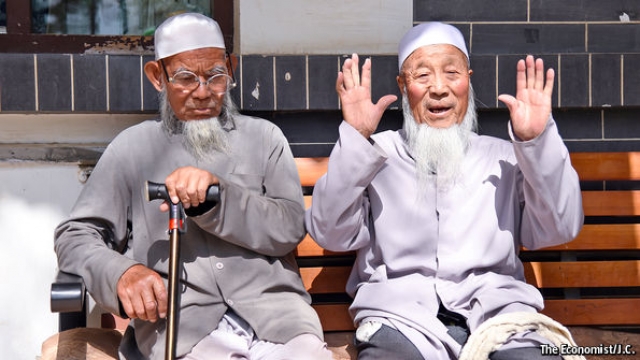
THE faithful are returning from the haj. Waiting for prayers outside the Great Mosque in Tongxin, a remote town in the western province of Ningxia, Li Yuchuan calls his pilgrimage a liberation: “Our prayers are just homework for it.” His 84-year-old friend (pictured, right) leaps up and twists himself with lithe agility into the shape of a pretzel. “We Muslims pray five times a day,” he says. “We are flexible and tough.” China’s Muslims need to be.  China has a richly deserved reputation for religious intolerance. Buddhists in Tibet, Muslims in the far western region of Xinjiang and Christians in Zhejiang province on the coast have all been harassed or arrested and their places of worship vandalised. In Xinjiang the government seems to equate Islam with terrorism. Women there have been ordered not to wear veils on their faces. Muslims in official positions have been forced to break the Ramadan fast. But there is a remarkable exception to this grim picture of repression: the Hui.

READ MORE....

Sunday, September 10, 2017

China Purchases 14% Of Rosneft From Qatar

By Zainab Calcuttawala

OIL PRICE - Sep 08, 2017,

China made a new move to strengthen its relationship with Russia this week by agreeing to buy a 14 percent stake in the oil and gas company Rosneft, according to a new report by the Associated Press.
The $9 billion purchase will transfer the Qatar Investment Authority’s 14.16 percent Rosneft stake to CEFC China Energy Company Ltd., Glencore said on Friday. China bought the shares at a 16 percent premium to the Rosneft share price over the past month. Final negotiations and regulatory approvals are needed before the exchange goes through, however.
“This deal intensifies the energy relationship between Russia and China. A direct stake in Rosneft will make CEFC China the main driver for the relationship of Rosneft with China, ahead of CNPC, Sinopec and Beijing Gas,” Wood Mackenzie senior analyst Christian Boermel said. “Rosneft keeps its customers close to its heart – buy a stake, get an oil supply agreement. CEFC China could soon take stakes in Rosneft projects, either in cash-intensive upstream projects, or in the downstream.”

READ MORE....

UAE-China economic cooperation to drive success of Belt & Road Initiative

The Hamdan Bin Mohammed Smart University (HBMSU) has hosted a roundtable on the ‘Belt & Road Initiative’ and Islamic Finance Executive Strategy to promote economic cooperation between China and the UAE in the non-oil commercial and production sectors.

by Nabilah Annuar

CPI FINANCIAL - Monday 21, August 2017

 Held under the theme ‘Sukuk and Economic Development: Opportunities and Challenges,’ the roundtable provided an international platform for exploring bilateral cooperation in the fields of trade, education, scientific research, and knowledge exchange under the Belt and Road Initiative. Discussions also centred on the challenges and opportunities in promoting Islamic financial instruments in China with a focus on Islamic Sukuk. The impact of Dubai’s emergence as the largest Islamic Sukuk hub in the world on Chinese companies was tackled as well.  The event was held with the support of the Dubai Islamic Economy Development Centre and provided an opportunity to capitalise on the leading experiences of the UAE in Islamic finance to support China’s ambitious initiative of connecting the economies and trade activities of more than 60 countries. The meeting was jointly organised by HBMSU’s Dubai centre for Islamic Banking and Finance, the National Development and Reform Commission of the People's Republic of China (NDRC), the China Islamic Finance Club, and ZhiShang Inter-Culture Communication.  Held under the theme ‘Sukuk and Economic Development: Opportunities and Challenges,’ the roundtable provided an international platform for exploring bilateral cooperation in the fields of trade, education, scientific research, and knowledge exchange under the Belt and Road Initiative. Discussions also centred on the challenges and opportunities in promoting Islamic financial instruments in China with a focus on Islamic Sukuk. The impact of Dubai’s emergence as the largest Islamic Sukuk hub in the world on Chinese companies was tackled as well.

READ MORE....

6th UAE-China Joint Economic Committee Meeting Concludes

ALBAWA - September 10th, 2017 

The 6th session of the UAE-China Joint Economic Committee held in the capital of Beijing, China has concluded. The UAE delegation was headed by H.E. Eng. Sultan bin Saeed Al Mansoori, Minister of Economy, while the Chinese side was led by Zhong Shan, Minister of Commerce of the People's Republic of China.  The two parties reported their achievements in the development of cooperative frameworks in several vital areas of common interest since the fifth session of the Joint Economic Committee. The most notable involved trade, investment, energy, infrastructure, financial services, tourism, as well as the steps taken to establish effective models for industrial cooperation and the exchange of expertise in the fields of information technology (IT).

READ MORE.....

Chinese enrollment at Israeli universities skyrockets

By SARAH LEVI

THE JERUSALEM POST - August 14, 2017

The influx of Chinese students at Israeli universities has been growing steadily in recent years.  On the forefront of this enrollment boom is the University of Haifa, which currently boasts some 200 Chinese students among its student body, compared to 20 in 2013, representing a 1,000% increase. A majority of these students come from the University of East China Normal University in Shanghai, which is a sister city of Haifa.  University of Haifa president Ron Robin welcomes the addition. “The cooperation with strategic partners from Chinese industry and academia serves the strategic goals of the university,” said Robin. “We have positioned ourselves as a leading international institution. As such, we welcome all the Chinese students to Israel, and intend to continue to deepen the ties and cooperation with the Chinese academy.”

READ MORE....