Xinhua - 2014-12-07
The main purpose of President Abdel-Fattah al-Sisi's expected visit
to Beijing is to create a kind of strategic partnership with China,
Egypt's International Cooperation Minister Naglaa al-Ahwani told Xinhua
on Saturday.
China is now attractive to the whole world, Naglaa al-Ahwani said
during an interview, adding that there is a mutual strong desire for
further cooperation between the two states.
"China is one of the most important states and the most growing
countries across the world with a very huge potential for development,"
she said.
Egypt has recently established a cabinet unit specified for China led
by Prime Minister Ibrahim Mahlab, including a number of key ministers
as members to study fields of cooperation with China.
Egypt seeks to attract more Chinese investments, Ahwani said. "The
concerned ministers provided a number of project proposals to be tackled
with the Chinese side before, during and after Sisi's visit to
Beijing."
READ MORE....
Monday, December 8, 2014
China, Turkey discuss Silk Road project
Zeynep Bilgehan ISTANBUL
HURRIYET DAILY - November/10/2014
 Representatives from Turkish NGOs and the Peace and Disarmament Association of the People’s Republic of China discussed the Silk Road project and possibilities for China and Turkey to cooperate further in a number of fields.
“We are very happy to discuss the Silk Road project, which was born in 2013, with our Turkish friends. Turkey has pioneered the ‘win-win’ principle that is based on peaceful development between China and the surrounding region,” said Ma Biabo, the head of the Chinese board, which visited Turkey upon the invitation by Turkey’s Marmara Group Foundation. He added that China and Turkey should have a “long-term perspective to develop their relations and respect” for each other.
READ MORE....
HURRIYET DAILY - November/10/2014
“We are very happy to discuss the Silk Road project, which was born in 2013, with our Turkish friends. Turkey has pioneered the ‘win-win’ principle that is based on peaceful development between China and the surrounding region,” said Ma Biabo, the head of the Chinese board, which visited Turkey upon the invitation by Turkey’s Marmara Group Foundation. He added that China and Turkey should have a “long-term perspective to develop their relations and respect” for each other.
READ MORE....

China slams Turkey for offer to shelter Uighurs
BEIJING - Reuters - Monday,December 8 2014
 China has lashed out at Turkey for offering shelter to roughly 200
Uighurs from the western Chinese region of Xinjiang who were rescued
from a human-smuggling camp in Thailand.
China has lashed out at Turkey for offering shelter to roughly 200
Uighurs from the western Chinese region of Xinjiang who were rescued
from a human-smuggling camp in Thailand.
Thai police found the group in March and Chinese officials identified “dozens” of them as Uighurs, a Muslim people from Xinjiang who speak a Turkic language. Many Uighurs chafe at government curbs on their culture and religion. Turkey’s state-run Anadolu news agency on Nov. 26 reported a request by Turkish Foreign Minister Mevlüt Çavuşoğlu for Thailand to send the Uighurs there, a move that angered China, which views their move to Thailand as “illegal immigration.”
Turkey asked ‘not to meddle’
Asked for a response on Turkey’s offer, China’s Foreign Ministry spokeswoman Hua Chunying said the case was a matter for China and Thailand and “the relevant country” should stop interfering.
READ MORE....
Thai police found the group in March and Chinese officials identified “dozens” of them as Uighurs, a Muslim people from Xinjiang who speak a Turkic language. Many Uighurs chafe at government curbs on their culture and religion. Turkey’s state-run Anadolu news agency on Nov. 26 reported a request by Turkish Foreign Minister Mevlüt Çavuşoğlu for Thailand to send the Uighurs there, a move that angered China, which views their move to Thailand as “illegal immigration.”
Turkey asked ‘not to meddle’
Asked for a response on Turkey’s offer, China’s Foreign Ministry spokeswoman Hua Chunying said the case was a matter for China and Thailand and “the relevant country” should stop interfering.
READ MORE....
China's Baidu makes first investment in Israeli start-up
JERUSALEM
REUTERS - Sun Dec 7, 2014
Dec 7 (Reuters) - China's dominant search engine Baidu Inc has made its first venture into Israel's booming start-up sector, investing $3 million in video capture firm Pixellot.
Pixellot developed a system of unmanned cameras that it says can cover the entire field or court at a sporting event and automate video production for both professional broadcasters and amateur fans.
Peter Fang, senior director of corporate development at Baidu, said on Sunday the Israeli technology "will revolutionise video content production" for internet users in China.
Pixellot said it planned to use the funds to expand its research and development and advance global marketing and business development. (Reporting by Ari Rabinovitch; Editing by Mark Potter)
REUTERS - Sun Dec 7, 2014
Dec 7 (Reuters) - China's dominant search engine Baidu Inc has made its first venture into Israel's booming start-up sector, investing $3 million in video capture firm Pixellot.
Pixellot developed a system of unmanned cameras that it says can cover the entire field or court at a sporting event and automate video production for both professional broadcasters and amateur fans.
Peter Fang, senior director of corporate development at Baidu, said on Sunday the Israeli technology "will revolutionise video content production" for internet users in China.
Pixellot said it planned to use the funds to expand its research and development and advance global marketing and business development. (Reporting by Ari Rabinovitch; Editing by Mark Potter)
Panda diplomacy reaching Israel:
China to give two to Haifa zoo Hopefully, that is.
First the Chinese pandas chief has to be convinced that the Haifa zoo is bear-worthy.
By Ruth Schuster
HAREETZ | Dec. 2, 2014
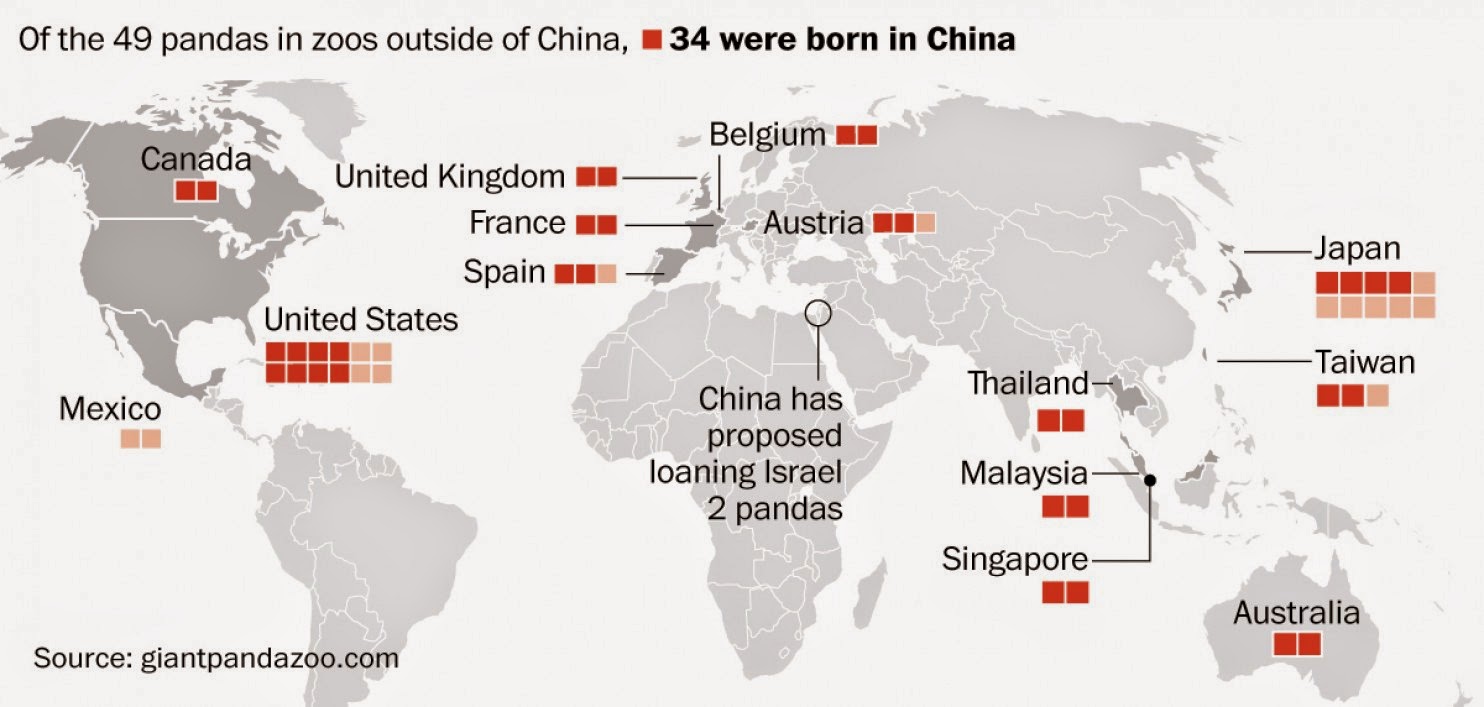 Following a diplomatic tradition going back millennia, China will be
gifting Israel with two giant pandas, if it decides that the conditions
in the Haifa zoo meet the animals' needs.
Following a diplomatic tradition going back millennia, China will be
gifting Israel with two giant pandas, if it decides that the conditions
in the Haifa zoo meet the animals' needs.
The delightful duo, which are actually a primitive species of bear, would be the latest to travel further to China's "Panda Diplomacy," a policy first employed used by the Empress Wu Zetian in the year 658 AD to charm the Japanese emperor Temmu. The gift is not a casual one and China does not confer it on just anybody. It even has a specific person responsible for all the pandas in the world, who came to visit Haifa last week together with a gigantic 200-man strong business delegation, says the Haifa municipality public relations department. "I hope it works out," cooed a representative of the city.
READ MORE....
First the Chinese pandas chief has to be convinced that the Haifa zoo is bear-worthy.
By Ruth Schuster
HAREETZ | Dec. 2, 2014
The delightful duo, which are actually a primitive species of bear, would be the latest to travel further to China's "Panda Diplomacy," a policy first employed used by the Empress Wu Zetian in the year 658 AD to charm the Japanese emperor Temmu. The gift is not a casual one and China does not confer it on just anybody. It even has a specific person responsible for all the pandas in the world, who came to visit Haifa last week together with a gigantic 200-man strong business delegation, says the Haifa municipality public relations department. "I hope it works out," cooed a representative of the city.
READ MORE....
Eight Sentenced to Death for Xinjiang Terrorist Attacks
Luo Dan
Xinhua - 2014-12-08
 A Xinjiang court sentenced eight people to death on Monday in
connection with two deadly terrorist attacks in April and May in the
regional capital, Urumqi.
A Xinjiang court sentenced eight people to death on Monday in
connection with two deadly terrorist attacks in April and May in the
regional capital, Urumqi.
The Intermediate People's Court of Urumqi sentenced another five to death with a two-year reprieve, and four others were sentenced to various terms of imprisonment.
Xinjiang saw its bloodiest day in five years on May 22 when 39 people were killed and 94 injured in an attack on a market in Urumqi. On April 30, three people were killed and 79 were injured in an attack at a railway station in the city.
Those sentenced to death include Ahmat Rixit, head of the group responsible for April's violence, and Abliz Dawut and Nurahmat Ablipiz, main plotters of the May attack.
From February 2010 to April 2014, Ahmat Rixit and his associates gathered many times to listen to and watch audio and video clips about terror under the guidance of Ismail Yusup, a member of the terrorist group Eastern Turkistan Islamic Movement (ETIM).
Following April's violence, the ETIM publicized a video showing a masked man assembling a bomb. The man, later identified as Ahmat Rixit, claimed the incident "a piece of good news," and called those who detonated the bomb "warriors." The video was made by his brother Abliz Rixit.
READ MORE.....
Xinhua - 2014-12-08
The Intermediate People's Court of Urumqi sentenced another five to death with a two-year reprieve, and four others were sentenced to various terms of imprisonment.
Xinjiang saw its bloodiest day in five years on May 22 when 39 people were killed and 94 injured in an attack on a market in Urumqi. On April 30, three people were killed and 79 were injured in an attack at a railway station in the city.
Those sentenced to death include Ahmat Rixit, head of the group responsible for April's violence, and Abliz Dawut and Nurahmat Ablipiz, main plotters of the May attack.
From February 2010 to April 2014, Ahmat Rixit and his associates gathered many times to listen to and watch audio and video clips about terror under the guidance of Ismail Yusup, a member of the terrorist group Eastern Turkistan Islamic Movement (ETIM).
Following April's violence, the ETIM publicized a video showing a masked man assembling a bomb. The man, later identified as Ahmat Rixit, claimed the incident "a piece of good news," and called those who detonated the bomb "warriors." The video was made by his brother Abliz Rixit.
READ MORE.....
From China to Jihad?
RICHARD BERNSTEIN
China File - 09.08.14
It’s a very long way from China’s arid Xinjiang Uighur Autonomous Region in the country’s far northwest to its semi-tropical borders with Vietnam, Laos, and Burma in the south, and then it’s another precarious distance from there, down rivers and across fortified borders, all the way to the seaside Thai town of Songkhla, about forty miles from the Malaysian border. And it’s longer still from Songkhla to the battlefields of Syria, thousands of miles away. But this town is where more than two hundred members of the Uighur minority from Xinjiang—many of them women and children—were arrested by Thai authorities in March this year. They have been accused, apparently, of planning to wage jihad in Syria.
READ MORE....
China File - 09.08.14
It’s a very long way from China’s arid Xinjiang Uighur Autonomous Region in the country’s far northwest to its semi-tropical borders with Vietnam, Laos, and Burma in the south, and then it’s another precarious distance from there, down rivers and across fortified borders, all the way to the seaside Thai town of Songkhla, about forty miles from the Malaysian border. And it’s longer still from Songkhla to the battlefields of Syria, thousands of miles away. But this town is where more than two hundred members of the Uighur minority from Xinjiang—many of them women and children—were arrested by Thai authorities in March this year. They have been accused, apparently, of planning to wage jihad in Syria.
READ MORE....
Sunday, December 7, 2014
LECTURE: “Republic of Turkey Under Siege: Terror, Radical Islam, and Organized Crime” by Kemal Silay
24日 周三:下午或晚上,Kemal Silay讲座:陷入包围中的土耳其共和国:恐怖主义、激进伊斯兰主义和集团犯罪
December 24th,
Wednesday: Lecture by Kemal Silay in the afternoon or in the evening:
“Republic of Turkey Under Siege: Terror, Radical Islam, and
Organized Crime”
Location:
PEKING UNIVERSITY - 5 Yiheyuan Rd, Haidian, Beijing, China
LECTURE: The Emergence of Modern Uyghur Nationalism in the Context of American Hegemony and Turkish Nationalism By Tugrul Keskin
THE EMERGENCE OF MODERN UYGHUR NATIONALISM IN THE CONTEXT OF AMERICAN HEGEMONY AND TURKISH NATIONALISM
DECEMBER 18, 2014
DECEMBER 18, 2014
晚上,Tugrul Keskin讲座:
Lecture by Tugrul Keskin in the evening
Location:
PEKING UNIVERSITY - 5 Yiheyuan Rd, Haidian, Beijing, China
Monday, December 1, 2014
Hundreds of Thai Uyghur Migrants Flee from Repatriation
NTD TV - 2014-11-15
Thai official disclosed that more than 100 migrants thought to be from China’s Uyghur minority have escaped from shelters in Thailand. The authorities feared they have fallen into the hands of a human trafficking ring. Under pressure from Beijing, media have reported that Thailand was requested to return these Uyghurs to China.
Thai official disclosed that more than 100 migrants thought to be from China’s Uyghur minority have escaped from shelters in Thailand. The authorities feared they have fallen into the hands of a human trafficking ring. Under pressure from Beijing, media have reported that Thailand was requested to return these Uyghurs to China. AFP reported on Nov. 13 that, “more than 100 migrants thought to be from China’s Uyghur minority have escaped from shelters in Thailand.” “Thailand has held dozens of the migrants since March, when they were discovered during a raid on a suspected people-smuggling camp in the kingdom's deep south and sentenced for illegal entry,” said the report. “Songkhla province police had said they were waiting to identify the nationalities of the group before deciding their fate. The migrants claimed they were Turkish, but US-based Uyghur activists identified them as Uyghurs from China's northwestern Xinjiang region.”
READ MORE.....
Thai official disclosed that more than 100 migrants thought to be from China’s Uyghur minority have escaped from shelters in Thailand. The authorities feared they have fallen into the hands of a human trafficking ring. Under pressure from Beijing, media have reported that Thailand was requested to return these Uyghurs to China.
Thai official disclosed that more than 100 migrants thought to be from China’s Uyghur minority have escaped from shelters in Thailand. The authorities feared they have fallen into the hands of a human trafficking ring. Under pressure from Beijing, media have reported that Thailand was requested to return these Uyghurs to China. AFP reported on Nov. 13 that, “more than 100 migrants thought to be from China’s Uyghur minority have escaped from shelters in Thailand.” “Thailand has held dozens of the migrants since March, when they were discovered during a raid on a suspected people-smuggling camp in the kingdom's deep south and sentenced for illegal entry,” said the report. “Songkhla province police had said they were waiting to identify the nationalities of the group before deciding their fate. The migrants claimed they were Turkish, but US-based Uyghur activists identified them as Uyghurs from China's northwestern Xinjiang region.”
READ MORE.....
EVENT: Xinjiang and China's Central Asia Policy
Tuesday, December 9, 2014, from 5 to 7 PM
(reception at 5 p.m., followed by main program at 5:30)
How do China's concerns over the Uyghurs of Xinjiang affect its strategy in Central Asia? Arguing that China's turn to land routes to the West arise from its desire to escape from US control of sea lanes, Ben Chang suggests ways in which China's approach to former Soviet parts of Central Asia may mirror its strategy in Xinjiang.
This presentation will offer insights of importance to anyone following Central Asia, China, energy, development, and western strategies in Central Asia.
Featuring:
Benjamin Chang
Analyst, Long Term Strategy Group
Moderated by:
S F Starr
Chairman, Central Asia-Caucasus Institute/Silk Road Studies Program
Location:
Rome Building Auditorium
Johns Hopkins University - SAIS
1619 Massachusetts Ave., NW
Washington, DC 20036
(reception at 5 p.m., followed by main program at 5:30)
How do China's concerns over the Uyghurs of Xinjiang affect its strategy in Central Asia? Arguing that China's turn to land routes to the West arise from its desire to escape from US control of sea lanes, Ben Chang suggests ways in which China's approach to former Soviet parts of Central Asia may mirror its strategy in Xinjiang.
This presentation will offer insights of importance to anyone following Central Asia, China, energy, development, and western strategies in Central Asia.
Featuring:
Benjamin Chang
Analyst, Long Term Strategy Group
Moderated by:
S F Starr
Chairman, Central Asia-Caucasus Institute/Silk Road Studies Program
Location:
Rome Building Auditorium
Johns Hopkins University - SAIS
1619 Massachusetts Ave., NW
Washington, DC 20036
Monday, November 17, 2014
China's top domestic security chief visits Iran to push for anti-terror cooperation
BEIJING
Reuters - Mon Nov 17, 2014
China's domestic security chief has visited Iran to push for greater cooperation in the fight against terror, the Chinese foreign ministry said on Tuesday, as Beijing seeks allies in its efforts to maintain stability in Xinjiang.
Beijing says it faces a threat from militant Islamists in its far western region of Xinjiang, where hundreds have died in unrest in the past two years or so, and has repeatedly pushed for greater regional efforts to tackle the problem.
Meng Jianzhu, who leads China's anti-terror efforts, met with several senior officials while in Tehran, including Vice President Eshaq Jahangiri and Interior Minister Abdolreza Rahmani Fazl on his Nov. 15-17 trip, the ministry said.
READ MORE....
Reuters - Mon Nov 17, 2014
 |
| Chinese Public Security Minister Meng Jianzhu (C) speaks to reporters as Pakistan's Interior Minister Rehman Malik (L) looks on, after arriving at a military base in Rawalpindi September 26, 2011. Credit: Reuters/Mian Khursheed |
China's domestic security chief has visited Iran to push for greater cooperation in the fight against terror, the Chinese foreign ministry said on Tuesday, as Beijing seeks allies in its efforts to maintain stability in Xinjiang.
Beijing says it faces a threat from militant Islamists in its far western region of Xinjiang, where hundreds have died in unrest in the past two years or so, and has repeatedly pushed for greater regional efforts to tackle the problem.
Meng Jianzhu, who leads China's anti-terror efforts, met with several senior officials while in Tehran, including Vice President Eshaq Jahangiri and Interior Minister Abdolreza Rahmani Fazl on his Nov. 15-17 trip, the ministry said.
READ MORE....
Sunday, November 16, 2014
China Cuts Saudi Oil Imports Amid Colombia Shipment Boost
Bloomberg News - Oct 22, 2014
China reduced oil imports from Saudi Arabia even as the world’s largest crude exporter cuts prices to lure Asian customers amid intensifying competition from Colombia to Oman.
Oil deliveries from Saudi Arabia fell 2.7 percent to 4.74 million metric tons last month from a year earlier, according to data released today by the General Administration of Customs in Beijing. Shipments from Colombia surged 389.6 percent, while Russian deliveries increased by 56.8 percent.
Asian consumers are benefiting from a wider choice of suppliers offering cheaper crude, from Venezuela to Alaska and Nigeria, as the highest U.S. production in almost 30 years cuts American demand. Saudi Arabia reduced prices for oil for Asia to the lowest in almost six years as it aims to maintain market share even as global benchmark prices have dropped about 25 percent from June.
READ MORE.....
China reduced oil imports from Saudi Arabia even as the world’s largest crude exporter cuts prices to lure Asian customers amid intensifying competition from Colombia to Oman.
Oil deliveries from Saudi Arabia fell 2.7 percent to 4.74 million metric tons last month from a year earlier, according to data released today by the General Administration of Customs in Beijing. Shipments from Colombia surged 389.6 percent, while Russian deliveries increased by 56.8 percent.
Asian consumers are benefiting from a wider choice of suppliers offering cheaper crude, from Venezuela to Alaska and Nigeria, as the highest U.S. production in almost 30 years cuts American demand. Saudi Arabia reduced prices for oil for Asia to the lowest in almost six years as it aims to maintain market share even as global benchmark prices have dropped about 25 percent from June.
READ MORE.....
Shoukry meets vice-president of China’s Communist Party
Daily News Egypt / November 6, 2014
Egyptian Minister of Foreign Affairs Sameh Shoukry and the vice-president of the Communist Party of China Hai-Ting met on Friday to discuss “the Chinese government’s support of the political, economic, and social advancements Egypt is making,” the foreign ministry said in a statement.
Shoukry thanked China for its role in helping developing countries economically, especially through the Group 77 organisation, which was created in 1964 to facilitate trade and economic agreements between developing countries.
Shoukry also told the Chinese official that Egypt is interested in attracting Chinese investments. He stated that Egypt wishes for high participation of Chinese companies in its next economic conference in February.
Hai-Ting stated his country “trusts completely that Egypt’s future is bright with its new leadership” and that visits between the two states would be more frequent.
He added that China would also like to revive its economic connection to the region, stressing on reviving its old silk route. He did not offer more details.
READ MORE.....
Egyptian Minister of Foreign Affairs Sameh Shoukry and the vice-president of the Communist Party of China Hai-Ting met on Friday to discuss “the Chinese government’s support of the political, economic, and social advancements Egypt is making,” the foreign ministry said in a statement.
Shoukry thanked China for its role in helping developing countries economically, especially through the Group 77 organisation, which was created in 1964 to facilitate trade and economic agreements between developing countries.
Shoukry also told the Chinese official that Egypt is interested in attracting Chinese investments. He stated that Egypt wishes for high participation of Chinese companies in its next economic conference in February.
Hai-Ting stated his country “trusts completely that Egypt’s future is bright with its new leadership” and that visits between the two states would be more frequent.
He added that China would also like to revive its economic connection to the region, stressing on reviving its old silk route. He did not offer more details.
READ MORE.....
China to double Iranian investment
BBC - 16 November 2014
Water, electricity, oil and gas projects will all benefit from the extra financing, Mr Mahsouli said.
Iran has turned to China, Russia and Turkey for financing as Europe and the US have strict sanctions on the nation.
The US has an almost total economic embargo on Iran, while the European Union tightened up its sanctions in 2012, particularly targeting the energy and banking industries.
READ MORE.....
China is set to double its investment in Iranian infrastructure projects, Iran's Mehr news agency reports.
China has raised its quota for Iranian projects to $52bn
(£33bn) from $25bn the report said, quoting Iran's deputy minister for
energy, Esmail Mahsouli. Water, electricity, oil and gas projects will all benefit from the extra financing, Mr Mahsouli said.
Iran has turned to China, Russia and Turkey for financing as Europe and the US have strict sanctions on the nation.
The US has an almost total economic embargo on Iran, while the European Union tightened up its sanctions in 2012, particularly targeting the energy and banking industries.
READ MORE.....
Tuesday, November 11, 2014
China Sees Itself at Center of New Asian Order
Beijing Builds Roads, Pipelines, Railways and Ports to Bind Itself to Region
By Jeremy Page
The Wall Street Journal - Nov. 9, 2014
HORGOS, China—In a valley flanked by snow-capped peaks on China’s border with Kazakhstan, a vision of Beijing’s ambitions to redraw the geopolitical map of Asia is taking shape. This remote outpost, once a transit point for Silk Road merchants, is where China is building one of its newest cities.
Covering more than twice the area of New York City, Horgos had just 85,000 residents when it was founded in September, enveloping several towns and villages in an area known for lavender fields.
China’s plan is to transform the sleepy frontier crossing into an international railway, energy and logistics hub for a “Silk Road Economic Belt” unveiled by President Xi Jinping last year to establish new trade and transport links between China, Central Asia and Europe.
READ MORE...
By Jeremy Page
The Wall Street Journal - Nov. 9, 2014
HORGOS, China—In a valley flanked by snow-capped peaks on China’s border with Kazakhstan, a vision of Beijing’s ambitions to redraw the geopolitical map of Asia is taking shape. This remote outpost, once a transit point for Silk Road merchants, is where China is building one of its newest cities.
Covering more than twice the area of New York City, Horgos had just 85,000 residents when it was founded in September, enveloping several towns and villages in an area known for lavender fields.
China’s plan is to transform the sleepy frontier crossing into an international railway, energy and logistics hub for a “Silk Road Economic Belt” unveiled by President Xi Jinping last year to establish new trade and transport links between China, Central Asia and Europe.
READ MORE...
China's 'Marshall Plan' Is Much More China’s ‘one belt, one road’ initiative is no Marshall plan — it’s far more ambitious.
By Dingding Chen
The Diplomat - November 10, 2014
Chinese President Xi Jinping just announced that China will establish a Silk Road fund with $40 billion to support infrastructure investments in countries involved in the “one belt, one road” plan. This new proposal is in addition to the Asian Infrastructure Investment Bank (AIIB) proposal that 21 countries have already joined. A critical element of such plans is to “break the connectivity bottleneck” in Asia and beyond, which has seriously hindered development in many developing countries. Presumably a large amount of funding will go to building roads, railways, and ports in these countries. Thus, many analysts (see for example here, here, and here) have labeled China’s new initiatives as a Chinese version of the Marshall Plan, indicating that China would use such initiatives to seek influence and even dominance in Asia.
To be sure, there are some seeming similarities between China’s “one belt, one road” initiative with the U.S. Marshall plan, with the main one being that both plans aim at exporting their country’s capital, technology, and capacity to others who need them badly. But there are some major differences between China’s “one belt, one road” initiative and the Marshall Plan, which have not received adequate attention from many analysts. More specifically, China’s Silk Road vision is different from the Marshall Plan in motivation, challenges, and potential impact.
READ MORE.....
The Diplomat - November 10, 2014
Chinese President Xi Jinping just announced that China will establish a Silk Road fund with $40 billion to support infrastructure investments in countries involved in the “one belt, one road” plan. This new proposal is in addition to the Asian Infrastructure Investment Bank (AIIB) proposal that 21 countries have already joined. A critical element of such plans is to “break the connectivity bottleneck” in Asia and beyond, which has seriously hindered development in many developing countries. Presumably a large amount of funding will go to building roads, railways, and ports in these countries. Thus, many analysts (see for example here, here, and here) have labeled China’s new initiatives as a Chinese version of the Marshall Plan, indicating that China would use such initiatives to seek influence and even dominance in Asia.
To be sure, there are some seeming similarities between China’s “one belt, one road” initiative with the U.S. Marshall plan, with the main one being that both plans aim at exporting their country’s capital, technology, and capacity to others who need them badly. But there are some major differences between China’s “one belt, one road” initiative and the Marshall Plan, which have not received adequate attention from many analysts. More specifically, China’s Silk Road vision is different from the Marshall Plan in motivation, challenges, and potential impact.
READ MORE.....
Monday, November 10, 2014
China Voice: Asia-Pacific region needs "new rebalancing" between China and U.S.
by Jiang Xufeng and Fu Shuangqi
ICross China - 2014-11-10
BEIJING, Nov. 10 (Xinhua) -- After two years of absence, U.S. President Barack Obama arrived in Beijing Monday morning for the upcoming Asia-Pacific Economic Cooperation (APEC) Economic Leaders' Meeting.
Besides the meeting, he will pay a state visit to China, the first since his re-election.
China has welcomed his presence. Foreign Ministry spokesman Hong Lei told media that China hopes for positive results from his visit and is willing to work with the United States to build a new type of relations between major countries.
The upcoming meeting between President Xi Jinping and Obama is expected to set a tone for the bilateral relations not only in near future but also the long run.
The world is closely watching, whether the largest developed and developing countries, also the world's first and second largest economies, can figure out a solution to stabilize their relations and manage their differences, for their standoff may lead to collateral damages.
READ MORE....
ICross China - 2014-11-10
BEIJING, Nov. 10 (Xinhua) -- After two years of absence, U.S. President Barack Obama arrived in Beijing Monday morning for the upcoming Asia-Pacific Economic Cooperation (APEC) Economic Leaders' Meeting.
Besides the meeting, he will pay a state visit to China, the first since his re-election.
China has welcomed his presence. Foreign Ministry spokesman Hong Lei told media that China hopes for positive results from his visit and is willing to work with the United States to build a new type of relations between major countries.
The upcoming meeting between President Xi Jinping and Obama is expected to set a tone for the bilateral relations not only in near future but also the long run.
The world is closely watching, whether the largest developed and developing countries, also the world's first and second largest economies, can figure out a solution to stabilize their relations and manage their differences, for their standoff may lead to collateral damages.
READ MORE....
Xi urges China-Brunei cooperation in energy, maritime development
ICriss China - 2014-11-10
BEIJING, Nov. 10 (Xinhua) -- China is willing to cooperate with Brunei in the development of oil, gas and new energy, and to achieve "substantial progress" in jointly developing the South China Sea, President Xi Jinping said on Monday.
China will also encourage its businesses to increase investment in Brunei to enhance cooperation in infrastructure construction, as well as agriculture and fishery sectors, Xi said when meeting with Sultan of Brunei Hassanal Bolkiah.
Hassanal is in Beijing to attend the 22nd Asia-Pacific Economic Cooperation (APEC) Economic Leaders' Meeting on Nov. 10-11.
Xi said the two countries should increase high-level exchanges and strengthen strategic mutual trust as China-Brunei relations has been upgraded to the strategic cooperative one.
"China is willing to work with Brunei to strengthen maritime cooperation in order to achieve early and substantial progress in joint development of the South China Sea," he told Hassanal.
READ MORE....
BEIJING, Nov. 10 (Xinhua) -- China is willing to cooperate with Brunei in the development of oil, gas and new energy, and to achieve "substantial progress" in jointly developing the South China Sea, President Xi Jinping said on Monday.
China will also encourage its businesses to increase investment in Brunei to enhance cooperation in infrastructure construction, as well as agriculture and fishery sectors, Xi said when meeting with Sultan of Brunei Hassanal Bolkiah.
Hassanal is in Beijing to attend the 22nd Asia-Pacific Economic Cooperation (APEC) Economic Leaders' Meeting on Nov. 10-11.
Xi said the two countries should increase high-level exchanges and strengthen strategic mutual trust as China-Brunei relations has been upgraded to the strategic cooperative one.
"China is willing to work with Brunei to strengthen maritime cooperation in order to achieve early and substantial progress in joint development of the South China Sea," he told Hassanal.
READ MORE....
Sunday, November 9, 2014
China Sees Itself at Center of New Asian Order
The Wall Street Journal - Nov 10, 2014
In a valley flanked by snow-capped peaks on China’s border with Kazakhstan, a vision of Beijing’s ambitions to redraw the geopolitical map of Asia is taking shape. This remote outpost, once a transit point for Silk Road merchants, is where China is building one of its newest cities. As the WSJ’s Jeremy Page reports:
Covering more than twice the area of New York City, Horgos had just 85,000 residents when it was founded in September, enveloping several towns and villages in an area known for lavender fields.
China’s plan is to transform the sleepy frontier crossing into an international railway, energy and logistics hub for a “Silk Road Economic Belt” unveiled by President Xi Jinping last year to establish new trade and transport links between China, Central Asia and Europe.
Horgos is a small element of China’s wider effort to bind surrounding regions more closely to it through pipelines, roads, railways and ports, say diplomats and analysts who have studied the plans it has made public.
READ MORE.....
In a valley flanked by snow-capped peaks on China’s border with Kazakhstan, a vision of Beijing’s ambitions to redraw the geopolitical map of Asia is taking shape. This remote outpost, once a transit point for Silk Road merchants, is where China is building one of its newest cities. As the WSJ’s Jeremy Page reports:
Covering more than twice the area of New York City, Horgos had just 85,000 residents when it was founded in September, enveloping several towns and villages in an area known for lavender fields.
China’s plan is to transform the sleepy frontier crossing into an international railway, energy and logistics hub for a “Silk Road Economic Belt” unveiled by President Xi Jinping last year to establish new trade and transport links between China, Central Asia and Europe.
Horgos is a small element of China’s wider effort to bind surrounding regions more closely to it through pipelines, roads, railways and ports, say diplomats and analysts who have studied the plans it has made public.
READ MORE.....
Work for Benign Relations
Shen Dingli
Associate Dean, Fudan Unversity
Dr. Shen Dingli is a professor and Vice Dean at the Institute of International Studies, Fudan University. He is also the founder and director of China’s first non-government-based Program on Arms Control and Regional Security at Fudan University.
China and US Focus - November 3, 2014
 Next week, Beijing will host an informal meeting of APEC leaders. After that, Chinese and American heads of state will hold a Chinese version of the “Annenberg meeting”. Top Chinese and US diplomats have been shuttling across the Pacific since last month in preparation for the two important events. Such frequent exchanges of visits are rare in bilateral diplomatic interactions. China and the US have similar or common interests on broad bilateral, multilateral and global issues. No question about that. But their divergence in interests is equally broad and profound. Since the two countries’ leaders’ Annenberg meeting in California last June, although the two sides enhanced cooperation on such matters as web security and maritime concerns, their conflicts and struggles remain fierce. On the issue of cyber security, Washington has repeatedly accused the Chinese government of conducting frequent attacks on the United States. Yet the truth is the US government has carried out extensive eavesdropping at home and abroad. At least its behaviors have been confirmed by various leaked documents, like those exposed by Edward Snowden. After last year’s Annenberg meeting, both countries established their own cyber security working group and initiated collaboration on the platform of their strategic and economic dialogue. However, the fine momentum didn’t last long. In May, the US Department of Justice launched a high-profile prosecution of five Chinese military officers, making it impossible for the two parties to sustain the dialogue in this field. Through the two months of high-level exchanges, the US should prove its sincerity with practical deeds and eliminate this impediment to the next Xi-Obama meeting as well as a restoration of bilateral dialogues.
READ MORE.....
Associate Dean, Fudan Unversity
Dr. Shen Dingli is a professor and Vice Dean at the Institute of International Studies, Fudan University. He is also the founder and director of China’s first non-government-based Program on Arms Control and Regional Security at Fudan University.
China and US Focus - November 3, 2014
Next week, Beijing will host an informal meeting of APEC leaders. After that, Chinese and American heads of state will hold a Chinese version of the “Annenberg meeting”. Top Chinese and US diplomats have been shuttling across the Pacific since last month in preparation for the two important events. Such frequent exchanges of visits are rare in bilateral diplomatic interactions. China and the US have similar or common interests on broad bilateral, multilateral and global issues. No question about that. But their divergence in interests is equally broad and profound. Since the two countries’ leaders’ Annenberg meeting in California last June, although the two sides enhanced cooperation on such matters as web security and maritime concerns, their conflicts and struggles remain fierce. On the issue of cyber security, Washington has repeatedly accused the Chinese government of conducting frequent attacks on the United States. Yet the truth is the US government has carried out extensive eavesdropping at home and abroad. At least its behaviors have been confirmed by various leaked documents, like those exposed by Edward Snowden. After last year’s Annenberg meeting, both countries established their own cyber security working group and initiated collaboration on the platform of their strategic and economic dialogue. However, the fine momentum didn’t last long. In May, the US Department of Justice launched a high-profile prosecution of five Chinese military officers, making it impossible for the two parties to sustain the dialogue in this field. Through the two months of high-level exchanges, the US should prove its sincerity with practical deeds and eliminate this impediment to the next Xi-Obama meeting as well as a restoration of bilateral dialogues. READ MORE.....
Chinese tech giant Founder to open Israel subsidiary
The company, worth over $5 billion, is one of the biggest – from China or anywhere else — to invest in Israel
By David Shamah
The Times of Israel - November 6, 2014
Founder Technologies, a subsidiary of the Founder Group, one of China’s biggest companies, is set to open a subsidiary in Israel, according to documents released by the company. In 2012, Founder it took in $9.9 billion and had a net worth of $5.2 billion, operating in 80 countries.
Now it’s adding Israel, the company said in documents filed with local regulatory authorities, establishing a company in Tel Aviv to be called FounderTech (Israel) Limited. The Israeli company will belong to Founder subsidiary Shanghai Founder Technology (HK) Limited, and will concentrate on providing smart cities solutions. Participating in projects to be developed in Israel will be two other Founder organizations, Founder International Software Co. and Founder Broadband Network Service Co.
READ MORE.....
By David Shamah
The Times of Israel - November 6, 2014
Founder Technologies, a subsidiary of the Founder Group, one of China’s biggest companies, is set to open a subsidiary in Israel, according to documents released by the company. In 2012, Founder it took in $9.9 billion and had a net worth of $5.2 billion, operating in 80 countries.
Now it’s adding Israel, the company said in documents filed with local regulatory authorities, establishing a company in Tel Aviv to be called FounderTech (Israel) Limited. The Israeli company will belong to Founder subsidiary Shanghai Founder Technology (HK) Limited, and will concentrate on providing smart cities solutions. Participating in projects to be developed in Israel will be two other Founder organizations, Founder International Software Co. and Founder Broadband Network Service Co.
READ MORE.....
The Middle East Crisis and Sino-U.S. Relations
Brookings - October 27, 104
Martin Indyk, vice president and director of the Foreign Policy Program at Brookings Institution, delivered a public speech at Brookings-Tsinghua Center on October 27. Researcher of Division for Middle East Studies at Chinese Academy of Social Science Institute of West Asian and African studies Tang Zhichao also joined as a guest commentator. The discussion was warmly welcomed by more than 100 students, scholars and representatives from the media and the industry. Martin Indyk began his speech with a brief review of the historical roots of Middle East issues. Indyk made three main arguments, first asserting that the modern state system in the Middle East was not established naturally in the historical process. Instead, it was derived from the artificially created borders by British and French colonists during World War I. Consequently, countries in this region suffered from complicated religious and tribal conflicts, which made it more difficult to coordinate their developments. His second argument focused on the dominant role the United States played in the Middle East in the post-Cold War era. The United States, according to Indyk, chose to cooperate with Middle East monarchies for its own oil interests to ensure their rule or even repression of the local people. The region, however, ended up in chaos caused by people’s revolts. Last, Indyk argued that the U.S. war against Iraq after 9/11 exacerbated the regional instability by toppling Saddam’s regime and replacing it with a Shi'a dominated Iraqi government. The rise of ISIS, which Indyk considered to be the biggest threat in the Middle East, could also be considered an unexpected result of the war.
READ MORE....
Martin Indyk, vice president and director of the Foreign Policy Program at Brookings Institution, delivered a public speech at Brookings-Tsinghua Center on October 27. Researcher of Division for Middle East Studies at Chinese Academy of Social Science Institute of West Asian and African studies Tang Zhichao also joined as a guest commentator. The discussion was warmly welcomed by more than 100 students, scholars and representatives from the media and the industry. Martin Indyk began his speech with a brief review of the historical roots of Middle East issues. Indyk made three main arguments, first asserting that the modern state system in the Middle East was not established naturally in the historical process. Instead, it was derived from the artificially created borders by British and French colonists during World War I. Consequently, countries in this region suffered from complicated religious and tribal conflicts, which made it more difficult to coordinate their developments. His second argument focused on the dominant role the United States played in the Middle East in the post-Cold War era. The United States, according to Indyk, chose to cooperate with Middle East monarchies for its own oil interests to ensure their rule or even repression of the local people. The region, however, ended up in chaos caused by people’s revolts. Last, Indyk argued that the U.S. war against Iraq after 9/11 exacerbated the regional instability by toppling Saddam’s regime and replacing it with a Shi'a dominated Iraqi government. The rise of ISIS, which Indyk considered to be the biggest threat in the Middle East, could also be considered an unexpected result of the war.
READ MORE....
Istanbul Process comes to Beijing, marking new role for China in Middle East
Want China Times - 2014-11-01
That the Fourth Foreign Ministerial Conference of the Istanbul Process was held in Beijing on Friday suggests that China's diplomatic efforts on Afghanistan have paid off, reports our Chinese-language sister paper Want Daily. This suggests that Beijing will lead the next stage of the Afghanistan Reconstruction and fill the void left by departing NATO troops, which are being gradually pulled out of the country. Beijing has been expanding China's economic and diplomatic influence on Afghanistan since 2012, securing the rights to excavate multiple copper mines and oil fields in the country and local infrastructure and telecommunication projects. China stepped up its efforts this year since India, Iran and Pakistan have shown tremendous interest in Afghanistan. Retired political heavyweight Zhou Yongkang, who is currently under investigation for graft, played a key role in fostering relations between China and Afghanistan, said Hong Kong newspaper Ta Kung Pao. Zhou made an unexpected visit to Kabul in September 2012. Zhou was the highest-ranking Chinese official to visit Afghanistan since 1966.
READ MORE....
That the Fourth Foreign Ministerial Conference of the Istanbul Process was held in Beijing on Friday suggests that China's diplomatic efforts on Afghanistan have paid off, reports our Chinese-language sister paper Want Daily. This suggests that Beijing will lead the next stage of the Afghanistan Reconstruction and fill the void left by departing NATO troops, which are being gradually pulled out of the country. Beijing has been expanding China's economic and diplomatic influence on Afghanistan since 2012, securing the rights to excavate multiple copper mines and oil fields in the country and local infrastructure and telecommunication projects. China stepped up its efforts this year since India, Iran and Pakistan have shown tremendous interest in Afghanistan. Retired political heavyweight Zhou Yongkang, who is currently under investigation for graft, played a key role in fostering relations between China and Afghanistan, said Hong Kong newspaper Ta Kung Pao. Zhou made an unexpected visit to Kabul in September 2012. Zhou was the highest-ranking Chinese official to visit Afghanistan since 1966.
READ MORE....
Interview: China has right to play special role in Middle East: Jordan's senate president
Shanghai Daily - Nov 06, 2014
AMMAN, Nov. 6 (Xinhua) -- China should play a leading role in the Middle East, especially on the Palestinian issue and the Syrian crisis, Jordan's Senate President Abdul Raouf Rawabdeh said on Thursday, adding that Jordan-China relations are historic and at their best at present.
In an interview with Xinhua, Rawabdeh said China is one of the great countries that are making history and future at this stage, noting that Jordan has kept a distinguished relation with China since the time of the late King Hussein. He added that His Majesty King Abdullah's frequent visits to China have further developed this relationship.
China and Jordan have enjoyed a very friendly relationship since diplomatic ties were established in 1977, which is evident through cooperation in economy, commerce and services for the benefit of the two peoples, Rawabdeh said.
READ MORE....
AMMAN, Nov. 6 (Xinhua) -- China should play a leading role in the Middle East, especially on the Palestinian issue and the Syrian crisis, Jordan's Senate President Abdul Raouf Rawabdeh said on Thursday, adding that Jordan-China relations are historic and at their best at present.
In an interview with Xinhua, Rawabdeh said China is one of the great countries that are making history and future at this stage, noting that Jordan has kept a distinguished relation with China since the time of the late King Hussein. He added that His Majesty King Abdullah's frequent visits to China have further developed this relationship.
China and Jordan have enjoyed a very friendly relationship since diplomatic ties were established in 1977, which is evident through cooperation in economy, commerce and services for the benefit of the two peoples, Rawabdeh said.
READ MORE....
New Afghan leader talks peace on China trip
By Christopher Bodeen
The Associated Press - October 31, 2014
BEIJING -- Afghanistan's new president invited the Taliban to join in a peace process backed by the international community on Friday, an unusual direct reference to the insurgents who have stepped up attacks in an attempt to bring down his month-old government. Speaking at a conference on Afghan peace and reconstruction in Beijing, Ashraf Ghani Ahmadzai made no specific proposals and indicated government forces wouldn't back away from the fight. However, his mention of the Taliban by name marked a departure from his usual public references to them as "political opponents." "Peace is our highest priority. We invite the political opposition, particularly the Taliban, to join and enter Afghan dialogue, and ask all of our international partners to support an Afghan-led and Afghan-owned peace process," Ghani Ahmadzai said.
READ MORE....
The Associated Press - October 31, 2014
BEIJING -- Afghanistan's new president invited the Taliban to join in a peace process backed by the international community on Friday, an unusual direct reference to the insurgents who have stepped up attacks in an attempt to bring down his month-old government. Speaking at a conference on Afghan peace and reconstruction in Beijing, Ashraf Ghani Ahmadzai made no specific proposals and indicated government forces wouldn't back away from the fight. However, his mention of the Taliban by name marked a departure from his usual public references to them as "political opponents." "Peace is our highest priority. We invite the political opposition, particularly the Taliban, to join and enter Afghan dialogue, and ask all of our international partners to support an Afghan-led and Afghan-owned peace process," Ghani Ahmadzai said.
READ MORE....
Qatar to become Middle East clearing hub for China's yuan
The Gulf Times - November 4, 2014
Qatar will become the Middle East's first hub for clearing transactions in the Chinese yuan, in a step that could over the long run help Gulf oil exporting countries reduce their dependence on the US dollar. Industrial and Commercial Bank of China's Doha branch has been appointed as the clearing bank for yuan deals in Qatar, China's central bank said on Tuesday. "The signing of the MoU and the appointment of the renminbi clearing bank will increase the strong ties between China and Qatar and position Qatar as the regional centre for renminbi clearing and settlement," the Qatari central bank said. Seeking to promote global use of the yuan, China has in the past two years appointed clearing banks for Taiwan, Singapore, London, Frankfurt, Paris, Luxembourg and Seoul. Hong Kong and Macau had clearing banks earlier; Sydney is expected to join the list under a deal to be signed later this month. A clearing bank can handle all parts of a transaction from when a commitment is made until it is settled; having such a bank can reduce costs and time taken for trading, boosting activity in a financial centre. At present, the Gulf's wealthy oil and gas exporters rely heavily on the US dollar; most of their currencies are pegged to the dollar, and most of their huge foreign currency reserves are denominated in dollars.
READ MORE.....
Qatar will become the Middle East's first hub for clearing transactions in the Chinese yuan, in a step that could over the long run help Gulf oil exporting countries reduce their dependence on the US dollar. Industrial and Commercial Bank of China's Doha branch has been appointed as the clearing bank for yuan deals in Qatar, China's central bank said on Tuesday. "The signing of the MoU and the appointment of the renminbi clearing bank will increase the strong ties between China and Qatar and position Qatar as the regional centre for renminbi clearing and settlement," the Qatari central bank said. Seeking to promote global use of the yuan, China has in the past two years appointed clearing banks for Taiwan, Singapore, London, Frankfurt, Paris, Luxembourg and Seoul. Hong Kong and Macau had clearing banks earlier; Sydney is expected to join the list under a deal to be signed later this month. A clearing bank can handle all parts of a transaction from when a commitment is made until it is settled; having such a bank can reduce costs and time taken for trading, boosting activity in a financial centre. At present, the Gulf's wealthy oil and gas exporters rely heavily on the US dollar; most of their currencies are pegged to the dollar, and most of their huge foreign currency reserves are denominated in dollars.
READ MORE.....
Chinese president proposes Asia-Pacific dream
English.news.cn | 2014-11-09
BEIJING, Nov. 9 (Xinhua) -- Chinese President Xi Jinping called for efforts to create and fulfill an Asia-Pacific dream here Sunday, saying China's economy will bring huge opportunities and benefits to the region and the world.
He made the remarks when addressing the Asia-Pacific Economic Cooperation (APEC) CEO Summit, which attracted over 1,500 business people from 21 APEC member economies and 17 other countries and regions.
The Asia-Pacific has a strong impetus for development and a bright future, with a rising standing in the world, but the region now stands "at a crossroads", Xi said.
He listed several challenges facing the region, such as lingering impacts of the international financial crisis, fragile recovery in some economies, the daunting tasks of raising economic equality and efficiency, as well as different directions and priorities in accelerating the regional economic integration process.
"The development prospect of our region hinges on the decisions and actions we take today," he said. "We are duty-bound to create and fulfill an Asia-Pacific dream for our people."
READ MORE....
BEIJING, Nov. 9 (Xinhua) -- Chinese President Xi Jinping called for efforts to create and fulfill an Asia-Pacific dream here Sunday, saying China's economy will bring huge opportunities and benefits to the region and the world.
He made the remarks when addressing the Asia-Pacific Economic Cooperation (APEC) CEO Summit, which attracted over 1,500 business people from 21 APEC member economies and 17 other countries and regions.
The Asia-Pacific has a strong impetus for development and a bright future, with a rising standing in the world, but the region now stands "at a crossroads", Xi said.
He listed several challenges facing the region, such as lingering impacts of the international financial crisis, fragile recovery in some economies, the daunting tasks of raising economic equality and efficiency, as well as different directions and priorities in accelerating the regional economic integration process.
"The development prospect of our region hinges on the decisions and actions we take today," he said. "We are duty-bound to create and fulfill an Asia-Pacific dream for our people."
READ MORE....
3rd LD Writethru-China Focus: Xi says China's economic risks "not that scary"
ICROSS CHINA - 2014-11-09
BEIJING, Nov. 9 (Xinhua) -- President Xi Jinping on Sunday shrugged off worries over the risks Chinese economy is facing, saying that the risks are "not that scary."
"Indeed there are risks (in the Chinese economy), but not that scary," Xi told the Asia-Pacific Economic Cooperation (APEC) CEO Summit in a keynote speech.
Addressing worries that the Chinese economy may further decline in growth rate, Xi said "China's economic growth has become more stable and been driven by more diverse forces."
"Resilience best equips the Chinese economy against risks... And given the strategies and policy options at our disposal, we have the confidence and capability to cope with potential risks," he said.
READ MORE.....
BEIJING, Nov. 9 (Xinhua) -- President Xi Jinping on Sunday shrugged off worries over the risks Chinese economy is facing, saying that the risks are "not that scary."
"Indeed there are risks (in the Chinese economy), but not that scary," Xi told the Asia-Pacific Economic Cooperation (APEC) CEO Summit in a keynote speech.
Addressing worries that the Chinese economy may further decline in growth rate, Xi said "China's economic growth has become more stable and been driven by more diverse forces."
"Resilience best equips the Chinese economy against risks... And given the strategies and policy options at our disposal, we have the confidence and capability to cope with potential risks," he said.
READ MORE.....
Obama’s Chance to Get China Right
PAUL GEWIRTZ
China File - 11.08.14
 With much of his domestic agenda now stymied by the Republican sweep
of Congress, President Obama’s room for maneuver remains greatest in
foreign affairs. Yet with much of the Middle East in flames, an angry
Vladimir Putin threatening Russian aggression, the European economy in
dangerous decline, and an Ebola pandemic in Africa and looming
worldwide, there are limited opportunities for Obama to leave a large
positive legacy on the international landscape.
With much of his domestic agenda now stymied by the Republican sweep
of Congress, President Obama’s room for maneuver remains greatest in
foreign affairs. Yet with much of the Middle East in flames, an angry
Vladimir Putin threatening Russian aggression, the European economy in
dangerous decline, and an Ebola pandemic in Africa and looming
worldwide, there are limited opportunities for Obama to leave a large
positive legacy on the international landscape.
The U.S.-China relationship is one of them, and by fortunate coincidence President Obama will hold a summit meeting this week with China’s President Xi Jinping, their first in-depth meeting since June 2013. As Secretary of State John Kerry said just the other day, the U.S.-China relationship is the most “consequential” bilateral relationship in the world today—the one that, for better or for worse, will most significantly affect our future. The upcoming summit is President Obama’s most important chance to try to get this most consequential of U.S. relationships on a better track.
READ MORE....
China File - 11.08.14
The U.S.-China relationship is one of them, and by fortunate coincidence President Obama will hold a summit meeting this week with China’s President Xi Jinping, their first in-depth meeting since June 2013. As Secretary of State John Kerry said just the other day, the U.S.-China relationship is the most “consequential” bilateral relationship in the world today—the one that, for better or for worse, will most significantly affect our future. The upcoming summit is President Obama’s most important chance to try to get this most consequential of U.S. relationships on a better track.
READ MORE....
Thursday, November 6, 2014
China’s Uighur Unrest Is Opportunity for Afghans
By MATTHEW ROSENBERG
The New York Times - NOV. 5, 2014
The New York Times - NOV. 5, 2014
KABUL, Afghanistan — Since the British first tried and failed to subdue Afghanistan
in the 19th century, stumbling into a costly Afghan war seems to have
become a mandatory step for global power players. The Soviet Union did
it in the 1980s, and the American battle here has passed the 13-year
mark.
Now, China seems to be taking its turn in coming to grips with Afghanistan’s role in its national security.
No
one expects China to be sending troops any time soon, even with the
United States and NATO pulling out the last of their combat forces at
year’s end. But China has taken a major step in formalizing closer
relations with the Afghan government: Last week, it said it planned to
provide billions of dollars in new economic and security assistance.
Wednesday, November 5, 2014
Tuesday, November 4, 2014
China Planning $16.3 Billion Fund for ‘New Silk Road’
By Bloomberg News - Nov 4, 2014
China plans a $16.3 billion fund to finance construction of infrastructure linking its markets to three continents as President Xi Jinping pushes forward with his plans to revive the centuries-old Silk Road trading route.
The fund, overseen by Chinese policy banks, will be used to build and expand railways, roads and pipelines in Chinese provinces that are part of the strategy to facilitate trade over land and shipping routes, according to government officials who participated in drafting the plan.
More policies will be rolled out soon to encourage Chinese lenders to finance infrastructure in countries along the route connecting China to Europe, said the officials. They asked not to be identified as they weren’t authorized to speak publicly about the plans. Chinese companies will also be urged to invest in the countries and bid for contracts, the officials said.
READ MORE.....
China plans a $16.3 billion fund to finance construction of infrastructure linking its markets to three continents as President Xi Jinping pushes forward with his plans to revive the centuries-old Silk Road trading route.
The fund, overseen by Chinese policy banks, will be used to build and expand railways, roads and pipelines in Chinese provinces that are part of the strategy to facilitate trade over land and shipping routes, according to government officials who participated in drafting the plan.
More policies will be rolled out soon to encourage Chinese lenders to finance infrastructure in countries along the route connecting China to Europe, said the officials. They asked not to be identified as they weren’t authorized to speak publicly about the plans. Chinese companies will also be urged to invest in the countries and bid for contracts, the officials said.
READ MORE.....
Iran - China trade to reach $44b
Zawya - October 27, 2014
Tehran - Transactions between Iran and China will reach $44 billion by the end of 2014, said the vice president of Iran-China Chamber of Commerce. In an exclusive interview with Iran Daily's Tuesday edition, Majid-Reza Hariri added that the figure will indicate a 30-percent increase year-on-year, which was $34 billion.
Hariri said trade balance between the two countries, including oil exports, is in Iran's favor.
"In the past few years, 68 percent of bilateral trade pertained to Iran's exports to China and the rest to Tehran's imports from Beijing. However, excluding Iran's oil exports, 65 percent of the figure pertain to China's exports to Iran and 35 percent to Iran's exports," he said
He added that China ranks first among Iran's oil importers. "In the past 18 months, China has been the biggest importer of Iranian non-oil products as well," he said.
"Beijing also ranks first in terms of importing petrochemicals and minerals, including iron ore, chrome and other mineral gangues from Tehran."
READ MORE.....
Tehran - Transactions between Iran and China will reach $44 billion by the end of 2014, said the vice president of Iran-China Chamber of Commerce. In an exclusive interview with Iran Daily's Tuesday edition, Majid-Reza Hariri added that the figure will indicate a 30-percent increase year-on-year, which was $34 billion.
Hariri said trade balance between the two countries, including oil exports, is in Iran's favor.
"In the past few years, 68 percent of bilateral trade pertained to Iran's exports to China and the rest to Tehran's imports from Beijing. However, excluding Iran's oil exports, 65 percent of the figure pertain to China's exports to Iran and 35 percent to Iran's exports," he said
He added that China ranks first among Iran's oil importers. "In the past 18 months, China has been the biggest importer of Iranian non-oil products as well," he said.
"Beijing also ranks first in terms of importing petrochemicals and minerals, including iron ore, chrome and other mineral gangues from Tehran."
READ MORE.....
China and Iran Deepening Naval Ties, Iran Calls for Bilateral Blue Water Exercise
By Sam LaGrone
US NAVAL INSTITUTE - October 27, 2014
 Last week’s meeting between the heads of the Iranian Navy and the
People’s Liberation Army Navy (PLAN) in Beijing are the latest in a
bilateral campaign to increase military to military cooperation and a
recognition of growing Chinese interests in the Middle East.
Last week’s meeting between the heads of the Iranian Navy and the
People’s Liberation Army Navy (PLAN) in Beijing are the latest in a
bilateral campaign to increase military to military cooperation and a
recognition of growing Chinese interests in the Middle East.
On Oct. 23, Iranian Rear Adm. Habibollah Sayyari met PLAN Adm. Wu Shengli in Beijing, “to further pragmatic cooperation and strengthen military-to-military ties,” Sayyari said, according to Iranian state controlled PressTV.
Sayyari also met with Chinese Defense Minister Chang Wanquan to discuss enhanced naval cooperation.
“Chang said the two armed forces have seen good cooperation on mutual visits, personnel training and other fields in recent years. Exchanges between the two navies have been fruitful and their warships have paid successful visits to each other,” according to a release from the Chinese Ministry of National Defense.
Press reports from China and Iran spoke of increased technological cooperation between the two countries but did not go into specifics.
READ MORE....
US NAVAL INSTITUTE - October 27, 2014
On Oct. 23, Iranian Rear Adm. Habibollah Sayyari met PLAN Adm. Wu Shengli in Beijing, “to further pragmatic cooperation and strengthen military-to-military ties,” Sayyari said, according to Iranian state controlled PressTV.
Sayyari also met with Chinese Defense Minister Chang Wanquan to discuss enhanced naval cooperation.
“Chang said the two armed forces have seen good cooperation on mutual visits, personnel training and other fields in recent years. Exchanges between the two navies have been fruitful and their warships have paid successful visits to each other,” according to a release from the Chinese Ministry of National Defense.
Press reports from China and Iran spoke of increased technological cooperation between the two countries but did not go into specifics.
READ MORE....
Iran and China deepen a ‘blue water’ friendship
By Brian Murphy
The Washington Post - October 28, 2014
Last month, visitors to Bandar Abbas on Iran’s southern coast gathered to witness a never-seen-before event: two Chinese warships pulling into port. It could be just the start of a budding naval alliance stretching from the Pacific to the Persian Gulf. Iranian and Chinese commanders last week announced plans for greater maritime cooperation. While the details are vague, it clearly touches ambitions on both sides: Expanding the reach of their warships into faraway seas and new ports of call. And, at the same time, giving a jab at the United States and its preeminent naval power. For China, the Iranian naval alliance offers a convenient way-station for Beijing’s widening outreach in Africa, and another bonding moment in the largely transactional ties between China and Iran. China needs Iran’s oil and gas, and Iran is happy to oblige to help offset Western-led sanctions over Tehran’s nuclear program.
READ MORE....
The Washington Post - October 28, 2014
Last month, visitors to Bandar Abbas on Iran’s southern coast gathered to witness a never-seen-before event: two Chinese warships pulling into port. It could be just the start of a budding naval alliance stretching from the Pacific to the Persian Gulf. Iranian and Chinese commanders last week announced plans for greater maritime cooperation. While the details are vague, it clearly touches ambitions on both sides: Expanding the reach of their warships into faraway seas and new ports of call. And, at the same time, giving a jab at the United States and its preeminent naval power. For China, the Iranian naval alliance offers a convenient way-station for Beijing’s widening outreach in Africa, and another bonding moment in the largely transactional ties between China and Iran. China needs Iran’s oil and gas, and Iran is happy to oblige to help offset Western-led sanctions over Tehran’s nuclear program.
READ MORE....
Turkish-Chinese TV channel starts broadcasting in Turkey
The first and only Chinese-Turkish television channel CTV has begun
broadcasting films, documentaries and Chinese cultural and traditional
programs to promote Chinese economy, tradition and popular culture.
Turkish viewers wanted to watch a Chinese language television channel will be able to from Thursday, as the first Chinese Turkish television satellite channel CTV is launched.
Founded in cooperation with GB Times, a global media group, and an Istanbul based Turkish media group, Media Times, CTV will broadcast a wide range of television programs; documentaries, films and soap operas in both languages. The TV station will be available to audiences in Turkey and China.
"Not only are economic relations between the two countries growing but the cultural relations are also growing" said Yu Hongyang, China's Ambassador in Ankara.
Followed by millions of people in China, the media platforms of CTV and CTV Youtube will bring together the Turkish audience and the Chinese culture. The channel will also provide Chinese lessons.
Since 2009, when former Turkish President Abdullah Gul paid an official visit to China, the Turkish-Chinese relations have been improving. The two countries have signed many energy and economic agreements.
The ministry said 2012 was the “Year of China in Turkey” while 2013 was the “Year of Turkey in China”.
The ties between China and Israel are flourishing
Henry Srebrnik
Transcontinental Media - October 05, 2014
Following the establishment of the state of Israel in 1948 and the People’s Republic of China a year later ties between the two countries were virtually non-existent. A Maoist China that stridently supported revolution in the Third World, and gave aid to the Palestinian guerrilla movements, wanted nothing to do with the Jewish state.
But as China emerged as a modern trading nation that would change. Starting secretly during the 1980s, but with increasing openness after the establishment of official ties in 1992, arms sales at first defined Sino-Israeli relations. Israel became China’s second-largest weapons supplier.
In fact, during the 1990s, American officials accused Israel of illegally providing China with weapons such as the Patriot missile, Lavi jetfighter, and Phalcon airborne radar system.
The arms trade seems to have levelled off, though in 2012 Israel appointed Matan Vilnai, a former major general, as its ambassador to China. Today, though, China is more interested in acquiring Israeli technology. Cyber-security is just one cutting-edge field, along with drones, in which Israel excels and where China wants to improve.
China is also interested in many technologies where Israel is considered a world leader, such as water recycling, desalination, agriculture, and health and medicine.
READ MORE.....
Transcontinental Media - October 05, 2014
Following the establishment of the state of Israel in 1948 and the People’s Republic of China a year later ties between the two countries were virtually non-existent. A Maoist China that stridently supported revolution in the Third World, and gave aid to the Palestinian guerrilla movements, wanted nothing to do with the Jewish state.
But as China emerged as a modern trading nation that would change. Starting secretly during the 1980s, but with increasing openness after the establishment of official ties in 1992, arms sales at first defined Sino-Israeli relations. Israel became China’s second-largest weapons supplier.
In fact, during the 1990s, American officials accused Israel of illegally providing China with weapons such as the Patriot missile, Lavi jetfighter, and Phalcon airborne radar system.
The arms trade seems to have levelled off, though in 2012 Israel appointed Matan Vilnai, a former major general, as its ambassador to China. Today, though, China is more interested in acquiring Israeli technology. Cyber-security is just one cutting-edge field, along with drones, in which Israel excels and where China wants to improve.
China is also interested in many technologies where Israel is considered a world leader, such as water recycling, desalination, agriculture, and health and medicine.
READ MORE.....
Hebrew U student represents Israel to millions on popular Chinese game show
As the clock wound down on his opponent, a grin spread across Lechao Tang’s face. The buzzer sounded.
Tang, a Hebrew University student, applauded his foe politely – and the floor opened up beneath her feet, sending her plummeting unceremoniously below.
Tang represented Hebrew University in a popular Chinese game show earlier this month that pitted students from schools across the world against one another. His unlucky opponent hailed from the University of Cambridge, with other contestants representing Yale and Harvard.
But whereas Harvard and Yale are well-known abroad, Tang said that in China, the typical response when he says he studies in Israel is: “Where’s Israel?” “We are easternmost Asia and Israel is westernmost Asia,” he said. “I’m lucky to be the person to connect them.”
The quiz show, called “Who’s Still Standing,” spun off from the program “Lauf al Hamilyon” on Israel’s Channel 10.
During Tang’s screen-time, the show rose to China’s second most-viewed program.
READ MORE....
China pharma giant on the hunt for Israeli investments
WuXi PharmaTech’s new office will seek to work with – and maybe acquire – promising Israeli life sciences companies
By David Shamah
The Times of Israel - November 2, 2014
hinese pharmaceutical giant WuXi PharmaTech is making a move to Israel. The company is opening an office here to “promote WuXi’s broad platform of integrated R&D services to local customers,” the company said. It will be on the lookout for promising investments in the biotech and medical devices spheres, in cooperation with its new partner Pontifax, a venture capital firm that specializes in medical industry investments.
WuXi is one of the world’s largest medical research companies, with nearly 2,000 customers using its platform to develop and test new medicines. The company’s origins are in China, where it was established in 2000, and it now has extensive operations in the US, after it acquired Minnesota-based AppTec labs in 2008. The company’s services for the biopharmaceutical and medical device industries include testing, contract research and development, as well as pharmaceutical manufacturing services.
READ MORE....
By David Shamah
The Times of Israel - November 2, 2014
hinese pharmaceutical giant WuXi PharmaTech is making a move to Israel. The company is opening an office here to “promote WuXi’s broad platform of integrated R&D services to local customers,” the company said. It will be on the lookout for promising investments in the biotech and medical devices spheres, in cooperation with its new partner Pontifax, a venture capital firm that specializes in medical industry investments.
WuXi is one of the world’s largest medical research companies, with nearly 2,000 customers using its platform to develop and test new medicines. The company’s origins are in China, where it was established in 2000, and it now has extensive operations in the US, after it acquired Minnesota-based AppTec labs in 2008. The company’s services for the biopharmaceutical and medical device industries include testing, contract research and development, as well as pharmaceutical manufacturing services.
READ MORE....
Israel and China Share Market Opportunities
JSPACE NEWS - October 30, 2014
One of Israel’s most influential business conferences, the 12th Go4Israel Conference, was hosted Tuesday, October 27th at the Hilton Tel Aviv, and put particular emphasis on China. Over 1,000 participants took part in the conference including international and local entrepreneurs, investors and business leaders.
“The conference reflects Israel’s role in bringing the world’s West and East economies together. With an increasing presence of China in Israel’s business scene, we can help enhance global relationships between investors and entrepreneurs, mainly from Europe, China and Israel,” said the French-born Edouard Cukierman, the chairman and founder of Cukierman & Co. Investment House, which organized the conference along with its private equity fund, Catalyst Fund. Cukierman & Co. Investment House Ltd. heads Israel’s largest investment team and has been involved for the past 20 years in raising €4 billion in transactions, much of it for Israeli startups and mature companies.
“Israel has always been the center of attraction for investors and entrepreneurs from around the world,” Cukierman added.
READ MORE....
One of Israel’s most influential business conferences, the 12th Go4Israel Conference, was hosted Tuesday, October 27th at the Hilton Tel Aviv, and put particular emphasis on China. Over 1,000 participants took part in the conference including international and local entrepreneurs, investors and business leaders.
“The conference reflects Israel’s role in bringing the world’s West and East economies together. With an increasing presence of China in Israel’s business scene, we can help enhance global relationships between investors and entrepreneurs, mainly from Europe, China and Israel,” said the French-born Edouard Cukierman, the chairman and founder of Cukierman & Co. Investment House, which organized the conference along with its private equity fund, Catalyst Fund. Cukierman & Co. Investment House Ltd. heads Israel’s largest investment team and has been involved for the past 20 years in raising €4 billion in transactions, much of it for Israeli startups and mature companies.
“Israel has always been the center of attraction for investors and entrepreneurs from around the world,” Cukierman added.
READ MORE....
The uncertain future of China-Israel relations
By Naser al-Tamimi
Al-Arabiya - Friday, 4 April 2014
In a recent interview on Bloomberg TV, the Israeli President Shimon Peres stated: “The future is galloping like a horse, and if you don’t gallop with the horse, the horse will gallop without you.” His interesting words may apply to the tireless Israeli efforts in recent years to “gallop” with the Chinese horse. This Israeli “galloping” comes at a time when China is seeking to enhance the security of its energy imports from the Middle East by increasing its political and economic involvement in the region.
One of the striking issues that characterizes Beijing’s relations with the region is that it has good relations with all parties. China’s ties with Iran, Turkey, and the Arab world are growing rapidly. Today, China is the largest exporter to the Middle East, Saudi Arabia’s top trade partner in West Asia, the biggest importer of Iranian oil, the major player in the Iraqi oil game and a rising star in the Turkish economy. At the same time, China has been the top market for Israeli exports in Asia.
READ MORE....
Al-Arabiya - Friday, 4 April 2014
In a recent interview on Bloomberg TV, the Israeli President Shimon Peres stated: “The future is galloping like a horse, and if you don’t gallop with the horse, the horse will gallop without you.” His interesting words may apply to the tireless Israeli efforts in recent years to “gallop” with the Chinese horse. This Israeli “galloping” comes at a time when China is seeking to enhance the security of its energy imports from the Middle East by increasing its political and economic involvement in the region.
One of the striking issues that characterizes Beijing’s relations with the region is that it has good relations with all parties. China’s ties with Iran, Turkey, and the Arab world are growing rapidly. Today, China is the largest exporter to the Middle East, Saudi Arabia’s top trade partner in West Asia, the biggest importer of Iranian oil, the major player in the Iraqi oil game and a rising star in the Turkish economy. At the same time, China has been the top market for Israeli exports in Asia.
READ MORE....
China, Qatar vow to deepen oil, gas cooperation
Editor: Yamei Wang
English.news.cn | 2014-11-04
BEIJING, Nov. 4 (Xinhua) -- China and Qatar on Tuesday vowed to deepen their oil and gas cooperation during a meeting between Premier Li Keqiang and Sheikh Tamim Bin Hamad al-Thani, Emir of Qatar.
 China hopes to build a long-term, comprehensive and strategic
relationship of energy cooperation with Qatar and strengthen bilateral
cooperation in oil and gas exploration and development, liquefied
national gas production and integrated cooperation in the petrochemical
industry, Li said.
China hopes to build a long-term, comprehensive and strategic
relationship of energy cooperation with Qatar and strengthen bilateral
cooperation in oil and gas exploration and development, liquefied
national gas production and integrated cooperation in the petrochemical
industry, Li said.
He called on Qatar to allow Chinese companies to join more upstream and downstream block exploration programs in Qatar.
Tamim hailed the development of Qatar-China relations and pledged that Qatar will deepen bilateral ties and strengthen reciprocal cooperation and people-to-people exchanges.
He said Qatar will prioritize long-term energy cooperation with China.
Li said China is willing to participate in Qatar's high-speed railway construction through its advanced technology, and hopes Qatar will consider Chinese companies when seeking project bids.
READ MORE.....
English.news.cn | 2014-11-04
BEIJING, Nov. 4 (Xinhua) -- China and Qatar on Tuesday vowed to deepen their oil and gas cooperation during a meeting between Premier Li Keqiang and Sheikh Tamim Bin Hamad al-Thani, Emir of Qatar.
He called on Qatar to allow Chinese companies to join more upstream and downstream block exploration programs in Qatar.
Tamim hailed the development of Qatar-China relations and pledged that Qatar will deepen bilateral ties and strengthen reciprocal cooperation and people-to-people exchanges.
He said Qatar will prioritize long-term energy cooperation with China.
Li said China is willing to participate in Qatar's high-speed railway construction through its advanced technology, and hopes Qatar will consider Chinese companies when seeking project bids.
READ MORE.....
Wednesday, October 29, 2014
A New Book: China’s Search for Security
Andrew J. Nathan and Andrew Scobell
Columbia University Press - 2012
 Despite its impressive size and population, economic vitality, and drive
to upgrade its military, China Though rooted in the present,
Nathan and Scobell’s study makes ample use of the past, reaching back
into history to illuminate the people and institutions shaping Chinese
strategy today. They also examine Chinese views of the United States;
explain why China is so concerned about Japan; and uncover China’s
interests in such problematic countries as North Korea, Iran, and the
Sudan. The authors probe recent troubles in Tibet and Xinjiang and
explore their links to forces beyond China’s borders. They consider the
tactics deployed by mainland China and Taiwan, as Taiwan seeks to
maintain autonomy in the face of Chinese advances toward unification.
They evaluate the strengths and weaknesses of China’s three main power
resources—economic power, military power, and soft power.
Despite its impressive size and population, economic vitality, and drive
to upgrade its military, China Though rooted in the present,
Nathan and Scobell’s study makes ample use of the past, reaching back
into history to illuminate the people and institutions shaping Chinese
strategy today. They also examine Chinese views of the United States;
explain why China is so concerned about Japan; and uncover China’s
interests in such problematic countries as North Korea, Iran, and the
Sudan. The authors probe recent troubles in Tibet and Xinjiang and
explore their links to forces beyond China’s borders. They consider the
tactics deployed by mainland China and Taiwan, as Taiwan seeks to
maintain autonomy in the face of Chinese advances toward unification.
They evaluate the strengths and weaknesses of China’s three main power
resources—economic power, military power, and soft power.
The authors conclude with recommendations for the United States as it seeks to manage China’s rise. Chinese policymakers understand that their nation’s prosperity, stability, and security depend on cooperation with the United States. If handled wisely, the authors believe, relations between the two countries can produce mutually beneficial outcomes for both Asia and the world.
remains a vulnerable nation surrounded by powerful rivals and potential foes. Understanding China’s foreign policy means fully appreciating these geostrategic challenges, which persist even as the country gains increasing influence over its neighbors. Andrew J. Nathan and Andrew Scobell analyze China’s security concerns on four fronts: at home, with its immediate neighbors, in surrounding regional systems, and in the world beyond Asia. By illuminating the issues driving Chinese policy, they offer a new perspective on the country’s rise and a strategy for balancing Chinese and American interests in Asia.
CONTENTS:
Introduction
Part I. Interest and Identity in Chinese Foreign Policy
1. What Drives Chinese Foreign Policy?
2. Who Runs Chinese Foreign Policy?
Part II. Security Challenges and Strategies
3. Life on the Hinge: China’s Russia Policy During the Cold War and After
4. Deciphering the U.S. Threat
5. The Northeast Asia Regional System: Japan and the Two Koreas
6. China’s Other Neighbors: The Asia-Pacific
7. China in the Fourth Ring
Part III. Holding Together: Territorial Integrity and Foreign Policy
8. Problems of Stateness: Tibet, Xinjiang, Hong Kong, and Taiwan
9. Taiwan’s Democratic Transition and China’s Response
Part IV. Instruments of Power
10. Dilemmas of Opening: Power and Vulnerability in the Global Economy
11. Military Modernization: From People’s War to Power Projection
12. Soft Power and Human Rights in Chinese Foreign Policy
Part V. Conclusion
13. Threat or Equilibrium?
READ MORE......
Columbia University Press - 2012
Despite its impressive size and population, economic vitality, and drive
to upgrade its military, China Though rooted in the present,
Nathan and Scobell’s study makes ample use of the past, reaching back
into history to illuminate the people and institutions shaping Chinese
strategy today. They also examine Chinese views of the United States;
explain why China is so concerned about Japan; and uncover China’s
interests in such problematic countries as North Korea, Iran, and the
Sudan. The authors probe recent troubles in Tibet and Xinjiang and
explore their links to forces beyond China’s borders. They consider the
tactics deployed by mainland China and Taiwan, as Taiwan seeks to
maintain autonomy in the face of Chinese advances toward unification.
They evaluate the strengths and weaknesses of China’s three main power
resources—economic power, military power, and soft power. The authors conclude with recommendations for the United States as it seeks to manage China’s rise. Chinese policymakers understand that their nation’s prosperity, stability, and security depend on cooperation with the United States. If handled wisely, the authors believe, relations between the two countries can produce mutually beneficial outcomes for both Asia and the world.
remains a vulnerable nation surrounded by powerful rivals and potential foes. Understanding China’s foreign policy means fully appreciating these geostrategic challenges, which persist even as the country gains increasing influence over its neighbors. Andrew J. Nathan and Andrew Scobell analyze China’s security concerns on four fronts: at home, with its immediate neighbors, in surrounding regional systems, and in the world beyond Asia. By illuminating the issues driving Chinese policy, they offer a new perspective on the country’s rise and a strategy for balancing Chinese and American interests in Asia.
CONTENTS:
Introduction
Part I. Interest and Identity in Chinese Foreign Policy
1. What Drives Chinese Foreign Policy?
2. Who Runs Chinese Foreign Policy?
Part II. Security Challenges and Strategies
3. Life on the Hinge: China’s Russia Policy During the Cold War and After
4. Deciphering the U.S. Threat
5. The Northeast Asia Regional System: Japan and the Two Koreas
6. China’s Other Neighbors: The Asia-Pacific
7. China in the Fourth Ring
Part III. Holding Together: Territorial Integrity and Foreign Policy
8. Problems of Stateness: Tibet, Xinjiang, Hong Kong, and Taiwan
9. Taiwan’s Democratic Transition and China’s Response
Part IV. Instruments of Power
10. Dilemmas of Opening: Power and Vulnerability in the Global Economy
11. Military Modernization: From People’s War to Power Projection
12. Soft Power and Human Rights in Chinese Foreign Policy
Part V. Conclusion
13. Threat or Equilibrium?
READ MORE......
Tuesday, October 28, 2014
Al-Qaeda Declares War on China, Too
Al-Qaeda has joined the Islamic State in calling for jihad against China for its Uyghur policies.
By Zachary Keck
The Diplomat - October 22, 2014
READ MORE.....
By Zachary Keck
The Diplomat - October 22, 2014
Al-Qaeda central appears to have joined the Islamic State
in calling for jihad against China over its alleged occupation of
Xinjiang Uyghur Autonomous Region.
This week, al-Sahab media organization, al-Qaeda’s propaganda arm, released the first issue of its new English-language magazine Resurgence.
The magazine has a strong focus on the Asia-Pacific in general, with
feature articles on both India and Bangladesh, as well as others on
Afghanistan and Pakistan.
However, the first issue also contains an article entitled
“10 Facts About East Turkistan,” which refers to the name given to
Xinjiang by those who favor independence from China. The ten facts seek
to cast Xinjiang as a longtime independent state that has only recently
been brutally colonized by Han Chinese, who are determined to obliterate
its Islamic heritage.
“In the last 1,000 years of its Islamic history,” the
article says, Xinjiang “has remained independent for 763 years, while
237 years have been spent under Chinese occupation at various
intervals.”
This occupation has been costly, the article argues,
alleging that: “In 1949, 93 percent of the population of East Turkistan
was Uyghur, while 7 percent was Chinese. Today, as a result of six
decades of forced displacement of the native population and the
settlement of Han Chinese in their place, almost 45 percent of the
population of East Turkistan is Chinese.”
READ MORE.....
What Is a Uyghur?
 By Rian Thum
 Los Angeles Review of Books - October 26th, 2014
IN THE SCRAMBLE to make sense of the violence and repression in China’s Western region of Xinjiang, where many of the Uyghur inhabitants resist Chinese rule, local Uyghur perspectives have gone largely unreported. The following extract, from The Sacred Routes of Uyghur History, aims to uncover Uyghur understandings of the region’s history and the forces that shaped those understandings. One example of what is commonly overlooked is the term “Altishahr,” a Uyghur word for the part of Xinjiang traditionally inhabited by the Uyghurs (and, incidentally, the name of the most popular Uyghur rap group). In this extract, the word is adapted as “Altishahri,” that is, a person from Altishahr, to address an unusual obstacle to writing about Uyghur history: as of, say, 1900, there were no Uyghurs. “Uyghur” at that time was the name of an extinct ancient kingdom, while the people of Altishahr called themselves simply “Musulman” (Muslim). In the first decades of the 20th century, Altishahri elites revived the “Uyghur” term as a name for their own ethnic group, but it took quite a long time for the name to catch on. That process, outlined below, was accompanied by the radical shift from a media landscape dominated by manuscripts to the eventual ascendancy of the printed word. The fitful and slow penetration of print ultimately facilitated new imaginations of a Uyghur past, transforming an older system of Altishahri history, which had been characterized by tazkirahs, the biographies of local Muslim saints. (Adapted from The Sacred Routes of Uyghur History by Rian Thum, published by Harvard University Press. Copyright © 2014 by the President and Fellows of Harvard College. Used by permission. All rights reserved.)
Reformers, Nationalism, and the “Uyghur” Identity
Between the fall of Ya‘qub Beg’s state in 1877 and the arrival of Chinese Communist rule in 1949, reform movements laid the groundwork for new ways of understanding the world, which would eventually reshape Altishahr’s approach to the past. Among the new ideas that took root in Altishahr, nationalism represented perhaps the most profound reorganization of Altishahri self-imagination since the arrival of Islam.1 Early ventures in nationalist thought appeared against the background of a dizzyingly complex succession of political upheavals, driven by actors as diverse as Han Chinese anti-Qing revolutionaries, disbanded Qing soldiers, military strongmen, Uyghur nationalists, and communist revolutionaries. In the first half of the 20th century, Altishahr saw Qing imperial rule, tyrannical autocrats, loosely democratic experiments, and early moves toward socialism.2 At the same time, printing, the telegraph, radio, film, and modern industry made their first inroads in the region. There is no room in this study for an in-depth look at all of these phenomena in their interaction, but it would be impossible to discuss the encounter between nationalism and Altishahri tazkirah-based historical practice without providing a thumbnail sketch of the processes by which nationalist thought became a central feature of the new Altishahri worldview.
READ MORE....
Sunday, October 26, 2014
Interview on China and Xi Jinping's Central Asian Policies (In Turkish)
You can watch the full program from the following address:
Monday, October 20, 2014
2014 APEC Third Senior Officials' Meeting (SOM3) Held in Beijing
 On 20-21 August, 2014 APEC Third Senior Officials' Meeting (SOM3) was
held in Beijing. As the last plenary gathering of Senior Officials
before this year's Leaders' Week, its main objective is to make
comprehensive preparation for the APEC Economic Leaders' Meeting (AELM)
in November. During the two-day meeting, Senior Officials from 21 APEC
member economies held in-depth discussions centered around the theme
"Shaping the Future through Asia-Pacific Partnership" and the three
priority areas, including regional economic integration, innovative
development, economic reform and growth, and comprehensive connectivity
and infrastructure development. The discussions allowed APEC members to
build more consensus and implement cooperation initiatives, making sound
preparations for the outcomes of the Leaders' Meeting.
On 20-21 August, 2014 APEC Third Senior Officials' Meeting (SOM3) was
held in Beijing. As the last plenary gathering of Senior Officials
before this year's Leaders' Week, its main objective is to make
comprehensive preparation for the APEC Economic Leaders' Meeting (AELM)
in November. During the two-day meeting, Senior Officials from 21 APEC
member economies held in-depth discussions centered around the theme
"Shaping the Future through Asia-Pacific Partnership" and the three
priority areas, including regional economic integration, innovative
development, economic reform and growth, and comprehensive connectivity
and infrastructure development. The discussions allowed APEC members to
build more consensus and implement cooperation initiatives, making sound
preparations for the outcomes of the Leaders' Meeting.State Councilor H.E. Mr. Yang Jiechi, Chairman of the APEC China 2014 Organizing Committee, addressed the opening of the meeting. Vice Foreign Minister Li Baodong, 2014 APEC SOM Chair, presided the meeting. Assistant Commerce Minister Wang Shouwen attended the meeting. Meeting participants also include delegates from 21 APEC member economies, APEC Secretariat, ABAC, and APEC observers.
READ MORE.....
America, China and the Islamic State
Shanghai Institutes for International Studies
2014-10-10
By Dan Steinbock
Washington has launched still another “war against terror” in the Middle East and beyond. It is the kind of escalation that the Islamic State has hoped. In contrast, Beijing is likely to stick to cautious engagement.
Half a month after offering the American people his rationale for taking the United States into a new Middle East war to combat the Islamic State (IS), President Obama issued a call to the world to join America in the fight against violent religious extremism. Taking the moral high ground, President Obama told the UN General Assembly that “there can be no reasoning, no negotiations with this brand of evil.”
Undoubtedly, the IS represents the kind of brutality that is new even in the most violent war-torn enclaves of the Middle East.
But as the critics see it, the rise of the Islamic State is the result of President Bush’s war on terror and military actions, while its further radicalization is the effect of President Obama’s efforts to overcome the Middle East’s divides with raw military power, but without ground troops – and a political solution.
Huge investment, barbaric returns
A decade ago, neoconservatives in Washington envisioned a new democratic Middle East, including a stable, prosperous Iraq that would be united and peaceful. And they walked the talk. Between 2003 and 2012, U.S. aid to Iraq totaled more than $57 billion. During the same period, war costs in Iraq soared to $3.5 trillion (Joint Economic Committee of Congress). That’s more than 20 percent of U.S. gross domestic product.
READ MORE.....
2014-10-10
By Dan Steinbock
Washington has launched still another “war against terror” in the Middle East and beyond. It is the kind of escalation that the Islamic State has hoped. In contrast, Beijing is likely to stick to cautious engagement.
Half a month after offering the American people his rationale for taking the United States into a new Middle East war to combat the Islamic State (IS), President Obama issued a call to the world to join America in the fight against violent religious extremism. Taking the moral high ground, President Obama told the UN General Assembly that “there can be no reasoning, no negotiations with this brand of evil.”
Undoubtedly, the IS represents the kind of brutality that is new even in the most violent war-torn enclaves of the Middle East.
But as the critics see it, the rise of the Islamic State is the result of President Bush’s war on terror and military actions, while its further radicalization is the effect of President Obama’s efforts to overcome the Middle East’s divides with raw military power, but without ground troops – and a political solution.
Huge investment, barbaric returns
A decade ago, neoconservatives in Washington envisioned a new democratic Middle East, including a stable, prosperous Iraq that would be united and peaceful. And they walked the talk. Between 2003 and 2012, U.S. aid to Iraq totaled more than $57 billion. During the same period, war costs in Iraq soared to $3.5 trillion (Joint Economic Committee of Congress). That’s more than 20 percent of U.S. gross domestic product.
READ MORE.....
The Delegation of Turkish Think Tanks Visit SIIS
Shanghai Institutes for International Studies
2014-09-30
 On September 29, Led by Mr. Yasar YAKIS, former Turkish Foreign
Minister, the delegation of Turkish Think Tanks visit SIIS and talk
about Middle East situation and China-Turkish relations with Prof. Yang
Jiemian, Chairman of the Council of SIIS Academic Affairs, Prof. Li
Weijian, Executive Director of the Institute for Foreign Policy Studies,
Dr. Ye Qing, Director of the Center for West Asian & African
Studies, Dr. Jin Liangxiang, Mr. Zhou Yiqi, Dr. Zhang Weiting from the
Center for West Asian & African Studies also attend the meeting.
After the meeting, SIIS President Chen Dongxiao meets with the
delegation and exchanges views on major powers’ role on Middle East
situation, Afghanistan situation and some other issues.
On September 29, Led by Mr. Yasar YAKIS, former Turkish Foreign
Minister, the delegation of Turkish Think Tanks visit SIIS and talk
about Middle East situation and China-Turkish relations with Prof. Yang
Jiemian, Chairman of the Council of SIIS Academic Affairs, Prof. Li
Weijian, Executive Director of the Institute for Foreign Policy Studies,
Dr. Ye Qing, Director of the Center for West Asian & African
Studies, Dr. Jin Liangxiang, Mr. Zhou Yiqi, Dr. Zhang Weiting from the
Center for West Asian & African Studies also attend the meeting.
After the meeting, SIIS President Chen Dongxiao meets with the
delegation and exchanges views on major powers’ role on Middle East
situation, Afghanistan situation and some other issues.
READ MORE.....
2014-09-30
On September 29, Led by Mr. Yasar YAKIS, former Turkish Foreign
Minister, the delegation of Turkish Think Tanks visit SIIS and talk
about Middle East situation and China-Turkish relations with Prof. Yang
Jiemian, Chairman of the Council of SIIS Academic Affairs, Prof. Li
Weijian, Executive Director of the Institute for Foreign Policy Studies,
Dr. Ye Qing, Director of the Center for West Asian & African
Studies, Dr. Jin Liangxiang, Mr. Zhou Yiqi, Dr. Zhang Weiting from the
Center for West Asian & African Studies also attend the meeting.
After the meeting, SIIS President Chen Dongxiao meets with the
delegation and exchanges views on major powers’ role on Middle East
situation, Afghanistan situation and some other issues.READ MORE.....
Saturday, October 18, 2014
China's Resistance War Against Japanese Aggression
CCTV - On Sept. 18, 1931,
Japanese troops blew up a section of railway near Shenyang that was under their control. They then accused Chinese troops of sabotaging the railway to create a pretext for war. Later that evening, they bombarded the barracks of Chinese troops near Shenyang, starting a large-scale armed invasion of northeast China. On July 7, 1937, the Lugouqiao Incident occurred, and the nationwide War of Resistance Against Japanese Aggression started.

Japanese troops blew up a section of railway near Shenyang that was under their control. They then accused Chinese troops of sabotaging the railway to create a pretext for war. Later that evening, they bombarded the barracks of Chinese troops near Shenyang, starting a large-scale armed invasion of northeast China. On July 7, 1937, the Lugouqiao Incident occurred, and the nationwide War of Resistance Against Japanese Aggression started.
China, U.S. working to ensure positive results from Obama's upcoming China visit
Zhang Jianfeng
Xinhua 10-19-2014
BOSTON, Oct. 18 (Xinhua) -- Chinese State Councillor Yang Jiechi said here Saturday that China is willing to work with the United States to make proper preparations for the upcoming visit to China by U.S. President Barack Obama so that it can yield positive results.
Yang made the remarks during his talks with U.S. Secretary of State John Kerry, during which they exchanged views in depth on the construction of a new model of major-country relationship as well as regional and international issues of mutual concern.
The discussions focused on the preparations for the visit to China in early November by Obama, while attending the informal leadership meeting of the Asia-Pacific Economic Cooperation (APEC) to be held in Beijing in November.
Yang saluted "new and positive progress" that has been made in various aspects of the China-U.S. ties since last year's summit held by Obama and Chinese President Xi Jinping at the Annenberg Estate in California, where the two leaders reached an important consensus on seeking to build a new model of major-country relationship featuring non-conflict and non-confrontation, mutual respect and win-win cooperation.
READ MORE....
Xinhua 10-19-2014
BOSTON, Oct. 18 (Xinhua) -- Chinese State Councillor Yang Jiechi said here Saturday that China is willing to work with the United States to make proper preparations for the upcoming visit to China by U.S. President Barack Obama so that it can yield positive results.
Yang made the remarks during his talks with U.S. Secretary of State John Kerry, during which they exchanged views in depth on the construction of a new model of major-country relationship as well as regional and international issues of mutual concern.
The discussions focused on the preparations for the visit to China in early November by Obama, while attending the informal leadership meeting of the Asia-Pacific Economic Cooperation (APEC) to be held in Beijing in November.
Yang saluted "new and positive progress" that has been made in various aspects of the China-U.S. ties since last year's summit held by Obama and Chinese President Xi Jinping at the Annenberg Estate in California, where the two leaders reached an important consensus on seeking to build a new model of major-country relationship featuring non-conflict and non-confrontation, mutual respect and win-win cooperation.
READ MORE....
Friday, October 17, 2014
Report: China and Algeria Relations (In Turkish)
Çin-Cezayir İlişkileri
Hatice EKE
Bigesam - 25 Ağustos 2014
Çin Afrika’daki varlığını yumuşak güç unsurlarını kullanarak pekiştirmeye devam etmektedir. Kara kıtada alt yapı çalışmaları, inşaat, haberleşme ve ulaşım alanlarında yaptığı yatırımlar ve kıtayla gün geçtikçe gelişen ticaret bağları Pekin’in elini oldukça güçlü kılmaktadır. Aynı şekilde Cezayir’de oldukça önemli bir seviyeye ulaşmış olan Çin yatırımları ve ikili ticaretin hacmi iki ülke arasındaki ilişkilerin geldiği noktayı görmek açısından dikkat çekmektedir. Öyle ki, Çin 2013 yılında Cezayir’in en çok ticaret yaptığı Fransa’yı da geride bırakarak tedarikçiler arasında ilk sıraya yerleşmiştir. Ayrıca yapılan yatırımların büyük çoğunluğunun Cezayir kamu ihaleleri üzerinden olduğunun da altı çizilmelidir. Cezayir, başta eski Sömürgecisi Fransa olmak üzere Avrupa ülkeleri ve ABD ile sahip olduğu ilişkilere ilaveten bu aktörlerden birçok açıdan farklı olan Çin ile ilişkilerini geliştirmek istemektedir. Cezayir’in Çin’i birçok alanda ortak olarak seçmesinin arkasındaki temel saikler batıya olan bağımlılığı kırmak, Çin dış politikasının milli çıkarlarla çok daha uyumlu bulunan iç işlerine müdahale etmeme ve “kazan-kazan” gibi politik ilkeler üzerinde şekillenmesi, Çin’in büyüyen iktisadi gücünden faydalanmak şeklinde sıralanabilir. Bağımsızlık mücadelesi yıllarına kadar dayanan Çin-Cezayir ilişkileri, 1999 seçimlerinin ardından uygulanması meclis tarafından kararlaştırılan ekonomik reformlarla birlikte iktisadi alanda da ivme kazanmış, iki ülke arasındaki bağlar güçlenmiştir. Bu analiz çerçevesinde Cezayir-Çin ilişkilerinin başta enerji ve altyapı konularında olmak üzere yatırımlar ile ticaret kalemlerine vurgu yaparak ekonomi ve -sınırlı olmakla beraber- güvenlik alanındaki yansımaları ele alınacaktır.
READ MORE.....
Hatice EKE
Bigesam - 25 Ağustos 2014
Çin Afrika’daki varlığını yumuşak güç unsurlarını kullanarak pekiştirmeye devam etmektedir. Kara kıtada alt yapı çalışmaları, inşaat, haberleşme ve ulaşım alanlarında yaptığı yatırımlar ve kıtayla gün geçtikçe gelişen ticaret bağları Pekin’in elini oldukça güçlü kılmaktadır. Aynı şekilde Cezayir’de oldukça önemli bir seviyeye ulaşmış olan Çin yatırımları ve ikili ticaretin hacmi iki ülke arasındaki ilişkilerin geldiği noktayı görmek açısından dikkat çekmektedir. Öyle ki, Çin 2013 yılında Cezayir’in en çok ticaret yaptığı Fransa’yı da geride bırakarak tedarikçiler arasında ilk sıraya yerleşmiştir. Ayrıca yapılan yatırımların büyük çoğunluğunun Cezayir kamu ihaleleri üzerinden olduğunun da altı çizilmelidir. Cezayir, başta eski Sömürgecisi Fransa olmak üzere Avrupa ülkeleri ve ABD ile sahip olduğu ilişkilere ilaveten bu aktörlerden birçok açıdan farklı olan Çin ile ilişkilerini geliştirmek istemektedir. Cezayir’in Çin’i birçok alanda ortak olarak seçmesinin arkasındaki temel saikler batıya olan bağımlılığı kırmak, Çin dış politikasının milli çıkarlarla çok daha uyumlu bulunan iç işlerine müdahale etmeme ve “kazan-kazan” gibi politik ilkeler üzerinde şekillenmesi, Çin’in büyüyen iktisadi gücünden faydalanmak şeklinde sıralanabilir. Bağımsızlık mücadelesi yıllarına kadar dayanan Çin-Cezayir ilişkileri, 1999 seçimlerinin ardından uygulanması meclis tarafından kararlaştırılan ekonomik reformlarla birlikte iktisadi alanda da ivme kazanmış, iki ülke arasındaki bağlar güçlenmiştir. Bu analiz çerçevesinde Cezayir-Çin ilişkilerinin başta enerji ve altyapı konularında olmak üzere yatırımlar ile ticaret kalemlerine vurgu yaparak ekonomi ve -sınırlı olmakla beraber- güvenlik alanındaki yansımaları ele alınacaktır.
READ MORE.....
Thursday, October 2, 2014
Wednesday, October 1, 2014
China celebrates 65th anniversary
English.news.cn | 2014-09-30
 BEIJING, Sept. 30 (Xinhua) --
President Xi Jinping said Tuesday China will continue to give priority
to development, adhere to reform and innovation and stay committed to
the path of peaceful development.
BEIJING, Sept. 30 (Xinhua) --
President Xi Jinping said Tuesday China will continue to give priority
to development, adhere to reform and innovation and stay committed to
the path of peaceful development.
Xi made the remarks when addressing a reception marking the 65th anniversary of the founding of the People's Republic of China (PRC).
Xi called for enhanced unity within the Communist Party of China (CPC), adding that the CPC should reinforce cooperation with other parties and maintain the bond with the people.
"We must stand firmly with the people," Xi said. "We will always proceed from and aim at realizing, safeguarding and developing the fundamental interests of the overwhelming majority of the people."
He called for enhanced confidence in the path of socialism with Chinese characteristics as well as in the theory and system regarding the path.
The Communist Party of China is key to the country's success, Xi said.
READ MORE....
Xi made the remarks when addressing a reception marking the 65th anniversary of the founding of the People's Republic of China (PRC).
Xi called for enhanced unity within the Communist Party of China (CPC), adding that the CPC should reinforce cooperation with other parties and maintain the bond with the people.
"We must stand firmly with the people," Xi said. "We will always proceed from and aim at realizing, safeguarding and developing the fundamental interests of the overwhelming majority of the people."
He called for enhanced confidence in the path of socialism with Chinese characteristics as well as in the theory and system regarding the path.
The Communist Party of China is key to the country's success, Xi said.
READ MORE....
Plight of Uighurs in China
Jamal Doumani
ARAB NEWS - Friday 26 September 2014
Like their fellow-ideologues in the former Soviet Union, communist officials in Beijing have kept their promise: They will answer dissent with repression. In China today, if you’re the member of an ethnic minority with a complaint, that you are rash enough to air in public, expect to be dragged into “court” to face a life sentence.
That’s what happened to prominent Uighur intellectual Ilham Tohti last Tuesday. Tohti is widely respected abroad as a moderate voice within China’s eight million-strong Muslim Uighur community, who inhabit Xinjiang Province in the country’s far northwestern corner. The charges were advocating separatism, criticizing the government and “voicing support for terrorists.”
READ MORE....
ARAB NEWS - Friday 26 September 2014
Like their fellow-ideologues in the former Soviet Union, communist officials in Beijing have kept their promise: They will answer dissent with repression. In China today, if you’re the member of an ethnic minority with a complaint, that you are rash enough to air in public, expect to be dragged into “court” to face a life sentence.
That’s what happened to prominent Uighur intellectual Ilham Tohti last Tuesday. Tohti is widely respected abroad as a moderate voice within China’s eight million-strong Muslim Uighur community, who inhabit Xinjiang Province in the country’s far northwestern corner. The charges were advocating separatism, criticizing the government and “voicing support for terrorists.”
READ MORE....
Saudi Arabia admits to purchase of Chinese DF-21 missile
Staff Reporter
WANT CHINA TIMES - 2014-09-22
Saudi Arabia purchased DF-21 ballistic missiles from China to defend Mecca and Medina, said Dr. Anwar Eshqi, a retired major general and advisor to the joint military council of Saudi Arabia, during a press conference.
"Saudi military did indeed receive DF-21 missiles from China and the integration of the missiles, including a full maintenance check and upgraded facilities, is complete," said Eshqi as cited in the state-run newspaper OKAZ. In addition to defending two holy cities of Islam, the DF-21 will also be used to form a protective umbrella to defend Saudi Arbia's allies over the Persian Gulf, he added, indicating that the missiles are not for offensive attacks.
READ MORE....
WANT CHINA TIMES - 2014-09-22
Saudi Arabia purchased DF-21 ballistic missiles from China to defend Mecca and Medina, said Dr. Anwar Eshqi, a retired major general and advisor to the joint military council of Saudi Arabia, during a press conference.
"Saudi military did indeed receive DF-21 missiles from China and the integration of the missiles, including a full maintenance check and upgraded facilities, is complete," said Eshqi as cited in the state-run newspaper OKAZ. In addition to defending two holy cities of Islam, the DF-21 will also be used to form a protective umbrella to defend Saudi Arbia's allies over the Persian Gulf, he added, indicating that the missiles are not for offensive attacks.
READ MORE....
China and Saudi Arabia: Working together for bright future
Saudi Gazette - Wednesday, October 01, 2014
On the occasion of the 65th anniversary of the founding of the People’s Republic of China, on behalf of the staff of the Chinese Embassy in the Kingdom and myself, I would like to extend warm congratulations and sincere wishes to the Chinese community living and working in Saudi Arabia. I would also like to pay tribute to the leadership of the Kingdom and its friendly people for their care and contribution to Sino-Saudi relations.
Since the founding of the People’s Republic of China in 1949, the Chinese government and its people have been working strenuously to build their homeland. Now, China’s GDP exceeds $9 trillion which ranks second in the world. China is the largest trader in goods with the highest foreign exchange reserves in the world. We are also witnessing significant developments in the fields of industry, agriculture, education, science, health, tourism and etc. With political stability, prosperous economy and progressing society, China is one of the fastest growing economies in the world. During the first half of 2014, China’s economic growth rate remained high at 7.4%.
READ MORE.....
On the occasion of the 65th anniversary of the founding of the People’s Republic of China, on behalf of the staff of the Chinese Embassy in the Kingdom and myself, I would like to extend warm congratulations and sincere wishes to the Chinese community living and working in Saudi Arabia. I would also like to pay tribute to the leadership of the Kingdom and its friendly people for their care and contribution to Sino-Saudi relations.
Since the founding of the People’s Republic of China in 1949, the Chinese government and its people have been working strenuously to build their homeland. Now, China’s GDP exceeds $9 trillion which ranks second in the world. China is the largest trader in goods with the highest foreign exchange reserves in the world. We are also witnessing significant developments in the fields of industry, agriculture, education, science, health, tourism and etc. With political stability, prosperous economy and progressing society, China is one of the fastest growing economies in the world. During the first half of 2014, China’s economic growth rate remained high at 7.4%.
READ MORE.....
A Piece of China for Piece of Turkey
Tal Buenos
Daily Sabah - 29.09.2014
World historiography and politics have yet to catch up with post-colonial times. However, the following discovery may push further toward international recognition of political realities that are strongly linked with a history of Western imperialism: there is documentation to show that the ones who sought to tear up the Ottoman Empire in the late 19th century are the same people who spoke freely of carving up China.
The crossing paths of Western imperialism in China and Turkey are exposed in a letter that was sent on May 16, 1895 to James Bryce in London from Robert Stein of the U.S. Department of the Interior in Washington
READ MORE.....
Daily Sabah - 29.09.2014
World historiography and politics have yet to catch up with post-colonial times. However, the following discovery may push further toward international recognition of political realities that are strongly linked with a history of Western imperialism: there is documentation to show that the ones who sought to tear up the Ottoman Empire in the late 19th century are the same people who spoke freely of carving up China.
The crossing paths of Western imperialism in China and Turkey are exposed in a letter that was sent on May 16, 1895 to James Bryce in London from Robert Stein of the U.S. Department of the Interior in Washington
READ MORE.....
China Looks Forward to Free Trade Agreement with Turkey
Daily Sabah - 28.09.2014
Turkey's Foreign Minister Mevlüt Çavuşoğlu met with his Chinese counterpart Wang Yi on Saturday as part of the on-going UN General Assembly meetings in New York.
As the ministers agreed on advancing bilateral ties between Turkey and China, Chinese minister said that a free trade agreement between the two countries can benefit both sides.
During the meeting, the Chinese delegation said they are looking forward to a visit by President Erdoğan to China while, the Turkish officials urged China to support Turkey as a temporary member of UN Security Council.
Both sides' ministers had focused on several issues including high speed rail projects in Turkey and cooperation in defence systems and nuclear energy.
READ MORE....
Turkey's Foreign Minister Mevlüt Çavuşoğlu met with his Chinese counterpart Wang Yi on Saturday as part of the on-going UN General Assembly meetings in New York.
As the ministers agreed on advancing bilateral ties between Turkey and China, Chinese minister said that a free trade agreement between the two countries can benefit both sides.
During the meeting, the Chinese delegation said they are looking forward to a visit by President Erdoğan to China while, the Turkish officials urged China to support Turkey as a temporary member of UN Security Council.
Both sides' ministers had focused on several issues including high speed rail projects in Turkey and cooperation in defence systems and nuclear energy.
READ MORE....
Subscribe to:
Posts (Atom)