Saturday, November 19, 2016

Now Accepting Applications! 2017 Asia Studies Fellowship at the East-West Center in Washington DC


This fellowship supports scholars and analysts who wish to undertake research and writing on topics of relevance to contemporary US-Asia policy; in particular, key challenges in U.S.-Asia relations and possible responses and approaches to addressing those challenges.
The fellowship finances residencies for a period of three months in Washington, D.C. at the East-West Center in Washington. Residency may begin as early as March 2017 and extend through September 2017.
Fellows will complete articles or a monograph and must give a seminar on their topic. The fellowship includes a monthly stipend, round trip economy airfare to Washington, D.C., and reimbursement of any applicable visa fees.
The application period for the 2017 Asia Studies Fellowship is NOW OPEN.
The deadline for applications is January 2, 2017.
For detailed information and how to APPLY, please click HERE to visit our Visiting Fellowships web page.
Contact Info: 
Grace Ruch Clegg
Projects and Outreach Coordinator, East-West Center in Washington
Contact Email: 
URL: 

A New Book: China in the Middle East: The Wary Dragon

Alireza Nader and Andrew Scobell

RAND - 2016-11-30

This study examines China’s interests in the Middle East and assesses China’s economic, political, and security activities there to determine whether China has a strategy toward the region and what such a strategy means for the United States. The study focuses on China’s relations with two of its key partners in the Middle East: Saudi Arabia and Iran.

Friday, November 18, 2016

Donald Trump and Central Asia's 'Great Game'

How will Donald Trump’s election affect the balance of power in Central Asia?

By Ario Bimo Utomo

TE DIPLOMAT - November 16, 2016

The long-awaited U.S. presidential election has come to an end, with Donald Trump successfully pulling off an upset win. While the United States remains the most influential country on Earth, the results from November 8, 2016 will definitely bring some changes to the international constellation, including Central Asia.
Since their catapult to independence thanks to the collapse of the Soviet Union, the Central Asian states have shifted their role from a mere political backyard into new international entities. Their strategic geographic position as the fulcrum of Eurasia has also positioned them as the crossroads between East and West. Consequently, Central Asia is regarded as fertile soil for power contests between major political powers. Currently, there are three noticeable powers playing the so-called Great Game: the United States, Russia, and China. All three countries regard Central Asia as an important region.

READ MORE....

Thursday, November 17, 2016

New China Grant at the U.S. Institute of Peace


From: "Chang, I-Wei Jennifer"
Date: Friday, November 18, 2016 at 12:16 AM
Subject: New China Grant at the U.S. Institute of Peace

We are issuing a call for grant proposals for our new China Grant on China’s Role in Peace and Conflict Dynamics. http://www.usip.org/grants-fellowships/grant-opportunities/china-grant Our areas of focus include China’s role in the Middle East.  Could you please disseminate the China Grant info and link on your website and to the China, Islam, and Middle East mailing list?  That would be greatly appreciated.

USIP’s China grant is a new initiative starting in 2017 that explores China’s impact on conflict dynamics, particularly in Afghanistan, Iraq, Myanmar, Nigeria, Pakistan, South Sudan, and Syria. The China grant supports projects that promote education, training, dialogue, and capacity building for peacemakers in the United States, China, and third countries. These projects serve the purpose of enhancing U.S.-China understanding and cooperation on global conflict issues, developing strategies for managing differences, and helping ensure that China has a positive or mitigating impact on conflict dynamics around the world.

Priorities include:
  • Partnering with scholars and practitioners in China to share insights, best practices, and lessons learned in peacebuilding, peacekeeping, and peace diplomacy.
  • Working with Chinese companies, local civil society groups, and/or government stakeholders to promote conflict-sensitive business practices.
  • Helping key actors in the United States, China, and third countries develop the institutional, legal, and technical capacity to resolve conflicts without violence.
Priority will be given to projects based in or engaging actors in the above-listed countries, but organizations in any country with a strong history of relevant work may apply.
Subject to available funding, current plans for this solicitation are as follows:
  • Number of projects funded: 3-5
  • Grant range: $15,000 (minimum) to $50,000 (maximum)
To apply, please complete the concept note form in FLUXX by December 26, 2016. To begin, go to https://usip.fluxx.io and click “New Registration.” Then, complete the form selecting “Grant” as the competition type and “Asia” as the center to which you are applying. Once the form has been submitted, you will be contacted by USIP with further instructions. USIP will contact finalists by January 6, 2017, to request more detailed proposals.
Shortlisted candidates will be invited to complete the second step of the process. This will entail preparing and submitting full grant applications on USIP’s application template that will be provided to all those invited to participate in this round. Final decisions regarding funding will be made by the United States Institute of Peace Board of Directors.
Please note that after review of all concept notes, only shortlisted applicants will be contacted and invited to submit full grant applications to USIP. We will not be able to provide status updates on submitted concept notes at any time.

All questions should be directed to ChinaProgram@usip.org.

Best regards,

Jennifer

I-wei Jennifer Chang
Program Specialist, China Program
United States Institute of Peace
Making Peace Possible

Wednesday, November 16, 2016

Turkey and the Middle East: Past, Present and Future - November 26, 2016 - Center for Turkish Studies, Shanghai University

Iran, China sign agreement to boost defense-military cooperation

PRESS TV - Mon Nov 14, 2016

Iran and China have signed an agreement to boost defense-military cooperation and fight terrorism.  The agreement was inked by Iranian Defense Minister Brigadier General Hossein Dehqan and his Chinese counterpart General Chang Wanquan in Tehran on Monday at the end of an earlier meeting between the two sides. “The development of [Iran’s] long-term defense-military relations and cooperation with China is among the top priorities of the Islamic Republic of Iran’s defense diplomacy,” Dehqan said in the meeting.  He added that the two countries’ defense-military cooperation would guarantee regional and international peace and security.  He emphasized that all countries in Asia and the Oceania shoulder the responsibility to maintain peace and stability.      “Today, foreign meddling and lack of respect for the national sovereignty of countries have turned the Middle East region into a hotbed of crisis and insecurity in the world and led to [the emergence of] terrorism and its spread throughout the world,” Dehqan said.  He added that the US and some regional countries are supporting terrorism and the scourge is overflowing into Europe, Central Asia and the Caucasus as well as other regions.  “Today, the threat of Daesh and terrorism has turned into an important regional and international challenge,” the Iranian defense minister said.

READ MORE....

China and Israel equals winning combination, Netanyahu tells trade delegation

By i24news - 11/02/2016

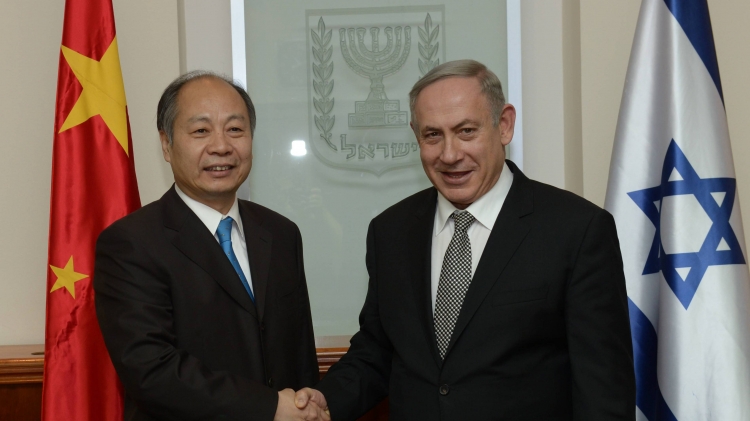
Israel hosts representatives from National Development and Reform Commission tasked with promoting commerce  Israel's Prime Minister Benjamin Netanyahu on Wednesday met with representatives from China's National Development and Reform Commission, a macroeconomic management agency with broad administrative and planning control over the Chinese economy, to discuss ways to promote the trade between the two countries.  The meeting was part of the schedule of a three day summit that saw upward of 200 Chinese official and businessmen arrive to Israel for strategic dialogue with local businesses, entrepreneurs and officials.

READ MORE....

Israel, China Launch Program To Bolster Economic Ties

by Deborah Danan

BREITBART - 8 Nov 2016

TEL AVIV – Israel’s Foreign Ministry announced a new NIS 3 million ($800,000) initiative to strengthen economic ties with China, Hebrew news site nrg reported on Sunday.  Israeli graduates of Far East and Chinese-language studies can enroll in a special program beginning in 2017 run jointly by the Foreign Ministry and China’s National Development and Reform Commission (NDRC).  According to the Prime Minister’s Office Director-General Eli Groner, who is leading the China-Israel economic initiative, the program aims to train Israelis on how to deal with the Chinese market.  Groner told cabinet ministers on Sunday that although he is generally of the view that governments should refrain from meddling in the free market, the situation is different when it comes to China.

READ MORE....

Shimon Peres wanted close relations with China

Henry Srebrnik

THE GUARDIAN - NOV 11, 2016

Israel’s former president Shimon Peres, who died last month at the age of 93, had a career in public service that spanned more than six decades. He held almost every senior post in Israeli politics.  The presidency, which he attained in 2007, allowed Peres to travel around the world, promoting Israel’s high-tech prowess and cultural reach.  “He had a very forward-looking belief in technology,” according to professor Yehudah Mirsky of Brandeis University in Waltham, Mass., and a former official of the U.S. State Department.  “He was always reading work on the cutting edge of things like nanotechnology, biotech and more.”  In his 1994 Nobel Peace Prize acceptance speech, Peres had articulated his future-oriented vision. “Countries used to divide the world into their friends and foes,” he declared.  “No longer. The foes now are universal: poverty, famine, religious radicalization, desertification, drugs, proliferation of nuclear weapons, ecological devastation. They threaten all nations, just as science and information are the potential friends of all nations.”

READ MORE....

Chinese FM meets Turkish president, PM on cooperation

Visiting Chinese Foreign Minister Wang Yi met with Turkish President Recep Tayyip Erdogan and Prime Minister Binali Yildirim in Ankara, capital of Turkey, on Monday.

Xinhua, November 15, 2016 

Erdogan said that Turkey attaches great importance to China-Turkey relations and is willing to maintain high-level exchanges to address issues concerning partnership through strategic cooperation.  "I'm pleased to see the consensus reached between Chinese President Xi Jinping and me in our previous meetings being effectively implemented," he said.  He also agreed to align China's Belt and Road Initiative with Turkey's "Middle Corridor" project, push ahead with major cooperation projects such as high speed railway construction and strengthen bilateral cooperation in fields such as tourism, culture and education.  The two countries need to deepen cooperation in security and anti-terrorism and support each other in efforts of safeguarding national sovereignty, security and stability, the president added.  In his meeting with Wang, Yildirim said that frequent high-level mutual visits have played a positive role in boosting bilateral relations between Turkey and China.

READ MORE....

China Turkey's 'friend in need': China foreign minister

In an exclusive interview, Wang Yi hails China's expression of 'immediate support' to Turkey in wake of defeated coup

Anadolu News Agency - Nov 14, 2016

China's Foreign Minister Wang Yi has stressed how his country stepped up to demonstrate "immediate" support to Turkey after the failed July 15 coup bid.  Speaking to Anadolu Agency in an exclusive interview on Sunday in Ankara, paying an official visit, Wang said, "China immediately expressed support for the Turkish government’s efforts to uphold stability in accordance with the law and sent a vice foreign minister to visit Turkey”.  Asked about Turkey and China’s cooperation on security issues and the Fetullah Terrorist Organization's (FETO) activities in the country, Wang said, "Neither of us allows any activity on its soil that undermines the other's security and stability”.  He added, "China and Turkey have both suffered from terrorism; we are both firmly opposed to terrorism in all manifestations. Strengthening security and counter-terrorism cooperation serves the fundamental interests of our two countries”.  Wang added that since last year, the nation’s presidents, Xi Jinping and Recep Tayyip Erdogan, have met three times and reached important agreements on protecting national security and fighting terrorism.  Ahead of the G20 Summit in Hangzhou this September, Erdogan and Xi signed three bilateral agreements in the areas of energy, nuclear security, and agricultural health certification.  "There is zero tolerance for any organization or individual that engages in such activities," Wang said, adding that China's support for Turkey in the wake of the coup attempt "proves that China is a friend in need”.

READ MORE.......

Sino-Turkish ‘Solid Strategic Partnership’ China’s Dream or a Reality?

Sino-Turkish ‘Solid Strategic Partnership’ China’s Dream or a Reality?    

Mordechai Chaziza    
Department of Politics and Governance, Ashkelon Academic College  

China Report November 2016 vol. 52 no. 4 265-283 

Abstract  This article analyses the motivation behind China’s measures to formalise a solid strategic partnership with Turkey. One cannot ignore the inherent potential and impact on the region of a Chinese strategic partnership with Turkey and Beijing’s balancing efforts to contain US predominance in the Middle East. However, China’s bilateral relationship with Turkey is essentially limited, with narrow strategic manoeuvrability, which make the two countries unlikely to become solid strategic partners in the foreseeable future. Yet an improved strategy and more sophisticated diplomatic tactics by China could bring it closer to reality.

READ MORE.....

Tuesday, November 15, 2016

$300 million fund between China, UAE to invest in films, TV

By Leng Shumei

Global Times - 2016/11/14

China and the United Arab Emirates (UAE) extended their partnership into the film industry for the first time, as two media companies formed a $300 million fund to invest in movies and television programs produced in China, the UAE and Hollywood.  The China Intercontinental Communication Center (CICC) and Image Nation Abu Dhabi on Sunday signed an agreement in Abu Dhabi, the UAE, to establish a film fund worth $300 million, the Xinhua News Agency reported.  The partnership is comprised of three core initiatives and the first initiative, a weekly factual entertainment series titled USILK, will be launched to air in January 2017, according to a press release sent to the Global Times by the CICC on Monday.  Image Nation aims "to build the foundations of a film and television industry" in the UAE, Michael Garin, chief executive of Image Nation, according to the release. Garin said that the agreement with CICC would also promote an "exchange of talent" between China, the UAE and Hollywood.  The agreement builds on a recent $10 billion strategic investment fund launched by China and the UAE last year and is the first extension of that relationship into the media industry, read the release.  China and the UAE agreed in December 2015 to set up a major investment cooperation fund worth $10 billion, Xinhua reported.  Deng Li, director of the Foreign Ministry's Department of West Asian and North African Affairs, was quoted by Xinhua as saying that the fund would be invested in China, the UAE and third-party markets.  The CICC project came amid rocketing Chinese investment in Hollywood in recent years, including property and entertainment giant Dalian Wanda Group's acquisition of leading Hollywood film producer Legendary Entertainment earlier this year and its previous purchase of AMC Theaters in 2012.  CICC Vice President Jing Shuiqing was quoted in the release as saying that China and the Arab countries have fostered great friendship through the ancient Silk Road and the Belt and Road initiative proposed by Chinese President Xi Jinping in 2013, and have brought new opportunities for collaboration between China and the United Arab Emirates.  In September in a letter to Congress, about 16 US lawmakers raised concerns about Chinese investment in the US entertainment and media industries, calling for an expansion of the government process to review foreign investments in the country, The New York Times reported.

Iran, China Sign Military Cooperation Agreement

Iran and China are reportedly slated to hold joint military drills in the near future.

By Franz-Stefan Gady

THE DIPLOMAT - November 15, 2016

Iranian Defense Minister Hossein Dehgan and his Chinese counterpart, Chang Wanquan, signed an agreement on November 14 pledging closer military cooperation in a number of areas including military training and counterterrorism operations. Both sides also pledged to hold joint military exercises in the near future.
The Chinese defense minister arrived in Tehran on Sunday for a three-day visit. Chang Wanquan expressed confidence that Iran-China defense ties will be strengthened in the years ahead.
“The upgrading of relations and long-term defense-military cooperation with China is one of the main priorities of the Islamic Republic of Iran’s defense diplomacy (…)” Iran’s defense minister said, according to the Tehran Times. “We assess the visit of the Chinese defense minister in line with this (Iran’s defense diplomacy,” he added.

READ MORE....

China and Saudi Arabia's Burgeoning Defense Ties

Tensions in the U.S.-Saudi alliance have China poised to expand its defense ties with Riyadh.

By Samuel Ramani

THE DIPLOMAT - November 16, 2016

On November 7, 2016, Saudi Arabia’s ruling monarch King Salman bin Abdulaziz met with Meng Jianzhu, a special envoy of Chinese President Xi Jinping, in Riyadh. After a series of talk between Chinese officials and senior members of the Saudi royal family, the Saudi government unveiled a five-year plan for Saudi Arabia-China security cooperation during Meng’s visit. This plan would include counterterrorism cooperation and joint military drills, cementing Saudi Arabia’s status as a vital Chinese ally in the Middle East.
Even though China has emerged as Saudi Arabia’s leading economic partner in recent years, the transition toward a full-fledged defensive partnership is a new, largely unforeseen development. In contrast to the multibillion dollar annual arms contracts binding Saudi Arabia to the United States, China only sold $700 million in arms to Riyadh from 2008-2011. Low levels of Riyadh-Beijing security cooperation were attributed to China’s long-standing friendship with Iran, disagreements over Bashar al-Assad’s future in Syria and long-standing Chinese disdain for Saudi Arabia’s sponsorship of Islamist networks.

READ MORE....

Defense coop. with China Iran's priority

MEHR NEWS AGENCY - Mon 14 November 2016
Iran’s Defense Minister Brigadier General Hossein Dehghan said the development of long-term defense-military relations and cooperation with China is considered as Iran's top priority in defense diplomacy.  Dehghan officially welcomed Chinese Minister of Defense Chang Wanquan on Monday and discussed international and regional issues with his Chinese counterpart .  Pointing to Chinese President Xi Jinping's visit to Tehran in late January, Dehghan said presidents of Iran and China agreed to expand defense-military cooperation and to fight against terrorism within the framework of comprehensive cooperation.  He underlined that Iran gives top priority to promoting long-term defense-military relations and cooperation with China.  Describing Iran-China defense-military cooperation as a guarantee for international and regional peace and security, Dehghan said maintaining peace and stability in Asia-Pacific region is responsibility of all countries in the region.  Today, he added, the region has turned into the epicenter of the crisis and insecurity in the world due to foreign interference and lack of respect for national sovereignty. It has led to the spread of terrorism around the world, he underlined.  Chang Wanquan, for his part, expressed satisfaction with his visit to Iran, saying Iran is a great country with an ancient civilization and a distinguished position in political, security, military, economic and cultural fields.  Iran and China enjoy shared interests and mutual understanding on various regional and global issues to completely pave the way for the development of defense-military cooperation between the two countries.  Chinese defense minister referring to Dehghan's trip to China on 2014, highly regarded Iran-China's relations and underlined the need for the expansion and deepening of defense cooperation with the implementation of military agreements signed between the two countries.  Iran and China also signed an agreement on Monday to hold joint military drills and to cooperate in fighting terrorism, seeking to "create a collective movement to confront this threat."  In addition to the joint military training exercises, Iran and China of terrorism.  The two nations have upgraded their military ties in recent years, with each country's naval ships visiting the other's ports.

Iran, China sign defense cooperation deal

TEHRAN TIMES -  November 14, 2016
“The upgrading of relations and long-term defense-military cooperation with China is one of the main priorities of the Islamic Republic of Iran’s defense diplomacy…” Iranian Defense Minister Hossein Dehqan said at a meeting with visiting Chinese counterpart General Change Wanquan.  Wenquan arrived in Tehran on Sunday for a three-day visit. “We assess the visit of the Chinese defense minister in line with this (Iran’s defense diplomacy,” Brigadier General Dehqan added.  The agreement envisions, inter alia, counterterrorism efforts and exchange of experiences in personnel training between the two militaries.  No more details were available.  Closer military cooperation between Iran and China is advantageous to regional and international peace, the Iranian commander stressed.  “Maintaining peace and stability in Asia and Oceania is a collective responsibility of all countries in the region.”   Also, in the meeting, the Chinese defense minister appeared confident of stronger defense ties with Iran, citing common regional and international interests.  He also underscored the importance of a full implementation of defense agreements as the way forward, expressing hope for a new chapter in defense cooperation. The visit comes two years after Dehqan paid an official visit to Beijing, where the two commanders exchanged ideas on defense ties. Defense cooperation between the two countries dates back to nearly three decades ago.  Since the 1980’s, Beijing has been a key partner in supplying Tehran with advanced military hardware, including tactical ballistic and anti-ship cruise missiles.  There were also rumors last year regarding the interest shown by Iran in purchasing 150 Chengdu J-10 fighters from China for a contract value of $1 billion, though the deal was not finalized.  Also, the Iranian Armed Forces Chief of Staff Major General Mohammad Hossein Baqeri has shown interest in staging joint military drills with China in a separate meeting with visiting Wanquan. “Iran is prepared to expand and deepen defense and military cooperation between the two countries and stage joint military war games,” Baqeri was quoted as saying.  Iran’s growing international defense ties, called “defense diplomacy”, comes after the country clinched a historic agreement on its nuclear program with great powers including China. China and Iran have shown determination to strengthen all-encompassing relations particularly after the nuclear deal reached in July 2015.  During the last year’s January visit to Tehran by Chinese President Xi Jinping, a record number of 17 documents were inked.  As the defense ministers were signing the deal, the RIA news agency reported that Iran and Russia are in talks over an arms deal worth around $10 billion under which Moscow delivers T-90 tanks, artillery systems, planes and helicopters to Tehran.  This is while Russian Ambassador to Iran Levan Dzhagaryan had seen military deals with Tehran limited by the UN Resolution 2231.

China, Iran pledge to deepen military exchange

Xinhua, November 16, 2016

Chinese Defense Minister Chang Wanquan on Monday held talks with Iranian Defense Minister Hossein Dehqan in Tehran.Chang said the development of bilateral relations between China and Iran is not only positive for mutual interest of Chinese and Iranian peoples, but also positive for world peace and stability.  Witnessing increased mutual visits and personnel training cooperation between the armed forces in recent years, Chang said he is confident that the friendly relations between the two countries as well as the armed forces will be further reinforced.  Dehqan hailed Chang's remarks, voicing the hope that further military exchange and cooperation between Iran and China will continue to play a positive role in safeguarding regional peace and world stability.  Chang arrived in Tehran on Sunday for a three-day visit at the invitation of Dehqan.

READ MORE....

Monday, November 14, 2016

Sun Yat-sen, The Three Principles of the People (1929)

Sun Yat-sen (1866-1925) was the leading intellectual figure in the western-influenced nationalist movement which had overthrown the Manchu dynasty in China in 1911. The lecture from which this extract is taken was given in 1924.
 
The population of the world today is approximately a billion and a half. One fourth of this number live in China, which means that one out of every four persons in the world is a Chinese. The total population of the white races of Europe also amounts to four hundred millions. The white division of mankind, which is now the most flourishing, includes four races: in central and northern Europe, the Teutons, who have founded many states, the largest of which is Germany, others being Austria, Sweden, Norway, Holland, and Denmark; in eastern Europe, the Slavs, who also have founded a number of states, the largest being Russia, and, after the European war, the new countries of Czechoslovakia and Yugoslavia; in western Europe, the Saxons or Anglo-Saxons, who have founded two large states England and the United States of America; in southern Europe, the Latins, who have founded several states, the largest being France, Italy, Spain, and Portugal, and who have migrated to South America forming states there just as the Anglo-Saxons migrated to North America and built up Canada and the United States. The white peoples of Europe, now numbering only four hundred million persons, are divided into four great stocks which have estab-lished many states. Because the national spirit of the white race was highly developed, when they had filled up the European continent they expanded to North and South America in the Western Hemisphere and to Africa and Australia in the southern and eastern parts of the Eastern Hemisphere.
From San Min Chit I (The Three Principles of the People), by Dr. Sun Yat-sen, tr. F.W. Price, Shanghai, 1929, pp. 77-100.
The Anglo-Saxons at present occupy more space on the globe than any other race. Although this race originated in Europe, the only European soil it holds are the British Isles—England, Scotland and Ireland—which occupy about the same position in the Atlantic that Japan occupies in the Pacific. The Anglo-Saxons have extended their territory westward to North America, eastward to Australia and New Zealand, and south-ward to Africa until they possess more land and are wealthier and stronger than any other race. Before the European war the Teutons and the Slavs were the strongest races; moreover, by reason of the sagacity and ability of the Teutonic peoples, Ger-many was able to unite more than twenty small states into a great German confederation. At the beginning an agricultural nation, it developed into an industrial nation and through industrial prosperity its army and navy became exceedingly powerful.
Before the European war all the European nations had been poisoned by imperialism. What is imperialism? It is the policy of aggression upon other countries by means of political force, or, in the Chinese phrase, "long-range aggression." As all the peoples of Europe were imbued with this policy, wars were continually breaking out; almost every decade had at least one small war and each century one big war. The greatest of all was the recent European war, which may be called the World War because it finally involved the whole world and pulled every nation and people into its vortex. The causes of the European war were, first, the rivalry between the Saxon and Teutonic races for control of the sea. Germany in her rise to greatness had developed her navy until she was the second sea power in the world; Great Britain wanted her own navy to rule the seas 59 she tried to destroy Germany, whose sea power was next to hers. From this struggle for first place on the sea came the war.
A second cause was each nation's struggle for more territory. In eastern Europe there is a weak state called Turkey. For the past hundred years the people of the world have called it the "sick man of Europe." Because the government was unenlight-ened and the sultan was despotic, it became extremely helpless and the European nations wanted to partition it. Because the Turkish question had not been solved for a century and every nation of Europe was trying to solve it, war resulted. The first cause of the European war, then, was the struggle between white races for supremacy; the second cause was the effort to solve critical world problems. If Germany had won the war, she would have held the supreme power on the sea after the war and Great Britain would have lost all her territory, breaking into pieces like the old Roman Empire. But the result of the war was defeat for Germany and the failure of her imperialistic designs.
The recent European war was the most dreadful war in the history of the world. Forty to fifty million men were under arms for a period of four years, and near the end of the war they still could not be divided into conquerors and vanquished. One side in the war was called the Entente; the other side, the Allied Powers. The Allied Powers* at first included Germany and Austria; Turkey and Bulgaria later joined them. The Entente Powers** at first were Serbia, France, Russia, England, and Ja-pan; Italy and the United States joined afterwards. The United States' entry into the war was due entirely to racial considera-tions. During the first two years of the war Germany and Austria were in the ascendancy. Paris and the English Channel were almost captured by the German and Austrian armies. The Teu-tons thought that Great Britain was certainly done for, and the British themselves were thoroughly alarmed. Seeing that the American people are of the same race as they, the British used the plea of race relationship to stir up the people of the United States. When America realized that England, of her own race, was in danger of being destroyed by Germany, of an alien race, inevitably "the creature sorrowed for its kind" and America threw in her lot with England to defend the existence of the Anglo-Saxons. Moreover, fearing that her own strength would be insufficient, America tried with all her might to arouse all the neutral countries of the world to join in the war to defeat Germany.
During the war there was a great phrase, used by President Wilson and warmly received everywhere "self-determination of peoples." Because Germany was striving by military force to crush the peoples of the European Entente, Wilson proposed destroying Germany's power and giving autonomy henceforth to the weaker and smaller peoples. His idea met a world wel-come, and although the common people of India still opposed Great Britain, their destroyer, yet many small peoples, when they heard Wilson say that the war was for the freedom of the weak and small peoples, gladly gave aid to Great Britain. Al-though Annam had been subjugated by France and the common people hated the French tyranny, yet during the war they still helped France to fight, also because they had heard of Wilson's just proposition. And the reason why other small peoples of Europe, such as Poland, Czechoslovakia and Romania, all en-listed on the side of the Entente against the Allied Powers was because of the self-determination principle enunciated by Presi-dent Wilson. China, too, under the inspiration of the United States, entered the war; although she sent no armies, yet she did contribute hundreds of thousands of laborers to dig trenches and to work behind the lines. As a result of the noble theme pro-pounded by the Entente all the oppressed peoples of Europe and of Asia finally joined together to help them in their struggle against the Allied Powers. At the same time, Wilson proposed, to guard the future peace of the world, fourteen points, of which the most important was that each people should have the right of self-determination. When victory and defeat still hung in the balance, England and France heartily endorsed these points, but when victory was won and the Peace Conference was opened, England, France, and Italy realized that Wilson's proposal of freedom for nations conflicted too seriously with the interests of imperialism; and so, during the conference, they used all kinds of methods to explain away Wilson's principles. The result was a peace treaty with most unjust terms; the weaker, smaller na-tions not only did not secure self-determination and freedom but found themselves under an oppression more terrible than before. This shows that the strong states and the powerful races have already forced possession of the globe and that the rights and privileges of other states and nations are monopolized by them. Hoping to make themselves forever secure in their exclusive position and to prevent the smaller and weaker peoples from again reviving, they sing praises to cosmopolitanism, saying that nationalism is too narrow; really their espousal of international-ism is but imperialism and aggression in another guise.
But Wilson's proposals, once set forth, could not be recalled; each one of the weaker, smaller nations who had helped the Entente to defeat the Allied Powers and had hoped to attain freedom as a fruit of the victory was doomed to bitter disappoint-ment by the results of the Peace Conference. Then Annam, Burma, Java, India, the Malay Archipelago, Turkey, Persia, Af-ghanistan, Egypt, and the scores of weak nations in Europe were stirred with a great, new consciousness; they saw how com-pletely they had been deceived by the Great Powers' advocacy of self-determination and began independently and separately to carry out the principle of the "self-determination of peoples." Many years of fierce warfare had not been able to destroy imperialism because this was a conflict of imperialisms between states, not a struggle between savagery and civilization or be-tween Might and Right. So the effect of the war was merely the overthrow of one imperialism by another imperialism; what sur-vived was still imperialism. But from the war there was uncon-sciously born in the heart of mankind a great hope the Russian Revolution. The Russian Revolution had begun much earlier, as far back as 1905, but had not accomplished its purpose. Now during the European war the efforts of the revolutionists were crowned with success. The reason for the outbreak of revolution again at this time was the great awakening of the people as a result of their war experience. Russia sent over ten million soldiers into the field—not a puny force. Without Russia's part in the war, the Entente's line on the western front would long before have been smashed by Germany; because Russia was embarrassing the Germans on the eastern front, the Entente Powers were able to break even with Germany for two or three years and finally turn defeat into victory. Just halfway through the war, Russia began to reflect, and she realized that in helping the Entente to fight Germany she was merely helping several brute forces to fight one brute force and that no good results would come of it in the end. A group of soldiers and citizens awoke, broke away from the Entente, and concluded a separate peace with Germany.
As far as their legitimate national interests were concerned, the German and the Russian people had absolutely no cause for quarrel; but when it came to imperialistic designs, they vied with each other in aggressions until conflict was inevitable. Moreover, Germany went so far beyond bounds that Russia, in self-protec-tion, could not but move in accord with England, France, and the others. Later, when the Russian people awoke and saw that imperialism was wrong, they started a revolution within their own country, first overthrowing their own imperialism; at the same time, to avoid foreign embarrassments, they made peace with Germany. Before long, the Entente also signed a peace with Germany and then all sent soldiers to fight Russia. Why? Be-cause the Russian people had awakened to the fact that their daily sufferings were due to imperialism and that to get rid of their sufferings they must eliminate imperialism and embrace self-determination. Every other nation opposed this policy and so mobilized to fight Russia, yet Russia's proposal and Wilson's . were undesignedly similar; both declared that the weaker, smaller nations had the right of self-determination and freedom. When Russia proclaimed this principle, the weaker, smaller peo-ples of the world gave their eager support to it and all together began to seek self-determination. The calamitous war through which Europe had passed brought, of course, no great imperialis-tic gain, but, because of the Russian Revolution, a great hope was born in the heart of mankind.
Of the billion and a half people in the world, the most powerful are the four hundred million whites on the European and Ameri-can continents; from this base the white races have started out to swallow up other races. The American red aborigines are gone, the African blacks will soon be exterminated, the brown race of India is in the process of dissolution, the yellow races of Asia are now being subjected to the white man's oppression and may, before long, be wiped out.
But the one hundred fifty million Russians, when their revolu-tion succeeded, broke with the other white races and condemned the white man's imperialistic behavior; now they are thinking of throwing in their lot with the weaker, smaller peoples of Asia in a struggle against the tyrannical races. So only two hundred fifty million of tyrannical races are left, but they are still trying by inhuman methods and military force to subjugate the other twelve hundred fifty million. So hereafter mankind will be di-vided into two camps: on one side will be the twelve hundred fifty million; on the other side, the two hundred fifty million. Although the latter group are in the minority, yet they hold the most powerful positions on the globe and their political and economic strength is immense. With these two forces they are out to exploit the weaker and smaller races. If the political arm of navies and armies is not strong enough, they bear down with economic pressure. If their economic arm is at times weak, they intervene with political force of navies and armies. The way their political power cooperates with their economic power is like the way in which the left arm helps the right arm; with their two arms they have crushed most terribly the twelve hundred fifty million. But "Heaven does not always follow man's desires." The Slavic race of one hundred fifty million suddenly rose up and struck a blow at imperialism and capitalism, warring for mankind against inequality. In my last lecture I told of the Russian who said, "The reason why the Powers have so defamed Lenin is because he dared to assert that the twelve hundred fifty million majority in the world were being oppressed by the two hundred fifty million minority." Lenin not only said this, but also ad-vocated self-determination for the oppressed peoples and launched a campaign for them against injustice. The powers attacked Lenin because they wanted to destroy a prophet and a seer of mankind and obtain security for themselves. But the people of the world now have their eyes opened and know that the rumors created by the powers are false; they will not let themselves be deceived again. The political thinking of the peo-ples of the world has been enlightened to this extent.
Now we want to revive China's lost nationalism and use the strength of our four hundred million to fight for mankind against injustice; this is our divine mission. The powers are afraid that we will have such thoughts and are setting forth a specious doctrine. They are now advocating cosmopolitanism to inflame us, declaring that, as the civilization of the world advances and as mankind's vision enlarges, nationalism becomes too narrow, unsuited to the present age, and hence that we should espouse cosmopolitanism. In recent years some of China's youths, de-votees of the new culture, have been opposing nationalism, led astray by this doctrine. But it is not a doctrine which wronged races should talk about. We, the wronged races, must first recover our position of national freedom and equality before we are fit to discuss cosmopolitanism. The illustration I used in my last lecture of the coolie who won first prize in the lottery has already made this very clear. The lottery ticket represents cos-mopolitanism; the bamboo pole, nationalism. The coolie, on win-ning first prize, immediately threw away his pole* just as we, fooled by the promises of cosmopolitanism, have discarded our nationalism. We must understand that cosmopolitanism grows out of nationalism; if we want to extend cosmopolitanism we must first establish strongly our own nationalism. If nationalism cannot become strong, cosmopolitanism certainly cannot pros-per. Thus we see that cosmopolitanism is hidden inside the bam-boo pole; if we discard nationalism and go and talk cosmopolitanism we are just like the coolie who threw his bam-boo pole into the sea. We put the cart before the horse. I said before that our position is not equal to that of the Annamese or the Koreans; they are subject peoples and slaves while we cannot even be called slaves. Yet we discourse about cosmopolitanism and say that we do not need nationalism. Gentlemen, is this reasonable?
According to history, our four hundred million Chinese have also come down the road of imperialism. Our forefathers con-stantly employed political force to encroach upon weaker and smaller nations; but economic force in those days was not a serious thing, so we were not guilty of economic oppression of other peoples. Then compare China's culture with Europe's an-cient culture. The Golden Age of European culture was in the time of Greece and Rome, yet Rome at the height of its power was contemporaneous with as late a dynasty in China as the Han. At that time China's political thinking was very profound; many orators were earnestly opposing imperialism and much anti-imperialistic literature was produced, the most famous be-ing "Discussions on Abandoning the Pearl Cliffs." Such writings opposed China's efforts to expand her territory and her struggle over land with the southern barbarians, which shows that as early as the Han dynasty China already discouraged war against outsiders and had developed the peace idea to broad proportions.

Chinese, Turkish FMs discuss infrastructure, security

CCTV.com  11-14-2016

Chinese Foreign Minister Wang Yi is in the Turkish capital for the first meeting of the China-Turkey foreign ministers’ consultation mechanism. Also at the press conference, Wang said bilateral relations with Turkey have maintained a stable and active momentum. Cavusoglu said frequent high-level exchanges in recent years and close consultations at all levels are helping promote the strategic partnership between the two countries.  The two ministers agreed to continue to dovetail China’s Belt and Road Initiative and Turkey’s Middle Corridor Initiative, and jointly push forward the high-speed rail project. They also agreed on closer cooperation in security and counter-terrorism.  The two sides will continue to support each other's efforts to maintain national sovereignty, security and stability. This years marks the 45th year since China and Turkey established diplomatic relations.  Wang said China will work with Turkey to seek further trust and a brighter future for bilateral relations.

Chinese foreign minister visits Ankara seeking to improve relations and create win-win projects

DAILY SABAH - NOV. 14, 2016

Considering Turkey as a major country in the region and placing high premium on its crucial role in regional and international affairs, Chinese Foreign Minister Wang Yi indicated that the Turkish and Chinese sides are currently discussing a number of win-win projects  Chinese Foreign Minister Wang Yi said Turkey is a major country in the region and placed a high premium on Turkey's significant role in the regional and international affairs, approaching the bilateral relationship from a strategic perspective. Answering Daily Sabah's questions during his visit to Ankara, Minister Wang Yi said that practical cooperation between China and Turkey covers a wide range of areas from energy to infrastructure, adding that currently the Turkish and Chinese sides are also discussing a number of other win-win projects.  Underlining Turkey's important role in connecting with China's "Silk Road Economic Belt" initiative, Minister Wang Yi said that it will be an important building block of the transport corridor, linking Asia and Europe, acting as a "Steel Silk Road" running all the way from China to London.

READ MORE....

Wang Yi Meets with Foreign Minister Mevlut Cavusoglu of Turkey

MINISTRY OF FOREIGN AFFAIRS OF PRC -  2016/04/27

On April 27, 2016, Foreign Minister Wang Yi met in Beijing with Foreign Minister Mevlut Cavusoglu of Turkey, who was in China to attend the fifth Foreign Ministers’ Meeting of the Conference on Interaction and Confidence-Building Measures in Asia (CICA).  Wang Yi said that both China and Turkey are founding members of the CICA, and China is willing to communicate and cooperate with Turkey to well implement the consensus reached in the 2014 CICA Shanghai Summit, enhance confidence of Asian countries and persist in resolving issues through dialogues and consultations, in an effort to eventually build a security framework acceptable to all sides and consistent with the trend of regional development.  Wang Yi said that China stands ready to work with Turkey to implement the important consensus of the two heads of state, integrate development strategies, carry out cooperation in infrastructure and energy, and jointly push the G20 Hangzhou Summit towards success.  Wang Yi emphasized that cooperation in counter-terrorism and security is an important content of the political mutual trust between China and Turkey, and that the two sides should cooperate closely to jointly fight against terrorist organizations including the “East Turkistan Islamic Movement (ETIM)”, combat extremism, and deter illegal immigration.  Mevlut Cavusoglu congratulated on the successful convening of the 5th CICA Foreign Ministers’ Meeting, and expressed that Turkey will keep close cooperation with China to jointly promote security in Asia. Mevlut Cavusoglu said that Turkey attaches great importance to Turkey-China relations, and stands ready to continue to carry out high-level mutual visits and expand economic and trade cooperation with China. China’s security concerns are also Turkey’s concerns, and Turkey will take all necessary measures to practically strengthen bilateral cooperation in counter-terrorism and security, combat illegal immigration, fight against the ETIM, continuously pay attention to China’s security concerns, and allow nobody in Turkey to engage in activities jeopardizing China’s security. Turkey is looking forward to reinforcing cooperation with China in all fields.

Sunday, November 13, 2016

Saudi Arabia, China sign security cooperation pact


A five-year action plan for cooperation in the field of security training between Saudi Arabia and China was signed here on Sunday.
The agreement was signed during a meeting between Crown Prince Muhammad Bin Naif, Deputy Premier and Minister of Interior, and Meng Jianzhu, member of the Politburo of the Central Committee, secretary of the Central Political Legal Committee, special envoy of the Chinese President.

Saudi Arabia and China sign security pact

 
Saudi Arabia and China have agreed to increase cooperation on security and counter-terrorism issues, following talks in Riyadh on Sunday between the two countries' leaders.
A five-year plan for security cooperation was signed between the two nations following talks involving King Salman al-Saud, Crown Prince Mohammed bin Naif and Deputy Crown Prince Mohammed bin Salman with Chinese President Xi Jinping.
This follows a deal struck between the two nations in August, when Mohammed bin Salman visited Beijing. This resulted in 15 preliminary agreements on areas ranging from housing to energy.
Saudi media outlets are touting the visit as part of the kingdom's economic overhaul which aims to reduce its reliance on oil experts.
To this end, Riyadh hopes that such visits will present the oil-rich kingdom as a hub for business and investment opportunities.
Last month, China and Saudi Arabia held their first joint military drills as part of Beijing's latest effort to strengthen ties with the Middle East.
China said it faces a growing threat from terrorism as its global footprint expands, as well as its diplomatic involvement in Middle Eastern affairs.
Members of each side's special forces took part in a fortnight of training focusing on combat skills and tactics near China's southwestern city of Chongqing.

Monday, November 7, 2016

Turkey wants to be a bridge along the way - 土耳其希望成为“一带一路”的桥梁


Peking University

2016年11月2日,土耳其马尔马拉大学教授、土耳其大国民议会议员塔里普•库楚克詹(Talip Küçükcan)教授访问了北京大学阿拉伯语系,并作了《土耳其的外交政策与全球影响》的讲座。北京大学外国语学院付志明副院长主持讲座,来自外国语学院、国际关系学院、历史系的同学聆听了讲座。出席讲座的还有来自上海大学的土耳其教授图鲁•凯斯肯(Turgut Keskin)。


Chairman of the Council of Europe Parliamentary Assembly of Turkey Visits SIIS

SHANGHAI INSTITUTE FOR INTERNATIONAL STUDIES - 2016-11-07 

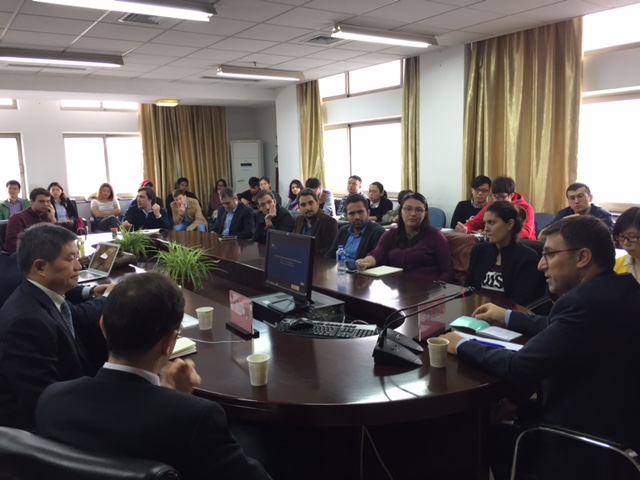
On November 1, 2016, SIIS President Chen Dongxiao met with Mr. Talip Küçükcan, Chairman of the Council of Europe and member of the Foreign Affairs Committee of the Grand National Assembly of Turkey and his colleagues. The two sides had a discussion on China-Turkey relations, the political and security situation in the Middle East etc. Mr. Sabri Tunç Cangili, acting Consul-General of Turkey in Shanghai, Prof. Tugrul Keskin in Shanghai University, Prof. Li Weijian, Prof. Jin Liangxiang, Dr. Liu Xin and Dr. Zhang Weiting from Center for West Asia and African Studies of SIIS also participated in the meeting.

Turkey signs $300 mln trade deal with China

The agreements include the trading of some materials and produce that are inherent in Turkey, such as marble, chrome ore, soya oil, hazelnut sauce and cotton fiber

YENISAFAK DAILY - Kasım 03, 2016

Turkey signed 36 agreements with China that could see $300 million trade between the two countries.  China Radio International (CRI) published a report citing that the Chinese Trade Delegation currently visiting Turkey has signed agreements in Istanbul at the Industry and Trade Symposium.  The 36 agreements include the trading of some materials and produce that are inherent in Turkey, such as marble, chrome ore, soya oil, hazelnut sauce and cotton fiber, the report said.  The agreements were discussed in September between Turkish President Recep Tayyip Erdoğan and his Chinese counterpart Xi Jinping on the sidelines of the G20 summit in the eastern Chinese city of Hangzhou.  CRI said the Chinese Trade ministry delegation's visit to Turkey was a sign of strong economic relations between Ankara and Beijing.  The visit carries tremendous importance for boosting bilateral trade and the strategic partnership between the two countries, the report said.

READ MORE....

Bank of China to start operation in Turkey

Xinhua, November 7, 2016

The Bank of China (BOC) will start its operation in Turkey by the end of this year, Turkish Banking Regulation and Supervision Agency (BDDK) President Mehmet Ali Akben said on Sunday.  "I suppose the BOC will start its operations in Turkey by the end of the year. We do not foresee any shortcomings or problems," Akben said after meeting with BOC high-ranking executives, the state-run Anadolu Agency reported.  The vice president and other representatives of the BOC and the BDDK had recently discussed a series of important projects, Akben said.  "They are now considering the issue of resource acquisition for projects like energy, bridge and Channel Istanbul," the BDDK president said, adding "they also care about the Silk Road project."  Channel Istanbul, or Kanal Istanbul, is the Turkish project name of artificial sea-level waterway being built to connect the Black Sea to the Sea of Marmara.  The BOC, the world's seventh largest bank and the third largest in China, launched its preparations to establish a commercial bank in Turkey last year.  It has been conducting its operations in Turkey through a representative office since 2011, and planned to establish a commercial bank with a total capital of TL 300 million (US$98 million).  After the completion of the application process and submission of the required documents in April, the bank was granted permission by the BDDK to run in Turkey in May.

READ MORE...

Turkish president praises frequent high-level contacts with China

Xinhua | 2016-11-06

ISTANBUL, Nov. 5 (Xinhua) -- Turkish President Recep Tayyip Erdogan on Saturday lauded frequent high-level exchanges with China, saying they are important in promoting bilateral ties as well as communication and coordination between the two countries.  In his meeting with visiting Chinese Vice Premier Wang Yang in Istanbul, Erdogan spoke of his last talks with President Xi Jinping in early September on the sidelines of the G20 summit in eastern Chinese city of Hangzhou, in which the Turkish leader said an important understanding was reached with Xi and a strategic planning was mapped out for the development of Turkey-China relations.  The Turkish leader also referred to Wang's meeting with Turkey's Deputy Prime Minister Mehmet Simsek in Ankara a day earlier, when the two co-chaired the first meeting of a governmental cooperation committee mechanism of deputy prime ministerial level between their countries.  Noting that Turkey and China had agreed to deepen cooperation on security and counterterrorism, Erdogan pledged more efforts to address properly Beijing's concerns in this regard.

READ MORE....

Talip Kucukcan Visits Shanghai Institute for International Studies

SHANGHAI INSTITUTE FOR INTERNATIONAL STUDIES - 2016-11-07  

http://www.siis.org.cn/index.php?m=content&c=index&a=show&catid=1&id=3661

2016年11日1日,上海国际问题研究院院长陈东晓会见了来访的土耳其议会欧洲事务委员会主任、议会对外关系委员会委员塔里普·库库乾(Talip Küçükcan)一行。双方就中土关系发展及中东地区政治安全形势等议题深入地交流了观点。
  土耳其驻上海领事馆代总领事萨布里·坎基利(Sabri TunçCangili)和上海大学土耳其籍副教授吐谷鲁·凯斯金(Tugrul Keskin)陪同参加会谈。上研院西亚非洲研究中心研究员李伟建、副研究员金良祥、助理研究员刘欣以及张卫婷博士等陪同会见。

Turkish Parliament member visits Chongyang Institute for Financial Studies Renmin University of China


Chongyang Institute for Financial Studies
Renmin University of China
Beijing, People’s Republic of China
2016-11-07

On Nov. 2, professor Talip Kucukcan, a member of Turkish Parliament, led a delegation to visit RDCY, along with professor Tugrul Keskin, a research fellow of Turkey Research Center at Shanghai University, and several researchers from Turkey. He Fan, Chief economist of RDCY, Chen Xiaochen, Head of the International Studies Department, and Cheng Cheng, associate researcher of RDCY attended the meeting. The meeting was hosted by Yang Qingqing, Director of the Research Cooperation Department of RDCY.
Professor Kucukcan introduced the current development situation and problems of Turkey, and tried to explore the cooperation potential between China and Turkey. Both sides also exchanged their views on the issues such as the long term influences of "Belt and Road Initiative" on the China-Turkey relations, the focuses and concerns of Chinese foreign investment. 


Thursday, November 3, 2016

China's Separation Between Mosque and State

Alice Su 

PULITZER CENTER - October 21, 2016

Driving through the Linxia Hui Autonomous Prefecture in Gansu province, in China’s northwest, minarets puncture the sky every few minutes. Many rise out of mosques that resemble Daoist temples, their details a blend of traditional Chinese and Islamic features: a bronze door knocker inscribed with the word “Allah” in Arabic, a crescent moon peeking above the pointed eaves of a tiled roof, and stone steles carved with hadith—a collection of sayings attributed to the Prophet Mohammed—in Chinese. This is the heartland of the Hui, a Chinese minority of about 10.5 million, distinguished from the majority Han ethnicity primarily by their Muslim identity.  China’s ruling Communist Party (C.C.P.) has long had a fraught relationship with religion, with harsh restrictions in regions like Xinjiang and Tibet, where religious identity is seen as a conduit to separatism. C.C.P. General Secretary Xi Jinping’s heightened sensitivity toward civil society and outside ideological influences, combined with the recent rise of global terrorism, has intensified government suspicion toward Muslims. Meanwhile, mainstream Han society, especially on the Chinese web, has grown increasingly vitriolic toward Muslims. Han chauvinism and ethnocentric nationalism are common in online forums, occasionally including Islamophobic warnings that the mosque will soon overshadow the Party.

READ MORE....

Meet China’s State-Approved Muslims

Adapting to Beijing's dictates has allowed Hui Islam to survive. But true believers say it's losing its soul. 

By Alice Su   

FOREIGN POLICY - NOV 2, 2016

LINXIA — Driving through the Linxia Hui Autonomous Prefecture in Gansu province, in China’s northwest, minarets puncture the sky every few minutes. Many rise out of mosques that resemble Daoist temples, their details a blend of traditional Chinese and Islamic features: a bronze door knocker inscribed with the word “Allah” in Arabic, a crescent moon peeking above the pointed eaves of a tiled roof, and stone steles carved with hadith — a collection of sayings attributed to the Prophet Mohammed — in Chinese. This is the heartland of the Hui, a Chinese minority of about 10.5 million, distinguished from the majority Han ethnicity primarily by their Muslim identity.  China’s ruling Communist Party has long had a fraught relationship with religion, with harsh restrictions in regions like Xinjiang and Tibet, where religious identity is seen as a conduit to separatism. Chinese President Xi Jinping’s heightened sensitivity toward civil society and outside ideological influences, combined with the recent rise of global terrorism, has intensified government suspicion toward Muslims. Meanwhile, mainstream Han society, especially on the Chinese web, has grown increasingly vitriolic toward Muslims. Han chauvinism and ethnocentric nationalism are common in online forums, occasionally including Islamophobic warnings that the mosque will soon overshadow the Party.

READ MORE...

China remains Algeria's largest supplier: report

GLOBAL TIMES - 2016/10/25

China has maintained its pole position as the largest commercial supplier of Algeria during the first nine months of 2016 with a trading volume of about 6.2 billion US dollars, according to figures provided by Customs' National Center for Data and Statistics on Monday.  China supplied about 17.7 percent of the overall 35 billion dollars imports bill of the North African nation.  At the end of 2015, imports from China accounted for about 16 percent of a total of 51.5 billion dollars imports bill of Algeria.  Italy shares the second position with France, with 3.7 billion dollars each, the figures show.  It shows that Algeria's exports in the first nine months this year hit 20 billion dollars, while Italy is its main exports destination with 3.8 billion dollars, followed by Spain, France, the United States and Canada.

READ MORE....

Chinese Companies Are Paying $45 Billion to Build Egypt's Next Capital

The ambitious project just received funding to move closer toward completion 

by Carrie Hojnicki

ARCHITECTURAL DIGEST - October 20, 2016

As soon as it was announced in March of 2015, Egypt’s plan to relocate its capital from Cairo to a plot of desert 28 miles east received a healthy dose of skepticism from critics at home and abroad. With political turmoil dominating headlines and no shortage of economic suffering, Egypt’s issues, it seemed, were simply too significant to allow such a move. Last week, however, an unexpected source pushed the project toward completion: China. Reviving the two nations' shared centuries-old history, dating back to the Silk Road, several Chinese companies have come forward to contribute the billions of dollars needed to fund the development. The latest commitment comes from the China Fortune Land Development Company (CFLDC), whose $20 billion pledge recently made headlines, joining a previous promise of $15 billion from another state-owned Chinese entity. What’s in it for China? you may wonder. According to the Atlantic, which featured the capital project earlier this month, the Eastern nation is in the process of bolstering its ties to the region in order to encourage Chinese business development abroad.

READ MORE...

Egyptian, Chinese Experts Discuss Middle East Issues in Cairo

ALLAFRICA - NOV 1, 2016

Egyptian and Chinese renowned experts held on Monday a symposium in Cairo to discuss the ongoing developments in the conflict-stricken Middle East region and China's role in urging for their settlement.
Held by the Chinese embassy in Cairo in cooperation with Egypt's state-run Al-Ahram Center for Political and Strategic Studies, the political experts from both sides elaborated on the turmoil in several regional states including Syria, Iraq, Libya and Yemen, the relevant growing terrorism and the influence of key regional and international players on their developments.
In his opening statement during the symposium, Chinese Ambassador to Egypt Song Aiguo said China as a regional friend seeks stability and development in the Middle East region.

READ MORE....

China and Saudi Arabia hold anti-terror drills

DAILY SABAH - OCT 28, 2016

Special forces from China and Saudi Arabia have held their first joint anti-terrorism drills, state media reported on Thursday, China's latest effort to expand security ties with countries in the Middle East and its Muslim neighbours.  China says its companies and citizens face a growing threat from terrorism as its global footprint expands, and the government has been getting more involved diplomatically in trouble spots in areas such as the Middle East.  President Xi Jinping visited Saudi Arabia early this year, vowing to expand security cooperation and oppose terrorism.  Twenty-five people from each side took part in training over two weeks from Oct. 10 focused on anti-terrorism combat skills and tactics near China's southwestern city of Chongqing, the People's Liberation Army Daily said.

READ MORE....

Qatar-China Year of Culture celebrates shared values

BAHRAIN NEWS AGENCY - 03/11/2016 

The World Innovation Summit for Education (WISE), along with the 21st Century Education Research Institute in China, will jointly host the WISE-LIFE China Education Forum in Beijing on 5th November 2016.  The LIFE Forum (Learners Innovation Forum on Education) will address the theme of ‘Innovating for Equity and Empowerment’, and will explore and encourage innovative practices and ideas to promote equitable education as an empowering force. The forum is expected to attract 1,000 education innovators, leaders and decision makers from China and worldwide.  The Beijing engagement, which takes place during the Qatar-China Year of Culture, is a timely opportunity to further explore collaborations between the two countries. It aims to deepen mutual understanding and celebrate common values between the two cultures, removing barriers and opening minds, according to Qatar News Agency (QNA).  Global innovators, including 2012 WISE Prize for Education Laureate Dr. Madhav Chavan, founder of the influential Indian learning organization ‘Pratham’, and Shannon May, co-founder of Bridge International Academy, will be among the speakers.

READ MORE....

Food, dance and fun on offer at new Chinese Festival in Qatar

By Shabina S. Khatri

DOHANEWS - NOVEMBER 3, 2016

A four-day Chinese Festival that includes performances, food stalls, a tea house and puppet shows kicked off at the MIA Park last night.  The event, part of the Qatar – China Year of Culture, runs through Saturday, Nov. 5.  It is a collaborative effort between Qatar Museums, the Ministry of Culture of China and the Zhejiang Provincial Department of Culture. In a statement, QM’s public and international relations director Mohammed Al Othman said:      “We are very excited to host this dynamic festival that promotes an understanding, celebration and appreciation of Chinese culture, traditions and people, in Qatar…      As the Qatar China Year of Culture draws to an end this December, we hope that visitors will take this opportunity to experience and engage with Chinese culture right here in Doha.”

READ MORE....

TechNation: Israel-China Catalyst Fund Leads $25m Investment in SatixFy

OurCrowd unveils new fund focusing on digital health; Automobile startup Otonomo raises $12 million to connect cars to apps.

Eliran Rubin

HAREETZ - Nov 03, 2016

Catalyst CEL Fund said on Tuesday it is leading a $25 million investment round in SatixFy Ltd, an Israeli provider of satellite communication technology.The investment round will be completed by the end of the year, Catalyst said. By designing its own silicon chips, SatixFy’s technology reduces the cost, size, weight and power consumption of user-terminals, and cost of air-time for satellite communications. The Catalyst CEL Fund, jointly managed by Israel’s Catalyst and China Everbright Ltd, primarily invests in mid-to-late stage companies whose growth strategy is oriented towards emerging markets with a special focus on China. (Reuters)  OurCrowd unveils new fund focusing on digital health  Jerusalem-based fundraising platform OurCrowd announced Tuesday that it had finished its first closing of a new fund named Qure, which will focus on digital healthcare.

READ MORE....