Tuesday, May 9, 2017

3rd China and The Middle East Conference - Shanghai University People’s Republic of China June 7-8, 2017


Shanghai University Presents an
International Conference on

3rd China and The Middle East Conference:
Asia to the Middle East: Asianization of the Middle East with Economic Characteristics?
Shanghai University
People’s Republic of China
June 7-8, 2017

North Building, Shanghai Academy, Shanghai University (Yan Chang Campus), Yan Chang Road, No. 149, Jing An District, Shanghai, China.
  
Organized by
Center for Turkish Studies and Center for Global Studies
Shanghai University

Organizing Committee
·      Dr. Guo Changgang, Shanghai University, People’s Republic of China.
·      Dr. Tugrul Keskin, Shanghai University, People’s Republic of China.
·      Dr. Chen Hao, Shanghai University, People’s Republic of China.
·      Dr. Yang Chen, Shanghai University, People’s Republic of China.
·      Dr. Wei Huang, Shanghai University, People’s Republic of China.
·      Dr. Yang Jun, Shanghai University People’s Republic of China.


International Committee:
·      Dr. Mohammedmoin Sadeq, Professor - Qatar University, Qatar.
·      Dr. Tugrul Keskin, Associate Professor - Shanghai University, China.
·      Dr. Mark Juergensmeyer, Professor - University of California at Santa Barbara, USA.
·      Dr. Tarik Yousef, Senior Fellow and Director, Brookings Doha Center, Qatar.
·      Dr. Sean Foley, Associate Professor - Middle Tennessee State University, USA.
·      Dr. Baris Doster, Associate Professor – Marmara University, Turkey.
·      Dr. Mojtaba Mahdavi, Associate Professor - University of Alberta, Canada.
·      Dr. Saban Kardas, Associate Professor – TOBB University, Turkey.
·      Dr. Nissim Otmazgin, Professor – The Hebrew University of Jerusalem, Israel.  
·      Dr. Sari Hanafi, Professor - American University of Beirut, Lebanon.
·      Dr. Juan Cole, Professor - University of Michigan, USA.
·      Dr. Yunus Emre, Associate Professor – Kultur University, Turkey.
·      Dr. Geoffrey Gresh, National Defense University, USA.
·      Dr. Merve Kavakci, Associate Professor - Uskudar University, Turkey.  

Are Japan and China competing in the Middle East?

Yoram Evron, University of Haifa 

EAST ASIA FORUM - 28 April 2017   

Over the years, China and Japan have followed very different paths of involvement in the Middle East. The one policy that both countries have consistently shared though is steering well clear of the region’s politics and conflicts. This is starting to change.
China and Japan are both highly dependent on Middle Eastern energy sources and are interested in expanding their economic interests in this area. Both countries are also trying to strengthen their political stance in the region and become more involved in big power Middle East politics.
But are the two countries’ competing trajectories in the Middle East related to the broader Sino–Japanese rivalry?
At face value, competition over access to energy sources seems like the greatest source of Sino–Japanese competition in the Middle East, with a direct contest over the development of some oilfields already happening. But looking deeper, it does not seem like their decisions concerning investments and other economic activities in the Middle East’s energy sector are dominated by their confrontation elsewhere.

READ MORE....

Is China pivoting towards the Middle East?

Mirek Dusek Head of Middle East and North Africa, Member of the Executive Committee Undo, World Economic Forum
Maroun Kairouz Community Lead, Regional Strategies, MENA, World Economic Forum

The World Economic Forum - 04 Apr 2017

At this year's World Economic Forum Annual Meeting in Davos, Chinese President Xi Jinping declared his intention to host a Belt and Road Summit for international cooperation, to which most countries from the Middle-East and North Africa (MENA) have been invited.
This follows China’s first Arab Policy Paper, outlining the government’s vision for an enhanced relationship with the countries of the region, which was issued in January 2016. The document indubitably reflects the Middle-East’s soaring importance in Beijing’s eyes, and could very well be a harbinger of its future plans. Indeed, in the decade to 2014, trade flows between the two sides have surged by 600%.
But does this development indicate a Chinese pivot to the region? And what are the key issues around the intensifying relationship between China and the countries of the MENA region throughout the past decade?

READ MORE.....

Syria: 5,000 Chinese Uyghurs fighting in Syria

Middle East Monitor - May 9, 2017

A Syrian official claimed that nearly 5,000 Chinese Uyghurs are fighting with militant groups in Syria.
Syrian Ambassador to Beijing, Imad Mustafa, said: “Our estimated numbers, because of the numbers we fight against, we kill, we capture, we wound, would be around 4-5,000 Xinjiang jihadists.”
“China as well as every other countries should be extremely concerned,” Mustafa said, adding that China and Syria are cooperating to face this threat.
China has repeatedly warned that the Uyghurs, a mostly Muslim minority pose a major threat to Beijing with some traveling illegally to Syria and Iraq through Southeast Asia and Turkey to fight with militants there.

Thursday, April 20, 2017

Conference: China Studies in Turkey April 27, 2017

Conference Program in Turkish: 


TÜRKİYE 2. ÇİN ÇALIŞMALARI KONFERANSI
PROGRAM
27 NİSAN 2017 PERŞEMBE
08.40 Kayıt
09.00 Açılış ve Oturum Başkanlarının ve Program Tanıtımı
09.05 Davetlilerine 1. Konferans Kitaoçığı Takdimi ve Aile Foto
09.15 Çin Türkiye Büyükelçisi Yu Hongyang’in Açılış Konuşması
09.20-10.50 BİRİNCİ OTURUM
TÜRKİYE - ÇİN ORTAK KÜLTÜREL MİRAS VE SANATIN KARŞILIKLI ETKİLEŞİMİ
Oturum Başkanı: Hasan Kanbolat (Ankara Politikalar Merkezi)
Konuşmacılar: Ayşe Erdoğdu (Topkapı Sarayı Porselen Bolumu Sorumlusu)
Prof. Dr. Banu Çaycı (Ankara Üniversitesi)
Prof. Dr. Caner Karavit (Mimar Sinan Üniversitesi)
Doç. Dr. Eyüp Sarıtaş (İstanbul Üniversitesi)
Doç. Dr. Giray Fidan (Gazi Üniveristesi )
Liu Zhongyu (ÇHC Tarih Araştırmaları Enstitüsü)
10.50-11.10 Çay-Kahve Arası
11.20-12.30 II. OTURUM
TÜRK TARİHİ ARAŞTIRMALARINDA ÇİN TARİH KAYNAKLARININ FONKSİYONU
Oturum Başkanı: Prof. Bulent Okay
Konuşmacılar: Doç. Dr. Mehmet Ali Çakmak (Gazi Üniversitesi)
Doç. Dr. Abdurrahman Uzunarslan (Gaziantep Üniversitesi)
Yard. Doç. Dr. İnci İnce Erdoğdu (Ankara Üniversitesi)
Kiraz Perinçek Karavit (Boğaziçi Üniversitesi)
Dr. Kubilay Atik (Ortadoğu Teknik Üniversitesi)
Dr. Li Lin (Çin Sosyal Bilimler Akademisi, Dünya Dinleri
Araştırmaları Merkezi)
12.30-14.30 Öğle Yemeği Arası
14.30-16.00 III. OTURUM
“BİR KUŞAK BİR YOL” GİRİŞİMİ BAĞLAMINDA TÜRK- ÇİN İŞBİRLİĞİNDE FIRSATLAT VE RİSKLER
Oturum Başkanı: Ertuğrul Günay (T.C. Eski Kültür Bakanı)
Konuşmacılar:Ertuğrul Günay (T.C. Eski Kültür Bakanı)
Özlem Ece (İKSV Kültür Politikaları Çalışmaları Direktörü)
Yıldız Berkkan (T.C. Kültür ve Turizm Bakanlığı)
Doç. Dr. Çağdaş Üngör (Marmara Üniversitesi)
Dr. Ümit Alperen (Ankara Politikalar Merkezi)
Li Jinxiu (Çin Sosyal Bilimler Enstitüsü, Tarih Araştırmaları
Merkezi)
16.00-16.15 Çay-Kahve Arası
16.15-17.45 IV. OTURUM
YENİ DÖNEMDE TÜRK-ÇİN SİYASİ VE EKONOMİK İŞBİRLİĞİ
Oturum Başkanı: E. Büyükelçi Ünal Çeviköz (Ankara Politikalar Merkezi)
Konuşmacılar: E. Büyükelçi Ünal Çeviköz
Doç. Dr. Şirin Saraçoğlu (Ortadoğu Teknik Üniversitesi)
Dr. Yüksel Görmez (T.C. Merkez Bankası)
Dr. Altay Atlı (İstanbul Politikalar Merkezi)
Kadir Temiz (Boğaziçi Üniversitesi)
Liu Dong (Çin Sosyal Bilimler Akademisi, Batı Asya
Araştırmaları Merkezi)
17.45-18.00 DEĞERLENDİRME
18.00 Akşam Yemeği

Edward Said Lecture Series at Shanghai University: US Foreign Policy Making Under Trump - Jones Siegel - April 24, 2017

Monday, March 27, 2017

EDWARD SAID LECTURE SERIES - APRIL 2017- CENTER FOR TURKISH STUDIES AT SHANGHAI UNIVERSITY

THE NEXUS SECURITY-DEVELOPMENT IN THE MAGHREB - NORTH AFRICA
PROFESSOR YAHIA H. ZOUBIR
KEDGE BUSINESS SCHOOL, FRANCE
Yahia H. Zoubir is Professor of International Relations and International Management, and Director of Research in Geopolitics at KEDGE Business School. He has been international visiting faculty in numerous universities and business schools for the last 30 years in China, the United States, and various European and Asian countries. He has published dozens of scholarly works, including books, articles, encyclopedias, and book chapters in international politics, foreign policy, governance, and security issues. He has coedited a book with SUN Degang on the Silk Road (2014). He also serves as consultant for governments and companies worldwide.
Date: THURSDAY April 6, 2017 - Time: 13:00 - 15:00 PM
Room: A 602

SHANGHAI UNIVERSITY
99 Shangda Road, BaoShan District, Shanghai. 200444
PEOPLE’S REPUBLIC OF CHINA

PEOPLE’S REPUBLIC OF CHINA IN TURKISH COURSE BOOKS FROM THE STANDPOINT OF CURRICULUMS ON SOCIAL SCIENCES
Assistant Prof.Dr.Hakan Dilman
Maltepe University, Istanbul - Turkey

Date and Time: Friday April 7, 2017 and 10:00 - 12:00 PM
Building - A 602

SHANGHAI UNIVERSITY
99 Shangda Road, BaoShan District, Shanghai. 200444
PEOPLE’S REPUBLIC OF CHINA


CHINA’S POLICY ON IRANIAN NUCLEAR ISSUE: COOPERATION AND DISAGREEMENTS WITH THE US AND RUSSIA

Mher Sahakyan, PhD.
Director, “China-Eurasia” Council for Political and Strategic -Research” Foundation, Armenia and Nanjing University, China.
Date and Time: Wednesday April 19, 2017 and 13:00 - 15:00 PM
Building - A 602

SHANGHAI UNIVERSITY

99 Shangda Road, BaoShan District, Shanghai. 200444
PEOPLE’S REPUBLIC OF CHINA

ORGANIZED BY CENTER FOR TURKISH STUDIES, CENTER FOR GLOBAL STUDIES AND HISTORY AT SHANGHAI UNIVERSITY
FOR MORE INFORMATION:
Tel: 86+15000-465734

Two Xinjiang universities to teach Urdu, Farsi

DAWN - APRIL 28, 2017

BEIJING: Two universities in China’s Xinjiang Uygur autonomous region will add Urdu and Farsi (Persian) to their undergraduate curriculum.  The Shihezi University and Xinjiang Normal University based in Urumqi are setting up Urdu and Farsi departments, respectively, and will start enrolling students nationwide this summer, according to a Shihezi University press release issued on Monday.  In 2013, Pakistan and China started building the China-Pakistan Economic Corridor, a 3,000km network of roads, railways and pipelines linking Xinjiang’s Kashgar area and the Gwadar port.  Farsi is the official language in Iran and Tajikistan and a major language in Afghanistan.

Changing State-Religion Dynamics in Xi-Jinping's China: And its Consequences for Sino-Saudi Relations - Mohammed Al-Sudairi

The main purpose of this report is to offer readers an overview of new developments that have taken place in China with respect to the party-state's management of Islam, as well as the consequences of these new developments for Sino-Saudi relations. The report is organized into four sections. The first section discusses the authoritarian turn under way in China, which serves to contextualize the new religious controls as the backdrop of a system-wide transformation. The second section looks at the party-state's traditional approach towards the religious sphere and the mechanisms of control it employs towards it. The third section highlights some of the changes that have taken place in the party-state's management of the religious sphere. It demonstrates the departures from traditional approaches of control, especially with regards to Islam and discusses some of the factors that have contributed to altering the party-state's attitudes, including, for example, Saudi Arabia's perceived role in promoting religious subversion. The last section considers some of the consequences this may carry for the future development of Sino-Saudi relations, and offers in turn a few policy recommendations aimed at avoiding such outcomes.

READ MORE.....

Netanyahu’s China Visit By Roie Yellinek

BESA Center Perspectives Paper No. 434, March 27, 2017

EXECUTIVE SUMMARY: Israeli PM Benjamin Netanyahu visited Beijing on March 20-21, 2017 – his second visit to China during the term of China’s current president, Xi Jinping. The trip was the product of an invitation from Xi, a point emphasized by Netanyahu’s office to deflect criticism over the frequency of his foreign junkets. The official reason for the visit was the marking of the twenty-fifth anniversary of diplomatic relations between the countries, but it could represent an opportunity for Israel to play a more prominent role on the international scene.
The prime minister’s office has stated that beyond marking the anniversary of the Chinese-Israeli bilateral relationship, PM Netanyahu’s visit to China this month had primarily a financial objective. The main goals were to continue building up the countries’ financial relationship, enhance cooperation, draw Chinese investment to Israel, and open the door for more diverse Israeli investment in the Chinese market. In addition, the trip was intended to continue an ongoing dialogue about establishing a free trade agreement between China and Israel, as well as mutual participation in the third Innovation Conference. During his visit, the prime minister met with President Xi Jinping, Premier Li Keqiang, and the heads of the largest corporations in China.

READ MORE.....

Sunday, March 26, 2017

Chinese drone factory in Saudi Arabia first in Middle East

Deal part of US$65b package sealed during visit of King Salman

Minnie Chan

SOUTH CHINA MORNING POST - Sunday, 26 March, 2017

Saudi Arabia’s key science and technology organisation has confirmed that one of the deals sealed during Saudi King Salman’s visit to China this month was an agreement to set up the first factory for Chinese hunter-killer aerial drones in the Middle East.  IHS Jane’s Defence Weekly reported on Thursday that the King Abdulaziz City for Science and Technology (KACST) had signed a partnership agreement on March 16 with China Aerospace Science and Technology Corporation (CASC), which makes China’s CH-4 unmanned aerial vehicle (UAV), a model with similar capabilities to the American Air Force’s MQ-1 Predator.

READ MORE....

Saturday, March 25, 2017

Sabah Columnists Club: New chapter in Chinese-Turkish ties discussed

DUYGU LELOĞLU

SABAH DAILY NEWS -   SHANGHAI - March 24, 2017 

The latest edition of Sabah Columnists Club, which brings together columnists from Daily Sabah and its sister the Sabah newspaper, was held in Shanghai on Friday and touched upon improving ties between China and Turkey.  The panel, which brought together Turkish columnists and Chinese media, was held at Shanghai University. Along with bilateral ties, participants discussed the July 15 coup attempt in Turkey, the Gülenist Terror Group (FETÖ), which is blamed for the putsch bid, as well as Europe's"hypocritical" stance towards Turkey. Daily Sabah columnists Saadet Oruç and Professor Kerem Alkin, as well as Sabah columnists Şeref Oğuz and Professor Hasan Bülent Kahraman, attended the event moderated by A Haber presenter Duygu Leloğlu.

READ MORE.....

Jerusalem’s Orient Express: Israel looks East for new opportunities

Israeli trade and diplomacy are steadily shifting from West to East, as previously dormant Asian powers surge.

ByAmotz Asa-El

The Jerusalem Post - March 25, 2017 

‘The Celestial Empire possesses all things in prolific abundance and lacks no product within its borders,” boasted China’s Qianlong Emperor while rejecting as “barbarian manufactures” a British diplomatic delegation’s display of barometers, telescopes and guns.  It was one of history’s most fateful statements of conceit, as China’s self-imposed isolation condemned it to industrial inferiority, imperial decline and military defeat. 

READ MORE.....

Wednesday, March 22, 2017

Sino-Saudi alignment creates strategic opportunity for Turkey - Micha’el Tanchum

HURRIYET DAILY NEWS - MARC 22, 2017

Beyond the $65 billion of economic deals signed between Riyadh and Beijing, last week’s visit by King Salman of Saudi Arabia to China confirmed the nascent strategic partnership developing between China and Saudi Arabia, as Beijing seeks to secure the commercial sea routes along China’s 21st Century Maritime Silk Road (MSR). 
While Turkey currently plays a marginal role in China’s MSR, the advance in the Sino-Saudi strategic cooperation presents an opportunity for Ankara to open maritime security cooperation with Beijing.
Although the first day of the Saudi monarch’s visit on March 16, 2017 grabbed international headlines with the signing of a $65 billion Sino-Saudi trade and investment package, the 20 plus agreements on oil investment and energy largely follow the traditional transactional pattern of the Sino-Saudi cooperation. In the security realm, the king’s visit was truly noteworthy for consolidating the strategic partnership established between China and Saudi during President Xi Jinping’s January 2016 visit to Riyadh. Three days prior to King Salman’s arrival in Beijing, China’s Foreign Ministry declared, “We stand ready to take King Salman’s visit as an opportunity to take China-Saudi Arabia comprehensive strategic partnership to a higher level.” King Salman reciprocated with his declaration in Beijing that “Saudi Arabia is willing to work hard with China to promote global and regional peace, security, and prosperity.”

READ MORE...

Israel and China a 'Marriage Made in Heaven,' Says Netanyahu

Though security cooperation remains limited, the two sides are pushing forward on trade and technology.

By Shannon Tiezzi

THE DIPLOMAT - March 22, 2017

Only a few days after the Saudi king departed from Beijing, the Chinese capital is playing host to another Middle Eastern leader: Prime Minister Benjamin Netanyahu of Israel. Netanyahu met with Chinese Premier Li Keqiang on Monday, followed by a meeting with President Xi Jinping on Tuesday.
Generally, the relationship between China and Israel has been constrained by both distance and geopolitics. Israel is a strong partner of the United States, while China’s historic support for the Palestinian cause has also complicated ties with the Israeli government. As recently as January 2017, Netanyahu announced that Israel would be limiting diplomatic ties with countries (including China) that supported a UN resolution denouncing Israeli settlements in Palestinian territory.
However, China and Israel are both keen to increase cooperation on economic matters. For Beijing, Israel is a particularly attractive partner as China attempts to become a global leader in the high-tech sector. Israel is also a potential hub for China’s “Belt and Road” initiative, given it geographic location. For now, both sides seem content to accept the necessity of more limited political and security cooperation while they attempt to harvest the benefits of an expanded economic partnership.

READ MORE....

Israel should develop economic ties with China, but with open eyes

Op-ed: In his visit to Beijing this week, Prime Minister Netanyahu must use all his diplomatic skills to maneuver between three different and conflicting interests—the economic reality, China’s hybrid economy and the US-China trade war on the horizon.

Oded Eran

YNET - 20.03.17

A quarter of a century ago, China and Israel established full diplomatic relations and I came to Beijing for the first time as part of the team negotiating a trade agreement, which was as basic, general and short as could be. Israeli officials, like the rest of the world, knew very little about the Chinese economy besides recognizing that if you sell one pair of socks to every Chinese person, you are doing well, very well.     This week, Prime Minister Benjamin Netanyahu is co-chairing the China-Israel Joint Committee on Innovation Cooperation. This is the flagship of the relationship. While Israel has led the world in investments in research and development in terms of the ratio to gross domestic product (GDP), in a few years China will surpass the United States, the leading country in absolute terms.

READ MORE.....

Netanyahu: Israel and China must cooperate on security and trade

ByTovah Lazaroff

JERUSALEM POST - March 20, 2017  

Meeting in Beijing's cavernous Great Hall of the People, Chinese Premier Li Keqiang praised Israel's advances, saying it was a world leader in some technologies.

Israel and China celebrated their economic “marriage” and spoke of Beijing’s diplomatic role in the Middle East and with regard to Iran on Monday, the second day of Prime Minister Benjamin Netanyahu’s visit to Israel’s top Asian trade partner.  “There is a great deal of convulsion in the world, including in our part of the world,” Netanyahu said when he met with Chinese counterpart Premier Li Keqiang. Netanyahu added that he hopes the two countries could “cooperate together for the advancement of security, peace and stability, and prosperity.”  The two met in Beijing’s Great Hall of the People next to a display of their countries’ flags as a band played their national anthems.  “The Chinese people and the Jewish people are both great peoples of the world,” Li said.

READ MORE.....

Free trade and top tech: what China wants from Israel

SOUTH CHINA MORNING POST - Tuesday, 21 March, 2017

Israeli Prime Minister Benjamin Netanyahu wraps up his trip to China on Wednesday, with technology and investment two areas of overlapping interest for the two countries. Israel is a key component in China’s “One Belt, One Road” trade initiative and China is keen to tap into Israel’s advances in agricultural technology.  China wish list from Israel includes:  • Belt-and-road-related infrastructure projects  China is bidding to build a high-speed railway connecting the Red Sea to the Mediterranean, a route seen as an alternative to the Suez Canal.  Chinese companies have had some success in winning tenders in Israel. Shanghai International Port Group won a 25-year operating concession to run the Haifa port in northern Israel, while China Harbour Engineering is contracted to build a US$876 million new port in Ashdod.

READ MORE....

China may grant Israel special economic waiver

Netanyahu tells Chinese leaders that Israel will supply the technology if in return Beijing provides much-needed capital

By Raphael Ahren

Times of Israel - March 21, 2017

EIJING — China appears willing to approve Israel’s request to be exempt from a new Chinese policy barring investments in foreign countries, Prime Minister Benjamin Netanyahu said Tuesday. In a bid to boost its domestic economy, Beijing in January decided to restrict Chinese capital spent abroad, causing much anguish among businessman worldwide. But on Tuesday, Netanyahu asked Chinese President Xi Jingping to make an exception for Israel, he told reporters, hours after their meeting at Diaoyutai State Guest House.

READ MORE....

Interview: China largest investor in Egypt's Suez Canal region with earnest, win-win partnership

Xinhua| 2017-03-16 

By Mahmoud Fouly
Ahmed Darwish, chairman of the Suez Canal Economic Zone (SCZone), introduces the SCZone during a press conference in Ain Sokhna, east of capital Cairo, Egypt on March 13, 2017. China is the largest investor in the development of Egypt's Suez Canal Corridor, a mega project showcasing the win-win partnership between the two countries, said Ahmed Darwish, chairman of the Suez Canal Economic Zone (SCZone), in an interview with Xinhua. (Xinhua/Zhao Dingzhe)
SUEZ, Egypt, March 16 (Xinhua) -- China is the largest investor in the development of Egypt's Suez Canal Corridor, a mega project showcasing the win-win partnership between the two countries, said Ahmed Darwish, chairman of the Suez Canal Economic Zone (SCZone), in an interview with Xinhua.
China's TEDA corporation, one of the oldest industrial developers of the region, has seen a steady increase in the number of its development projects and tenant factories since it entered Egypt and established a joint Suez Economic and Trade Cooperation Zone, in the Ain Sokhna district of the Suez Canal Corridor east of capital Cairo.
"Currently, the Chinese investments are the largest. We highly appreciate the earnestness of our Chinese partners. They were among the first to act as an industrial developer in the zone," the SCZone chief told Xinhua. "TEDA has put in place the micro-infrastructure and is re-promoting the land. They are doing an excellent job."
"This partnership is a win-win situation," because TEDA knows best how to promote the zone among Chinese investors while Egypt's trade agreements with African states make it easy for Chinese products to enter African markets without trade barriers or customs, he said.
READ MORE.....

Sino-Turkish relations in the Belt and Road era By Einar Tangen and Deniz C. Ozensoy

China.org.cn, March 22, 2017

As the traditional termini of the Silk Road, China and Turkey, have much potential for cooperation. In regard to national prosperity, they share the same perspective: Trade brings prosperity, which is why Turkey is an enthusiastic partner in the new Belt and Road Initiative.  From Turkey's perspective, China is already a significant trade partner, ranking in the top 10 with regard to imports. Similarly, Chinese companies have been investing in various infrastructure projects such as major ports. Even though Turkey is only a minor trade and tourism partner -- less than 2 percent of Chinese exports reaching Turkey -- geographically it is a major geo-economical partner, providing secure land and sea access to the European economic sphere.  Despite the favorable economic climate and strong desire to improve trade ties, Turkey presents several unique challenges to Chinese investors, such as political unrest, cultural and religious differences and disparate perspectives on international politics.  In 2015, meeting a representative of a Chinese railway company at a workshop in Beijing on investment in high speed railways, valued at several billion dollars, one of the writers was told the biggest risk in the industry was political risk -- a host government unilaterally cancelling a deal. However, Turkey's president, in seeking closer collaboration with China through a number of agencies such as the Shanghai Cooperation Organization and the Asia Infrastructure Investment Bank, has been following pro-China politics as best as he can.

READ MORE.....

Monday, March 20, 2017

The Uighur pop singer trying to build bridges

BBC - 17 March 2017

Xinjiang in China's far west is home to 10 million people from the Uighur minority. Most Uighurs are Muslim, and many complain of discrimination and marginalisation.
Uighur pop singer Ablajan Awut Ayup, or "AJ", is a local sensation, who says he wants to bridge the cultural gap by appealing to both China's majority Han and Uighur audiences.


Israel and China: Toward a Comprehensive Innovative Partnership

INSS Insight No. 906, March 19, 2017

Matan Vilnai , Assaf Orion , Galia Lavi

On March 20-21, 2017, 25 years after the establishment of diplomatic relations, Prime Minister Benjamin Netanyahu will visit China, his second visit there during Xi Jinping’s presidency. The visit will take place against the backdrop of the growing economic relations between Israel and China; China’s heightened interest in the Middle East; and the dynamic developing among the three world powers at the outset of Donald Trump’s presidency. Ties between Israel and China embody significant growth potential for the Israeli economy that must be maximized while taking every precaution to preserve Israel’s strategic relationship with the United States. The intention during Netanyahu’s upcoming visit is to define the relations between Israel and China as a “comprehensive innovative partnership,” a definition expressing both sides’ understanding of the center of gravity of their relations. The two have clearly agreed to avoid calling the partnership “strategic,” as in the background are Israel’s relationship with the United States and China’s relationship with other Middle East states.

READ MORE.....

The Evolution of Israeli-Chinese Friendship - Aron Shai

Research Paper 7

The S. Daniel Abraham Center  for International and Regional Studies
and
Confucius Institute

Table of Contents
Preface  9
The Awakening Dragon  11
A Sixty-Five Year Retrospective: From Mao Zedong to Xi Jinping  17
The Lure of Economic Opportunity: Bilateral Relations since 1992     24
The "New Path":  China’s Global Diplomatic Strategy 37
Sino-Israeli Relations: Future Prospects  54
Bibliography  58

The   study   of   China,   Chinese   literature,   language,   philosophy,   history,    geography  and  culture  at  Tel  Aviv  University  is  most  impressive.  It  is   conducted at the Department of East Asian Studies, the Confucius Institute,  the  faculty  of  Business Administration  and  at  various  other  departments.  Many  of  our  students  go  to  China  annually  to  improve  their  knowledge  of  this  unique  country  and  its  people  and  an  increased  number  of  Chinese   scholars come to the University regularly and are being exposed to a variety  of disciplines taught and researched here, be it nanotechnology, engineering,  medicine, the Hebrew language, Jewish culture, conflict resolution etc.

READ MORE.....

Benjamin Netanyahu arrives in China to build on economic ties

He touched down in Beijing this morning at the start of a three-day visit intended to mark 25 years of relations between the two countries

Marcus Dysch 

THE JEWISH CHRONICLE - March 19, 2017

Israeli Prime Minister Benjamin Netanyahu has arrived in China on the latest leg of his tour of foreign nations.  He touched down in Beijing this morning at the start of a three-day visit intended to mark 25 years of relations between the two countries.  President Xi Jinping will host an official dinner with Mr Netanyahu, who is being accompanied on the trip by his wife, Sara, as well as a group of around 90 leading Israeli business figures.  His meetings are likely to be aimed largely at developing economic ties in the Far East. He will chair a business forum for around 500 people this week.  Mr Netanyahu told last week’s Israeli cabinet meeting that there would be a series of talks with the heads of “the biggest corporations in China”.

READ MORE.....

Sunday, March 19, 2017

China's President Xi Jinping welcomes visiting Saudi King Salman


PM Netanyahu Arrives in China


Saudi king's Asia visit is about much more than oil

Tour hammers home how economic futures of region and Middle East are inextricably linked

Robert A. Manning     

NIKKEI ASIAN REVIEW - March 18, 2017

Saudi King Salman's monthlong tour of Asia highlights the growing economic nexus between the region and the Middle East. The trip has multiple aims that go well beyond oil: In addition to reinforcing religious, political and energy ties with Sunni Islamic-majority states -- namely Indonesia, Malaysia and Brunei -- the king was seeking investment and support for a bold, transformational plan to modernize the Saudi nation.  On King Salman's Southeast Asia swing, he made several investments in oil refineries in Malaysia and Indonesia to lock in Saudi market share and shore up the Sunni bond.  As for Japan -- Riyadh's second-largest economic partner, with $57 billion in two-way trade -- the Saudi visit followed Prime Minister Shinzo Abe's three trips to the Middle East since 2012. For Tokyo, King Salman's arrival presented an opportunity to both enhance energy security and to capture large infrastructure investment opportunities in Saudi Arabia, including an agreement to explore setting up special economic zones.

READ MORE....

Israel: China-Israel Relations: What You Need To Know

by Daniel Lorber

MONDAQ - 20 February 2017

China has a long-held reputation in the international community for being closed off from outsiders — a reputation that it cultivated for thousands of years. In recent decades, however, this past custom has rapidly been changing and China has become a world leader in manufacturing and production, leveraging a large population and an immense technological skill base. Today China is pushing for more growth, looking to drive innovation to launch its economy into the future. This has led to a trend of opening up to the world, and in keeping with that trend, China has begun to reach out to Israel.
Today Israel is only the third country with which China has developed a multi-visit visa program to encourage business and tourist travel. This highlights the importance of Israel's role as an innovation center for new technologies, particularly in the fields of Agrotech, Healthcare, Fintech and cyber security, and China's desire to strengthen its cooperation with Israeli technology companies.
In March, Prime Minister Benjamin Netanyahu and Chinese Vice Premier Liu Yandong announced that Israel and China were starting negotiations for a bilateral free trade agreement. A free-trade agreement between Israel and China may not only increase the gross national product of both countries, but also would most likely double the total value of traded goods between both countries, which currently stands at $8 billion.

READ MORE.....

Netanyahu’s China Visit Is All About Business

Prime minister has taken about 100 businesspeople as well as four ministers on trip this week.

Ora Coren

HAREETZ - Mar 20, 2017

 When Prime Minister Benjamin Netanyahu took off for China Saturday night, it was a very different kind of trip than the one he had made to Russia the week before.  Accompanying him to Beijing Netanyahu had no less than four ministers (though not Finance Minister Moshe Kahlon, who bowed out because of political dispute with the prime minister) and no fewer than 100 businesspeople and academics. These include makers of agricultural and desalination technology and two of Israel’s biggest banks, venture capital funds and even corporate lawyers.  Although Netanyahu’s round of meetings with Chinese leaders – including President Xi Jinping and Prime Minister Li Keqiang as well as a host of business leaders – will deal with security and diplomatic issues, the Prime Minister’s Office said that trade and investment cooperation is at the top of the agenda.

READ MORE....

China, Israel mark 25th anniversary of diplomatic ties

CCTV.com  03-20-2017

This year China and Israel are marking 25 years of diplomatic ties.  Israel was the first Middle Eastern country to recognize the People's Republic of China.  China is now Israel's largest trade partner in Asia, and third largest trade partner in the world. Last year, bilateral trade volume surpassed 11.3 billion US dollars, up from 3 billion in 2005. China has invested over 6 billion US dollars in Israel, covering a wide range of industries including cutting-edge technologies.  A number of Chinese companies have set up research and development centers in Israel, such as Huawei, Xiaomi and Fosun.  And a free trade deal is under negotiation.  In 2016, the number of Chinese tourists to Israel totalled close to 80 thousand, an increase of 69 percent.  And, a reciprocal ten-year visa plan went into effect in November.

READ MORE....

Hoping to boost trade, PM heads to China with largest-ever business delegation

Marking 25 years of relations with Beijing, Netanyahu to meet President Xi and other top officials, but focus of next week’s three-day visit is on boosting commercial ties

By Raphael Ahren

THE TIMES OF ISRAEL - March 16, 2017

Prime Minister Benjamin Netanyahu is set to take five ministers and the largest-ever Israeli business delegation to Beijing early next week on a three-day visit marking 25 years since Israel and China established diplomatic relations. Netanyahu, who is leaving on Saturday night, is scheduled to meet with China’s three most senior officials: President Xi Jinping — who will host the Israeli leader for an official dinner — Prime Minister Li Keqiang and the head of the country’s parliament, Zhang Dejiang.  His last visit to China was in May 2013.  Besides the diplomatic meetings, Netanyahu will also lay a wreath at the Monument to the People’s Heroes in Beijing’s Tiananmen Square. But the focus of the trip is to promote bilateral trade. A number of economic agreements seeking to help Israeli get better access to Chinese markets will be signed.

READ MORE....

PM Netanyahu departs for China

DEBKAfile March 19, 2017
Israeli Prime Minister Benyamin Netanyahu departed early Sunday morning for a trip to China that marks the 25th anniversary of the establishment of diplomatic ties between the two countries. He will meet President Xi Jinping and Prime Minister Li Keqiang, among others. Netanyahu is expected to sign agreements on cooperation in the fields of aviation, education, science, health and the environment, as well as in bringing Chinese construction workers to Israel. The prime minister is being accompanied by his wife Sara, five ministers and dozens of senior Israeli executives from a wide range of companies that are either doing business in China or seeking to enter the country's market. The members of the delegation will also participate in a business forum that is to be attended by about 500 people.

Israeli PM Netanyahu in China to boost trade ties

CGTN - 2017-03-20 

Israel and China are looking to reinforce trade ties, as Prime Minister Benjamin Netanyahu visits China. He arrived in Beijing on Sunday for his second official visit to the country. Chinese President Xi Jinping and other leaders will be meeting Netanyahu over the course of his stay, as well as the largest Israeli-business delegation to ever visit China.
“I’m embarking on an official visit to China by invitation of China's government. I will meet with the president, the premier, and we will mark 25 years of relations between Israel and the great power,” said Netanyahu ahead of his trip. Trade and commerce loom large during this visit. 90 business people are accompanying Netanyahu. They will be meeting heads of China’s biggest corporations, including multi-billion dollar Internet giant Baidu. Aside from bilateral trade agreements, business and politics, Israel’s prime minister is also visiting China to maintain and grow what could prove to be a very important relationship. During meetings with President Xi Jinping and Premier Li Keqiang, Prime Minister Netanyahu will undoubtedly touch on Middle Eastern politics, specifically regarding Iran and Syria.

READ MORE.

Saturday, March 18, 2017

Sharjah opens photo exhibition on Muslim communities in China

ZAWYA - 16 March, 2017

Sharjah: Sharjah Museum of Islamic Civilisation opened an exhibition that gives a glimpse into the lives of Muslims in China as documented by photographer Peter Sanders on Thursday.
The exhibition titled ‘Moments in the Lives of Muslims in China — Through the Lens of Peter Sanders’ is a comprehensive photo essay of 50 large-scale images that reflect the vibrant and diverse lives of Muslims at work, at school, at rest, and at worship in all corners of the country.

The images were captured over a period of 20 years by British photographer Sanders, who is also a Muslim, and the exhibition is his first partnership between Sharjah Museums Department (SMD). “The exhibition introduces aspects of global Muslim culture little known in our region or even internationally through artistically outstanding and culturally sensitive photographic works. This is a unique chance for the UAE community to appreciate how Muslims of a distinctive culture lead their lives and practise their faith,” said Manal Ataya, Director-General of SMD. 

READ MORE....

Conference: A New Era in China and Turkey Relations - March 24, 2017 Shanghai University

Friday, March 17, 2017

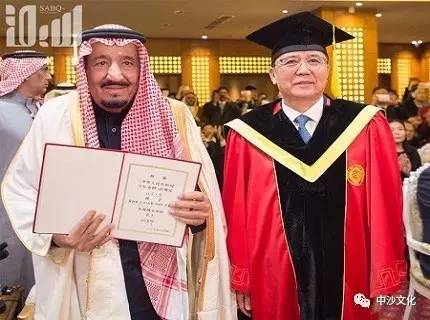
King Salman launches library at Peking University

Arab News — Saturday 18 March 2017

Beijing: King Salman today launched the King Abdulaziz Public Library at Peking University, which granted him an honorary doctorate. Upon arrival, the king was received by Chinese Education Minister Chen Baosheng and a number of officials. The university president delivered a speech in which he welcomed King Salman, saying the library opening enhances bilateral relations. The monarch watched a documentary film about the library and its role in publishing scientific and cultural literature in various languages. He delivered a speech in which he expressed pleasure at visiting Peking University, and thanked it for the honorary doctorate.

READ MORE.....

King Salman was awarded the honorary doctorate of Peking University

萨勒曼国王被授予北大荣誉博士学位,并为沙方捐赠北大的图书馆揭牌 
在沙特具有影响力的“赛拜阁”(先驱)电子报今日连发几篇新闻稿集中报道本次萨勒曼国王对中国的国事访问情况;其中,第一篇题为:
“抢先看位于中国的阿卜杜·阿齐兹国王公共图书馆”
        报道了位于中国北京大学内的“阿卜都·阿齐兹国王公共图书馆”为迎接萨勒曼国王参加揭牌仪式而做的相关准备工作。
       报道还称:“位于北京大学的阿卜杜·阿齐兹公共图书馆是第一个在亚洲建立的图书馆分部,这有力地推动了沙中两国的文化关系的发展;千年以来,两国通过丝绸之路进行商业活动,一直延续到今天,尤其是最近四个世纪的交往,两国逐渐建立了全面的政治关系。”
第二篇题为:
“两圣地的仆人参加位于北京大学的阿卜杜·阿齐兹国王图书馆揭牌启动仪式,并授予了荣誉博士学位”
        文章报道:“今日,当萨勒曼国王一行到达位于北京大学的阿卜杜·阿齐兹国王公共图书馆参加揭牌仪式时,由中国教育部部长陈宝生,阿卜杜·阿齐兹国王公共图书馆的总馆长费赛尔·阿卜杜莱赫曼教授、北京大学党委书记郝平以及部分相关领导人员进行了欢迎仪式。
        随后,由国王亲自为图书馆揭牌,标志着正式启用。
下面是两篇文章的相关配图:


Mohammed Al Sudairi on China Saudi Arabia ties


As Saudi Crown Prince Meets Trump, King Salman Arrives in Beijing for Economic Talks

by Frances Martel

BREITBART NEWS - 15 Mar 2017 

King Salman of Saudi Arabia has departed Japan and arrived in Beijing where he and President Xi Jinping are expected to discuss expanding economic ties between their two nations, shortly after Deputy Crown Prince Mohammed bin Salman completed his visit to the White House Tuesday.  King Salman will stay in Beijing for three days, according to the Chinese Foreign Ministry, and meet with Xi as well as Premier Li Keqiang and National People’s Congress (NPC) Chairman Zhang Dejiang. “China attaches great importance to the friendship and cooperation with Saudi Arabia,” Foreign Ministry spokeswoman Hua Chunying told reporters on Tuesday. “We stand ready to take King Salman’s visit as an opportunity to take China-Saudi Arabia comprehensive strategic partnership to a higher level.”  While King Salman’s visit to Tokyo involved an honorific meeting with Emperor Akihito, the Chinese hope to use his presence to strengthen their foothold in the Middle East. Chinese state media outlets are heralding the visit as a chance for China to take over what was once considered America’s market to exploit.

READ MORE.....

China, Saudis to Discuss CIC, CNPC Investment in Aramco IPO

Bloomberg News March 16, 2017

China’s in talks with Saudi Arabia for its sovereign wealth fund and largest energy company to invest in the initial public offering of the Middle East nation’s state oil producer, according to people with knowledge of the matter.
The nation’s $814 billion China Investment Corp. would be the principle investor in the planned flotation by Saudi Arabian Oil Co., according to the people, who asked not to be identified because the talks are private. China National Petroleum Corp. may also invest in the IPO, they said. No formal agreement has been reached, according to the people.
Saudi King Salman bin Abdulaziz is visiting Beijing this week as the world’s biggest oil exporter gears up for what may be the largest-ever initial public offering. Hong Kong is among markets including London, New York, Singapore and Tokyo that have been identified as possible venues for the sale of 5 percent of the company, which is valued between $400 billion and $2 trillion.
China, the world’s biggest energy user, is growing more reliant on overseas crude as its domestic reserves dwindle and economic growth spurs higher demand. President Xi Jinping said in a meeting with King Salman that the nations should step up energy cooperation, Xinhua News Agency reported Thursday, adding that the countries signed $65 billion worth of memorandums of understanding during the visit.

READ MORE.....

Thursday, March 16, 2017

China-Turkey Relations Grow Despite Differences over Uighurs

By Giorgio Cafiero and Bertrand Viala

MEI | Mar 15, 2017

Since the failed coup attempt of July 15, 2016, Turkey has been looking east for new partners to decrease Ankara’s dependence on traditional Western allies. The election of Donald Trump has contributed to the further estrangement of Turkey’s relationship with its traditional NATO allies, leaving Ankara less comfortable remaining so reliant on Washington for regional security matters. Unquestionably, Russia has played the most influential role in Turkey’s strategic pivot of the past eight months. However, China also factors into Turkey’s eastward shift.
Despite China not being one of Turkey’s major trading partners in the 20th century, Sino-Turkish relations have grown significantly since Turkey’s Justice and Development Party (A.K.P.) came to power in 2002. At that time, bilateral trade was roughly $1 billion; last year that figure reached $27 billion. As the A.K.P. has sought to continue strengthening Turkey’s relationship with China, the party’s ideology and domestic political agendas have at times constrained the potential for Ankara and Beijing to deepen their links. Specifically, tensions between the Chinese government and the country’s Muslim-practicing Uighur minority in Xinjiang have fueled problems in Sino-Turkish relations. Yet at this point, given Ankara’s interest in diversifying its web of partners on the international stage, it appears that the A.K.P. leadership has taken stock of China’s value to Turkey and has decided to tone down its public displays of solidarity with the Uighurs.

READ MORE....

Saudi visit opportunity for closer China ties

By Ding Long

Global Times - 2017/3/16

Saudi King Salman bin Abdulaziz Al Saud arrived in Beijing on Wednesday, embarking on a four-day state visit to China. China is one of six countries - the others are Malaysia, Indonesia, Brunei, Japan and the Maldives - on King Salman's 31-day Asian trip, a signal that Saudi Arabia is turning to the East for diversification.  Strengthening economic cooperation and political relations with East Asian countries is the primary goal of King Salman's trip. The Saudi economy relies heavily on oil revenues, which account for 40 percent of the economy, 80 percent of fiscal income and 90 percent of export value. But the oil price slump caused the country to run high deficits of $98 billion and $79 billion in 2015 and 2016, respectively. Moreover, the world economic downturn, rise of new energy, failure to curb oil output and other factors are expected to restrain any oil price rebound in the long run.  What's more disturbing is that with the increasing energy independence in the US, except for a small amount of oil products, the US is no longer in need of Saudi oil, which has weakened the longstanding security relationship between the two countries. At the same time, Saudi Arabia has been losing the European energy market as a result of the increasing marketing efforts made by Russia and other non-OPEC oil producers.

READ MORE.....

Saudi-Chinese ties get a fillip with King’s historic visit

SAUDI GAZETTE - March 16, 2017

Beijing — Custodian of the Two Holy Mosques King Salman arrived in China on Wednesday on an official visit.  The King was received at Beijing International Airport by State Councilor Yang Jiechi. A girl presented a bouquet of roses to the King.  King Salman will hold talks with Chinese President Xi Jinping and other senior leaders.  During the King’s stay, the two sides will discuss enhancing cooperation in areas such as culture, economy, trade, technology, security and defense.  They are expected to sign several agreements and memoranda on education, investment, transfer of technology, industry and trade.  Xi Jinping paid a state visit to Saudi Arabia in January 2016, during which the two countries enhanced their ties to a comprehensive strategic partnership.  Saudi Arabia is one of the first countries that have responded positively to China’s Belt and the Road Initiative, which was proposed by Xi in 2013 with an aim to build a trade and infrastructure network connecting Asia with Europe and Africa along the ancient Silk Road trade routes by land and sea.

READ MORE.....

Analysis: China and Saudi Arabia: Reinvigorating ties

Naser Al-Tamimi

ARAB NEWS | Thursday 16 March 2017

At the invitation of Chinese President Xi Jinping, Saudi Arabia’s King Salman is paying a state visit to China. The visit by the monarch, arguably the most strategically significant leg of his month-long Asia tour, comes as Riyadh has boosted its efforts to diversify the economy away from oil dependence, and broaden the Kingdom’s foreign partners. Although energy and trade will likely occupy an important place in the talks between the two leaders, the relations between both countries have expanded in various fields, especially in defense and security.

READ MORE....

China, Saudi Arabia sign 14 cooperative pacts

Xinhua| 2017-03-16

BEIJING, March 16 (Xinhua) -- China and Saudi Arabia signed 14 cooperative agreements during a visit by Saudi King Salman bin Abdulaziz Al Saud, said Chinese Vice Foreign Minister Zhang Ming on Thursday.  Chinese President Xi Jinping and King Salman attended the signing ceremony after their talks at the Great Hall of the People in Beijing.  Those agreements covered a wide range of cooperation areas, said Zhang, noting that a memorandum of understanding on production capacity and investment cooperation between the two governments worth about 65 billion U.S. dollars involves 35 cooperative projects.  The King is paying a state visit to China from March 15 to 18 as a guest of Xi.

President Xi and Saudi King Salman oversee signing of deals worth US$65 billion

CGTN -  2017-03-16

Chinese President Xi Jinping held a welcoming ceremony for King Salman bin Abdulaziz Al Saud of Saudi Arabia at the Great Hall of the People in Beijing on Thursday. The two heads of state oversaw the signing of deals worth potentially 65 billion US dollars.
At the invitation of Xi, King Salman is paying a state visit to China from March 15 to 18. The visit comes after Xi’s state visit to Saudi Arabia in January 2016, when the two countries established a comprehensive strategic partnership, “injecting new impetus into the China-Saudi Arabia relations in the new era,” Chinese Foreign Ministry Spokesperson Hua Chunying said at a press conference on Monday.
 

Wednesday, March 15, 2017

Saudi-Chinese joint ventures expected to be formed during king’s visit

Rodolfo C. Estimo Jr. 

ARAB NEWS - Saturday 4 March 2017

RIYADH: Top Saudi businessmen have expressed optimism that joint ventures or partnerships could be formed with Chinese counterparts during King Salman’s visit.
Sheikh Abdullah Al-Meleihi, board member of the Council of Saudi Chambers of Commerce and Industry, said 65-70 businessmen will join the king’s entourage during his trip, and they are looking forward to forming industrial partnerships with Chinese counterparts.
He said King Salman is expected to visit China, the world’s second-biggest economy, in mid-March. From there, he will proceed to Japan, Brunei and Jordan, where he will attend the Arab League Summit. Last Thursday he was in Indonesia, and before that Malaysia.

READ MORE.....

King Salman visits China, his fifth Asian destination

Al-Arabiya - March 15, 2016

King Salman arrived to China on Wednesday, his fifth destination in the historic trip to Asia.  The Saudi King concluded his visit to Japan by attending the closing session of the Forum on the Business vision between Saudi Arabia and Japan 2030 organized by the Saudi trade and investment system and the Japan Cooperation Center for the Middle East.  The forum discussed ways to achieve the emerging executive programs emanating from the kingdom vision 2030, and to promote trade and investment between Saudi Arabia and Japan.  The Forum discussed enhancing the volume of trade and investment between the two countries in the presence of a large number of Saudi and Japanese businessmen.  Saudi King Salman bin Abdul-Aziz and the Prime Minister of Japan Shinzo Abe also attended the signing of notes and program of cooperation between the governments of Saudi Arabia and Japan in the field of industrial revolution. They also signed a Memorandum of Cooperation on the implementation of the Japanese Saudi Vision for 2030.  Next, the Saudi delegation will head to China, the fifth destination of King Salman’s historic Asian tour.

READ MORE....

Saudi King begins first official visit to China


Saudi King Salman launches investment drive with Asia tour

The Gulf Times - February 24 2017

* King seeks to bolster economy, defence ties
* Asia is top buyer of Saudi oil
* Riyadh courts Asian investors in Aramco IPO
* King seeks to boost counter-terrorism cooperation
Saudi Arabia's King Salman starts a month-long Asian tour on Sunday to build ties with the world's fastest growing importers of Saudi oil and promote investment opportunities, including the sale of a stake in its giant state firm Saudi Aramco.
The octogenarian, who has overseen the launch of an ambitious economic reform plan since his accession two years ago, is expected to visit Malaysia, Indonesia, Japan and China.
In a sign of the importance which the kingdom places on strengthening economic ties with Asia, Indonesian officials say Salman will be accompanied by a 1,500-strong entourage including 10 ministers.
Energy Minister Khalid al-Falih and Aramco executives will travel with him, sources told Reuters, on the king's first trip outside the Middle East and North Africa since he visited the United States in 2015.
Saudi officials are keen to court Asian investors for the sale of a 5 percent stake in Aramco in 2018, which is expected to be the world's biggest IPO, and have solicited financial advice from banks with links to China.

READ MORE.....

King Salman Arrives in China

Peninsula Qatar -  15 Mar 2017

Beijing: The Custodian of the Two Holy Mosques King Salman bin Abdulaziz Al Saud of Saudi Arabia arrived in the People's Republic of China Wednesday on an official visit.
The Custodian of the Two Holy Mosques was received at Beijing International Airport by State Councilor Yang Jiechi, (SPA) news agency reported.

Saudi king arrives in China

Gulf Digital News March 15, 2017 

Saudi King Salman bin Abdul-Aziz Al Saud arrived in China on an official visit. He was received on arrival at Beijing International Airport by State Councillor Yang Jiechi.
The Saudi monarch was presented with a bouquet of roses as a group of children lined up to welcome him. King Salman was also received by Saudi Ambassador to China Turki bin Mohammed Al Madhi, ambassadors of Arab countries, and members of the Saudi embassy in Beijing.
The King was accompanied by Minister of State Dr Ibrahim bin Abdul-Aziz Al Assaf, Minister of Economy and Planning Adel bin Mohammed Faqih, Minister of Labour and Social Development Dr Ali bin Nasser Al Ghafis, Minister of State for Foreign Affairs Dr Nizar bin Obaid Madani and other officials.


Saudi King begins first official visit to China

CGTN - 2017-03-15

Saudi King begins first official visit to China POLITICS By Xu Han  2017-03-15 21:22:03  Share Like Btn Saudi Arabia's King Salman is in Beijing for an official visit that will last until Friday. He came at the invitation of President Xi Jinping.  Salman is the 25th son of the desert kingdom's founder, Abdulaziz bin Saud. In 1963, Salman became governor of the Riyadh Province, a post he held for nearly five decades. In June 2012, he was appointed crown prince. He also held the post of deputy prime minister while serving as defense minister. On January 23, 2015, Salman, then 79, became the kingdom's seventh ruler.  During his three days in Beijing, Salman is expected to hold meetings on the oil industry and on China's Belt and Road initiative. The monarch began his Asia Pacific tour late last month to cement economic ties in the region. He was in Japan before heading to China.

Belt and Road Initiative helps Saudi Arabia realize "Saudi Vision 2030" -- ambassador

Xinhua| 2017-03-14

BEIJING, March 14 (Xinhua) -- The China-proposed Belt and Road Initiative is expected to make "creative" contributions to helping Saudi Arabia realize its "Saudi Vision 2030" plan, Saudi Ambassador to China Turki Bin Mohamed Al-Mady has said.  "Saudi Arabia attaches great importance to China's Belt and Road Initiative," Al-Mady told Xinhua in a recent interview, referring to the initiative proposed by Chinese President Xi Jinping in 2013 aimed at building a trade and infrastructure network connecting Asia with Europe and Africa along the ancient Silk Road trade routes.  "Both countries have great potential, whether in infrastructure construction or in financial innovation," he added.  In a bid to diversify its heavily oil-dependent economy, Saudi Arabia announced a "Saudi Vision 2030" growth strategy last year, which includes privatizing some state-owned companies.  Saudi King Salman bin Abdulaziz Al Saud will pay a state visit to China from Wednesday to Saturday after Xi paid a state visit to Saudi Arabia in January 2016, during which both nations agreed to lift their relations to a comprehensive strategic partnership.  During the king's visit, the two sides will discuss enhancing cooperation in areas such as culture, economy, trade, technology, security and defense. They are expected to sign several agreements and memoranda on education, investment, transfer of technology, industry and trade.

READ MORE.....

Strange Bedfellows: Xi, the CCP and the House of Saud

 Chris Zambelis

THE NEW LENS - 2017/03/08

While the wider Middle East remains convulsed by conflict and instability, China’s influence and interests in the region continue to expand in a familiar pattern. As the world’s largest consumer of energy overall and the world’s second biggest importer of crude oil, China’s Middle East policy continues to be driven by the need for secure sources of energy. The China National United Oil Company (Chinaoil), a joint subsidiary of China National Petroleum Corporation (CNPC) and Sinochem Corporation, alone purchased 7 million barrels of Middle East crude in January 2017 (Yibada.com [New York City], Feb. 5). Unsurprisingly, China’s closest partner in the Middle East, Saudi Arabia is home to roughly 18 percent of the world’s total oil reserves and is the world’s top exporter of crude. The two countries’ relationship was solidified in 2009 when China surpassed the United States as the top destination of Saudi oil exports. Although Russia overtook Saudi Arabia as China’s number one supplier of oil in 2016, China’s reliance on Saudi oil will remain central to its energy security calculus (Gulf Business [Dubai], Jan. 17).

READ MORE....