Tuesday, July 19, 2016

Conference: The Middle East at Strategic Crossraods II - JULY 20-21, 2016 - SHANGHAI INSTITUTES FOR INTERNATIONAL STUDIES


处于战略十字路口的中东:携手应对挑战
THE MIDDLE EAST AT STRATEGIC CROSSROADS II:
JOINT EFFORTS TO DEAL WITH CHALLENGES
上海国际问题研究院 主办
上海国际战略问题研究会 协办
HOSTED BY
AND ASSISTED BY
SHANGHAI INSTITUTE OF INTERNATIONAL STRATEGIC STUDIES (SIISS)

JULY 20-21, 2016
VENUE: SIIS BUILDING

July 20, 2016 (WEDNESDAY)
Participants check in at Ramada Shanghai Caohejing
Address: 509,Caobao Road,Shanghai,China  Post code: 200233 

July 20
18:30 Dinner hosted by Prof. Wu Chunsi and Prof. Li Weijian
(外地和北京学者)
Ramada Shanghai Caohejing

July 21 (THURSDAY)
8:40: Participants lodged in Ramada wait in the hotel lobby and leave for SIIS Building
u  9:00—9:10  Opening Remarks
Moderator: Prof. Wu Chunsi
Prof.Yang Jiemian, President Emeritus of SIIS

9:10—10:30
Session I: The Middle East situation in general
Moderator: Prof. Yang Jiemian
10 minutes for each speaker.
Speaker
Ø  Amb. Gao Youzhen: Some personal observations on current Middle East political and security situation
Ø  Mr. Liviu Muresan: The agents of changes: China as a co-interested security provider in the MENA region
Ø  Prof. Liu Zhongmin: Three Development Trends  of Islamic Forces in the Middle Eastern Politics
Ø  Dr. Mohsen Shariatinia: Iran's priorities in a changing middle east"
Free discussion

10:30—11:00  Coffee Break
11:00—12:00  Session II The Roles of External Powers in the Region
ModeratorProf. Li Weijian
10 minutes for each speaker.
Speakers
Ø  Prof. Sun Degang: China’s Even-handedness in the Gulf Security: From the Gulf War to Iran-Saudi Discord
Ø  Prof. Steven Blockmans: The EU and the Middle East: what role for an actor that seems to recoil from geopolitics?
Ø  Ms. Meena Singh RoyIndia and the Gulf Region: Protecting Economic Interests and Building Strategic Partnerships
Ø  Dr. Andrey Baklitsky: Russia in the Middle East: from a backbencher to a trendsetter
Free discussion

12:00—13:30  Working Lunch
13:30—15:00 Session IIIThe Prospects of Middle East Hotspots
Moderator: Prof. Sun Degang
10 minutes for each speaker.
Speakers
Ø  Prof. Tang Zhichao: The future of Turkey after the military coup
Ø  Prof. Seyed Mohammad Marandi: Wahhabism, Brexit, and Blowback
Ø  Dr. Tugrul Keskin: Pan-Turkism to Localization: Sociological Origins and Political Transformation of the Nationalist Movement Party (MHP) in Turkey
Ø  Qin Tian: Removing Sanctions on Iran: the process and the obstacles
Ø  Dr. Jin Liangxiang: The nuclear issue and the prospect of Iran’s reintegration into international system

15:00—15:30 Coffee Break
15:30—17:00 Session IV
New Features of Middle East Terrorism and the Challenges
Moderator: Wu Chunsi
10 minutes for each speaker.
Speakers
Ø  Prof. Wang Jian: New Characteristics of terrorism in the Middle East
Ø  Mr. Mohammed Al-Sudairi: The New Eastern Frontier of the Da'wah
Ø  Prof. Tian Wenlin: The Issue of the Islamic State
Ø  Mr. Sajjad MalikThe Syrian cauldron: Implications of extremists’ involvement in the conflict
Ø  Dr. Bao ChengzhangChanging Tactics and Current Trends of the “Islamic State”
Free Discussion

17:00-1720 Concluding remarksProf. Wu Bingbing

18:00—19:00 Dinner hosted by President Emeritus Yang Jiemian
            (外国和北京学者)
Ramada Shanghai Caohejing

19:00 Participants Start to leave Shanghai

Participants Name List
International Participants
1.      Andrey Baklitsky , "Russia and Nuclear Nonproliferation" Program Director, PIR Center
2.      Liviu Muresan, Executive President, EURISC Fund, Romania
3.      Meena Singh Roy, Research Fellow & Coordinator West Asia Centre, Institute for Defence Studies and Analyses
4.      Mohammed Al-SudairiResearch Fellow, King Faisal Center for Research and Islamic Studies (KFCRIS), Saudi Arabia
5.      Mohsen Shariatinia, Assistant Professor of International Relations, Institute for Regional Studies, Shahid Beheshti University
6.      Prasant Tripathi, Indian Consul, Consulate of India to Shanghai
7.      Sajjad Malik, PHD candidate, National Defense University of Pakistan
8.      Seyed Mohammad MarandiProfessor of Tehran University
9.      Steven Blockmans, Senior Research Fellow & Head of the EU Foreign Policy Unit, Centre for European Policy Studies; Professor of EU External Relations Law and Governance, University of Amsterdam
10.   Tugrul Keskin, Assistant Professor of Political Science and International relations at Maltepe University, Turkey

Participants from Beijing
1.      Gao Youzhen, Former China’s Ambassador to Qatar
2.      Tang Zhichao, Senior Research Fellow, China Academy of Social Sciences
3.      Wu Bingbing, Senior Fellow, Institute for International and Strategic Studies, Peking University; Deputy Dean and Professor, Department of Arabic, Peking University
4.      Tian Wenlin, Senior Fellow with China Institute for Contemporary International Relations
5.      Qin Tian, Research Fellow with China Institute for Contemporary International Relations

Participants from Shanghai
6.      Wang Jian, Senior Fellow, Shang Academy of Social Sciences
7.      Liu Zhongmin, Director and Professor, Institute for Middle East Studies, Shanghai International Studies University (SISU)
8.      Sun Degang, Deputy Director and Professor, Institute for Middle East Studies, Shanghai International Studies University
9.      Bao Chengzhang, Research Fellow, Institute for Middle East Studies, SISU

SIIS Participants
10.   Yang Jiemian, President Emeritus and Senior Fellow of SIIS, and President of Shanghai Institute of International Strategic Studies (SIISS)
11.   Wu Chunsi, Director and Senior Fellow, Institute for International Strategic Studies, SIIS, and Secretary General of Shanghai Institute of International Strategic Studies (SIISS)
12.   Li Weijian, Senior Research Fellow of SIIS
13.   Jin Liangxiang, Research Fellow of SIIS
14.   Liu Xin, Research Fellow of SIIS
15.   Zhang Weiting, Research Fellow of SIIS
16.   Song Qing, Research Fellow of SIIS
17.   Zhou Yiqi, Research Fellow of SIIS

Saturday, July 9, 2016

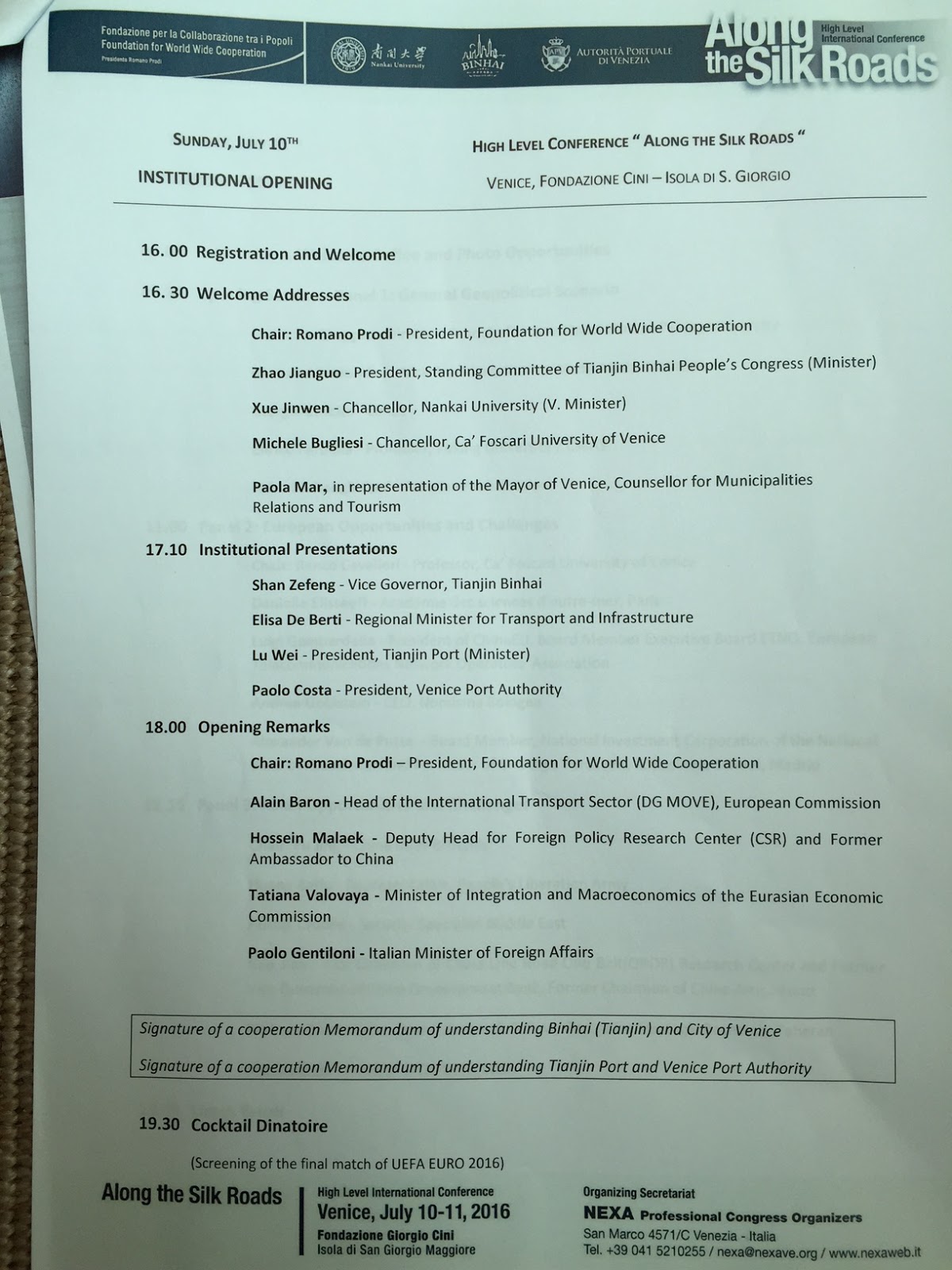
INTERNATIONAL CONFERENCE THE NEW SILK ROAD: CHALLENGES AND OPPORTUNITIES - Venice, Giorgio Cini Foundation, July 10 - 11 2016

The “One Belt One Road”(OBOR) policy, announced By President Xi Jinping, in September 2013 during a visit  in  Kazakhstan,  if  successful,  will  change  economic  and  strategic  equilibria  b etween  Asia  and  Europe  and  could have effects also on Africa.  OBOR puts under common Umbrella huge investments on Railways and Maritime infrastructure.  There are challenges and opportunities both for China and Europe, however to be really successful, there is a need of mutual understanding and cooperation between the two sides.  The Conference aims at putting together the Chinese and the European vision. Speakers will discuss on several issues:  How OBOR will affect international relations between countries and regions and how existing conflicts and destabilized areas could put at risk infrastructure investments? What about the economic impact of these investments looking at it from both the European and Asian perspective? How new railways and maritime routes and ports could  change  trade  flaws  and  affect  competiveness  of  countries, regions but also of existing infrastructure? To enrich the discussion think tanks and members of several institutions both from China, Asian and European countries are involved.

CONFERENCE PROGRAM


‘Belt and Road’ initiative must work on sustainability of projects by Liu Zongyi

From the Global Times 2016-06-26

The "Belt and Road" (B&R) initiative is the top-level design of China's opening-up and economic diplomacy in the new era. In China, it's a domestic development strategy aimed at poverty reduction and the development of central and western regions; but for the rest of the world, it's an open and inclusive initiative, sharing common ideas and a goal with the 2030 Agenda for Sustainable Development. Infrastructure construction is one of the core contents of the initiative, and also one of UN Sustainable Development Goals and the goals of the G20. When we talk about sustainable infrastructure development, in general we always think of ecological and social sustainability. But in fact, we need more conditions to achieve sustainable infrastructure development. The advancement of the B&R initiative will promote regional economic integration and bring prosperity. But it's evident that it faces instability that includes terrorism and geopolitical suspicion. Thus, for the B&R intiative, sustainable infrastructure development needs sustainable international and regional peace and stability, and sustainable regional economic cooperation. To realize and maintain regional peace and stability, G20 countries should coordinate and cooperate. Meanwhile, China hopes to synergize different countries or regional development plans along the belt and road. G20 countries should promote coordination and cooperation and set up common infrastructure standards to improve infrastructure construction and investment. Countries that receive B&R investment should be politically stable and capable of governing, which is one of the reasons that East Asian countries enjoyed fast economic growth and a large amount of FDI in the past decades. And they should have stable, sustainable and clear development policies that make foreign investors feel at ease. As for ecological and social sustainability, countries along the belt and road can enact laws and regulations according to international norms and their own reality, and ask foreign investors to abide. Ecological and social assessment can be undertaken by a third party. But the country should not break contracts for political reasons, and investors should enjoy the right to defend the safety of investment through international investment dispute settlement mechanisms. Now some international organizations are thwarting B&R infrastructure projects by using so-called ecological and social problems. The G20 should coordinate domestic investment policies of its members and set up a model for other countries. The sustainability of financial support is key. It can be divided into two sides: First, it's necessary to get various and sufficient financial support for infrastructure construction; second, the budget sustainability of the investment receptor, which means FDI should enter countries progressively but not instantly.
But how to get various financial support?
The government should play the leading role, adopting smart financing methods and enhancing public-private cooperation. The Asian Infrastructure Investment Bank (AIIB) and New Development Bank (NDB) can provide finance to B&R projects. All the members of the G20 should accept AIIB and NDB as a part of multilateral development network and stable resources of finance and knowhow similar to the World Bank and the Asian Development Bank. Lastly, the sustainability of infrastructure planning and design is also vital. The parties concerned should adopt a hollistic approach to solving bottle-neck infrastructure problems. The planning and design of infrastructure should carry out an integrative design according to local natural characteristics to achieve the construction of low-carbon infrastructure, ecological preservation and transportation links. To seek balance between short-term and long-term economic achievements, we should not only promote the service efficiency and utilization efficiency of infrastructure, but also keep in mind the development of the next decades, reserving spaces for necessary infrastructure upgrading. This requires us to deal with the contradiction between the short-term political tenure and long-term national development goals.

China’s Foreign Policy under President Xi

Yang Jiemian

Jiemian YANG’s Dinner Keynote Speech at the East Asian Partners Dialogue on Latin American Studies Co-Sponsored by the China Academy of Social Sciences, the Shanghai Academy and the Shanghai Institutes for International Studies on June 15, 2016
Mr. Xi Jinping became the CPC Secretary General in November 2012 and the PRC President in March 2013. In the past three years and more, China’s Foreign Policy under President Xi is both a continuity of the past and a change of the present with a view to the future developments. Here I would like to share some of my personal thoughts on the following four points: 1. Internal and External Contexts; 2. Theories and Strategies; 3. Policies and Actions; and 4. Difficulties and Challenges.
1. Internal and External Contexts
President Xi’s Foreign Policy is basically determined by both internal and external contexts. However, different leadership has its different imprints on foreign policy because of different perception, judgment and reaction.
1.1. Internal drivers for China’s foreign policy. Someone said that President Xi knows what China wants. I would put it into three groups of driving forces. Firstly, it is to strive for China’s rejuvenation and modernization. It includes economic development and defense development. Secondly, it is to pursue a better and fairer society. It is more of political and social goals. Thirdly, it is to work at a role consistent with China’s history, population and comprehensive national strength.
1.2. External Drivers. On its own initiative, China’s international positions and roles are greatly increasing. China has a built-in urge for further reform and opening up so as to go with the on-going globalization and information age. Moreover, China is more proactive in participating and promoting global governance and regional cooperation. On the outside pushers, the re-configuration of world powers is in favor of the emerging powers including China. The international community lays greater hope on China’s contribution to the peace and prosperity of the world. The West, especially the United States has heightened its strategic vigilance on China’s rising.
2. Theories and Strategies
President Xi attaches particular importance to diplomatic theory and strategy. He stresses that China’s foreign policy should be guided by the right theory and strategy. Conversely, China’s foreign policy practice should conscientiously be crystallized into theory and strategy.
2.1. Features of President Xi’s Diplomatic Theory. President Xi’s diplomatic theory is based on the basic theory of China’s overall political thinking and foreign relations principles.
Firstly, President Xi emphasizes on diplomatic philosophy that is to learn to summarize the laws and rules of developments by right positions and methodologies, especially historical and dialectical materialism. Therefore, China’s diplomatic theory is characterized with long-term vision and broad thinking of the world. China’s overall framework of the worldview is the general point of departures and arrivals.
Secondly, President Xi learns hard the fine tradition of Chinese history and cultures and adapts them to the present and future realities. Both late Chairman Mao Zedong and President Xi like to quote Chinese ancient sayings. However, Mao’s quotations are often related to political struggles but Xi’s emphasis is more on good governance and friendly neighborhood. That President Xi inherits and carries forward the Chinese culture can basically be summed up as building of fairer and better off Chinese societies, peace loving and peace defending, and orderly human community.
Thirdly, President Xi works out a number of new concepts in line with the new developments, such as right approach between virtue and interests, new type of international relations based on win-win cooperation, new model of major country relations. In a longer run, President Xi also wants to put these pieces of concepts into more systematic theories. Furthermore, Xi’s theoretic concepts are more constructive and converging to the rest of the world.
2.2. Features of President Xi’s diplomatic strategies. Strategy is a frequent reference in President Xi’s speeches and statements. Under him, more strategic elements have been added to the domestic, regional and global dimensions of China’s diplomacy.
First of all, President Xi is a man of strategy, partly attributable to his family and personal backgrounds of long evolving in China’s politics and militaries, but more because of China being at a historical turning point. Upon approaching to the center-stage of the world, China needs more strategic thinking, top-level planning and bottom-line clarity. President Xi also put forth a number of strategies of global, regional and bilateral affairs such as Belt and Road Initiative and China-Latin America and the Caribbean relations.
Secondly, President Xi’s strategy is characterized by holistic and dialectic thinking. President Xi puts all the major events and issues under broader framework of thinking, if not globally at least regionally. He also likes to deal with these events and issues in an integrated way. In the past three years, China has already convened two important national conferences on foreign strategies and policies. One is working conference on neighborhood diplomacy in October 2013. The other is Central Working Conference on Foreign Affairs in November 2014. Both of them are of great strategic significance on China’s foreign policy. As a matter of fact, they set the tone and guide the general direction of China’s diplomacy at least for the first term.
Thirdly, President Xi’s strategies are made up by both thematic diplomacy and country/regional one. China used to focus on diplomatic work towards countries and region. They are still the foci. China’s respective diplomacy is now more of global and multilateral, regional and interregional contents. In January 2015, President Xi Jinping attended in Beijing the opening ceremony of the first ministerial meeting of the Forum of China and the Community of Latin American and Caribbean States (CELAC), thus giving a final touch to the all-coverage of China’s cooperative mechanisms with all the developing regions. Additionally, China has recently developed thematic strategies in world economy, climate change and new commons. These are the new developments of China’s strategy to global governance and international system.
3. Policies and Actions
Policies are the actual carriers for translating theories and strategies into realities. Foreign policies and actions catch the most attentions of the media and people. Obviously, President Xi’s foreign policies and actions have already made them prominent among the contemporary ones.
3.1. Clear and Determined. Compared with his predecessors, President Xi’s foreign policies and actions are more of a global power’s approaches and styles.
Firstly, they are clear in purposes, visions and missions. President Xi repeatedly stresses that China’s foreign policies should show its major power’s responsibilities. He has made many speeches covering almost all the realms of global affairs and China’s diplomacy. Moreover, he is a man of action. Under his leadership, China initiated the BRICS New Development Bank and Asian Infrastructure Investment Bank, enhanced its support to the UN Peace-Keeping and other expenditures, and offered substantive assistance to the developing countries, especially the least developed countries (LDCs).
Secondly, they are firm and determined. Once President Xi and his colleagues have made the decisions, they will relentlessly promote and advance them. China is firm for a relation with the United States on the equal footing. China is determined to safeguard its rights in the South China Sea. China goes all out for maintaining stability. All are very much indicative of these features.
Thirdly, they are more predictable. President Xi is a straightforward person and he calls a spade a spade. According to his Selected Works and public speeches, one is not difficult to conclude what he wants to do and what he opposes to. For instance, President Xi’s attendance of UN Summits and Paris Conference on Climate Change in September 2015 show clearly what China want to shoulder the responsibilities in global governance and international system.
3.2. Pragmatic and Economic-Oriented. China is still a developing country and its strength mainly lies in the field of economics. However, China has greatly enhanced its economic clouts and upgraded its economic ladders. Therefore, China tries to effectively use the economic leverage to promote its foreign policy. For instance, China’s relations with the Latin American countries are mostly in the economic field. Another instance is China’s four partnerships with Europe for reform, growth, peace and civilization. Mostly they are of economic nature again.
3.3. Low-Politics and Public Diplomacy. China has attached greater importance to the low politics and public diplomacy. President Xi stresses people-to-people exchanges and calls for greater roles of think tanks.
4. Difficulties and Challenges
Foreign policy goes beyond one’s own country and is affected by both domestic and international factors. President Xi’s foreign policy is also confronted with many difficulties and challenges, some of them are profound ones. Particularly the following four merit our special attention.
4.1. The first is the limits. There is still a big gap between China’s goals and capabilities in foreign policy. Firstly, it is the hard power. In terms of domestic strength, China is about 75th place in the world according to per capita in 2015. In terms of comprehensive national strength, China is still lag behind in many fields such as science, technology and military. In many cases China ranks high in the production volume but low in the qualitative terms. Secondly, it is the intellectual and cultural power. In Chinese we say Mao Zedong lifted China out of a weak position being beaten, Deng Xiaoping the poor position being starvation, and it is still expected that Xi Jinping out of the position being scolded.  Thirdly, it is the institutions and mechanisms. China is a late and new comer at the institution and mechanism building of the international community. It is inexperienced and lacks accumulation of theories, talents and practices. The most obvious example is that China hosts no substantive Asian organizations of the United Nations, although China is the most important Asian country.
4.2. The second is priorities. For an administration that is expected to serve for two terms, President Xi has put forward a long list of domestic and foreign agendas for the years between 2013 and 2020. Some are long term and grandiose ones such as China Dream, Two Centennials and Belt and Road Initiative. Some are tough ones such as China-U.S. relations and South China Sea disputes. Therefore, these agendas and goals should be prioritized and focus on those that are doable and reachable ones.
4.3. The third is capacities. On the one hand, it is important to make full use of the existing and potential capacities. China needs to further modernize its foreign policy institutions and mechanisms so as to change the ad hoc capacities to institutional ones. On the other hand, China should proceed with its future capacity building, especially on global governance, international system and order, civil society and new science and technologies.
4.4. The fourth is publicities. Publicities here mean the following three dimensions. Firstly, China needs to make its own house in good order. Domestic strength is the basis of any country’s diplomacy. China needs to maintain its economic dynamism and social vitalities. Secondly, China needs to work harder and more effectively on the rights of discourses. Chinese narratives should be more understandable to the outside world and Chinese ways of thinking should be more accommodating with the whole world. Last but not least, China needs to adapt itself with the advancing of the times. Only holding the leadership in economics, science and technologies, political thinking and strategic leadership, can China succeed in garnering the global acceptance and support for its diplomacy.

Thursday, July 7, 2016

Why China's role is not very visible in the Middle East By Jin Liangxiang

China.org.cn, July 6, 2016

China's policy toward the Middle East is always discussed on different occasions. Though China has contributed many efforts to the resolution of major regional conflicts, it seems that China's role has never been sufficiently recognized. While American scholars would like to describe China as a free rider, analysts in the region would regard China as a business seeker. The reasons are actually very complicated.
The last 15 years have witnessed China playing a new constructive role in the Middle East within the new regional context. In September 2002, China appointed Ambassador Wang Shijie, a senior diplomat, as its first special envoy of Middle Eastern affairs. Since then, China has regularized its appointments of special envoys in the region. Until now, China has appointed four Middle East special envoys. The other three are Ambassador Sun Bigan, Ambassador Wu Sike and Ambassador Gong Xiaosheng.
In addition to envoys of Middle Eastern affairs in general, China also appointed special envoys for specific Middle Eastern issues. For instance, in 2007, 2014 and 2016, China appointed Ambassador Liu Guijin (& Ambassador Zhong Jianhua), Ambassador Sun Yuxi and Ambassador Xie Xiaoyan as special envoys respectively for the Darfur issue, Afghanistan issue and Syrian issue.
The above-mentioned appointments themselves indicate that China does attach great importance to regional issues, and does play significant roles in various regional issues though the effects might be different in different cases. In the Palestine-Israel conflict, China's role might be modest, but it does represent strong political support for the peace process. And China's mediating efforts in the Darfur issue paved the way for the soft landing of the crisis. China's special envoy on the Afghanistan issue also played a significant role in promoting relevant dialogue and reconciliation processes.
What's more, China also contributed to the Middle East economically as China has become a major economic partner of the region. China also provided military and security resources for the region in the form of UN missions.
So, why were China's efforts not sufficiently recognized? Or to put it another way, why is China's role not visible enough? The first reason should be the Western media's selective coverage of China's role in the region. Western media, particularly those of the United States, play leading roles in shaping global public opinion and even have strong influence in academic circles. Though they might be working for peace and stability in the region, their coverage remains biased.
They would like to cover more about the actions and behaviors of Western countries rather than those of non-Western countries, although it is not necessarily all positive. They have strong interest in covering the military actions of the West in the region while having little interest in reporting China's soft presence in the region despite the fact that China's economic contribution and mediating efforts do contribute to regional stability. What is even worse is that Western governments unfairly blame China for its reluctance to participate in military actions.
China's low level of visibility in the region can also be attributed to its unintentional and intentional low profile policies. Low profile policies have always been part of China's political culture. And the most famous motto in this regard should be the late Chinese leader Deng Xiaoping's warning in the early 1990s that China should be modest and prudent, keep a low profile and never seek hegemony.
It has already been a quarter century since Deng issued this warning, but it is still one of the major principles guiding China's overall policies, and China's policy toward the Middle East should be no exception. Though some scholars argue that China should take a more proactive policy as a result of its power increase, very few argue that China should give up its low profile policy in the Middle East.
To keep a low profile might also be China's policy option under the framework of the new type of relations among major countries. The new type of relations among major countries proposed by President Xi Jinping stands for non-confrontation among major countries at a strategic level, particularly between China and the United States.
China could be very easily regarded as an assertive or aggressive player by the United States in the Middle East if it keeps a high profile, despite the fact that the U.S. would always like to label China as a free rider. By the way, it is always difficult to please a leading power. It can easily find trouble with you whether you keep a low profile or high profile. A high profile can be regarded as a challenge while a low profile can be blamed for lacking initiative.
Though China will have to face up with blame and accusations no matter what it is doing in the region, Beijing might reasonably regard it as a cheap price to pay to keep a low profile. A higher price will always be waiting if someone is regarded as a potential challenge.
All in all, China's low visibility in the region is actually because of various complicated reasons. However, despite its low visibility, its contributions should not be neglected for any reason.
Dr. Jin Liangxiang is a columnist with China.org.cn.

Tuesday, July 5, 2016

Muslim Sanzijing: Shifts and Continuities in the Definition of Islam in China

Roberta Tontini, University of Heidelberg

Brill 2017

Monday, July 4, 2016

China and Qatar to build 11,000 residential units in Afghanistan

By Khaama Press - Thu Jun 30 2016

The construction work at least 11,000 residential units is expected to kick off in the near future with China to build the 10,000 units.
The Ministry of Urban Development Affair Syed Sadat Mansoor Naderi said Thursday that the construction work of 10,000 residential units will likely start in coming three months with the conclusion of a Memorandum of Understanding.
Naderi further added that the agreement for the construction of 1,000 residential units with Qatar has already concluded and the construction work is expected to start in the current solar year.
He was providing an update regarding the Ministry of Urban Development Affairs programs for the solar year 1395.
The construction of 10,000 residential units by China follows by a commitment made by the Chinese President during his to Kabul last year.

Amid glut of Chinese wares, Egypt merchants laud increased tariffs on imports

By Betsy Hiel

TRIBLIVE | Saturday, June 25, 2016

CAIRO — Shops in the medieval-era bazaar known as the Khan el Khalili are filled with reproductions of Egyptian artifacts and other souvenirs, brass lamps, colorful cloth and intricate jewelry, much of it handmade.  Off the bazaar's main street, where men sell restaurant equipment and food carts to street vendors, a workman hammers an enormous copper basin in a darkened stall.  Walid Abdel Gawad, 40, sits in his family-owned lantern shop. His stock includes elaborately designed lanterns traditionally sold and used during the Islamic holy month of Ramadan, when Muslims break their daylong fast at family or community feasts.  He expects business to pick up this season after years of struggling.

READ MORE....

China, Egypt zone in Tianjin to expand

By Zhang Min and Wang Yu

China Daily - 2016-06-28

As companies are embracing opportunities made possible by China's Belt and Road Initiative, a leading Tianjin firm is not lagging behind.  The China-Egypt Suez Economic and Trade Cooperation Zone, whose construction by TEDA Investment Holding Co Ltd began in 2008, is poised to kick off its second phase of expansion, said Zhang Bingjun, chairman of the board of TEDA Holding.  Zhang was speaking on the sidelines of the Summer Davos Forum in Tianjin.  The zone is located at the south end of the Suez Canal and the west coast of the Red Sea, 120 km from Cairo. Both governments have also pointed out that the site is at the intersection of the Belt and Road Initiative's footprint and the New Suez Canal Economic Corridor. In January, President Xi Jinping and his Egyptian counterpart Abdel Fattah el-Sisi unveiled the nameplate of the second stage of the project at the zone.  "After the second-phase expansion, the zone is expected to accommodate 200 enterprises, attract $3 billion in investment, and reach $10 billion in annual revenue," Zhang said.

READ MORE....

EgyptAir to run daily flight to Guangzhou city, China

EGYPT INDEPENDENT - Sat, 02/07/2016

Chairman & CEO of Egyptair Holding Company, Safwat Mosallam, has announced that the airline will be increasing the number of flights to China's Guangzhou city to one flight per day instead of five flights a week, as of next Tuesday.  Mosallam explained that the move reflects the importance of the Chinese market for the airline, with a significant amount of business and tourist traffic coming from China to Egypt. EgyptAir endeavors to provide a service that meets current demand.    The daily flight will be made by a Boeing B777-300ER, which can accommodate up to 340 passengers and is fitted with personal screens in each seat. Seats that become full-length flat beds are available in the first class section of the plane, for the long-haul flight.

READ MORE.....

Israeli startups pitch to China at virtual Tel Aviv roadshow

Omeq Medical, InovyTec among 10 medical device companies that presented at TechCode event

By Shoshanna Solomon

TIMES OF ISRAEL - June 29, 2016

Lior Margalit was not nervous, he said. He pitches his medical devices start-up, Omeq Medical, to investors all the time. This occasion was a bit different, though. He was going to present his company to about 50 Chinese investors sitting in three different cities via a conference call from an office on Tel Aviv’s trendy Rothschild Boulevard.

READ MORE...

Israel-China affair blooms even as culture gap weighs on rapport?

The Chinese seek a long-term relationship but Israelis ‘don’t want to spend time on you,’ says Chinese entrepreneur in Israel, ruefully

By Shoshanna Solomon

TIMES OF ISRAEL - June 7, 2016

In the past four years the romance between Israel and China has blossomed. More than 500 Chinese delegations visited Israel in 2015 and Chinese investment in Israeli companies and venture capital funds has surged to record highs. 
As the world’s second-largest economy shifts its focus from being a manufacturing and labor intensive economy to becoming a high-end innovative force, Asian giants including Alibaba Group, Hutchison Water Ltd., and Huawei have set up R&D centers, invested in funds and snapped up Israeli start-ups and companies.

READ MORE....

Daimler vows to take China off Iran roads

PRESS TV - Sat Jul 2, 2016

Daimler says its trucks division will start the deliveries of Mitsubishi Fuso brand in Iran later this year.   The German carmaker and Iran’s Mammut Group signed a distribution agreement for Fuso trucks, especially in the light-duty segment, back in January as the West lifted its sanctions on the Islamic Republic.  To redeem the lost ground in the reopened Iranian market, Daimler has to fight now-entrenched Chinese rivals, with trucks division head Wolfgang Bernhard saying the company will not cede business to the Chinese.   Two days after the lifting of economic sanctions against Iran in January, Daimler had signed letters of intent for the establishment of joint ventures in the Middle Eastern country.  Bernhard said Daimler’s market launch in Iran will initially begin with complete deliveries under the agreement signed between the two sides. 

READ MORE...

Iran, China to resume talks on Arak reactor modernization

PRESS TV - Mon Jun 20, 2016 

A senior Iranian official says Iran and China will resume negotiations on ways to modernize the Arak heavy water reactor.  Spokesman of the Atomic Energy Organization of Iran (AEOI) Behrouz Kamalvandi said on Monday that technical and legal experts of the body would hold talks with Chinese nuclear officials in Vienna later in the day, ISNA reported.  He added that the new round of the negotiations would be held as a follow-up to talks previously held between Iranian and Chinese delegations.  In August 2015, head of the AEOI, Ali Akbar Salehi, paid a visit to the Chinese capital of Beijing and discussed the setting up of a working group to redesign the Arak heavy water reactor.  The talks are in line with the nuclear agreement, known as the Joint Comprehensive Plan of Action (JCPOA), reached between Iran and the five permanent members of the UN Security Council – the United States, Britain, France, Russia and China – plus Germany on July 14, 2015.  After the JCPOA went into effect on January 16, all nuclear-related sanctions imposed on Iran by the European Union, the UN Security Council and the US were lifted. Iran, in return, has put some limitations on its nuclear activities.  During Chinese President Xi Jinping’s visit to Tehran in January, a nuclear agreement reached between Iran and China which included the modernization of the Arak heavy water reactor and the construction of 100-megawatt power plants.

READ MORE....

Saturday, July 2, 2016

China to Assist Israel in Construction of Island in Mediterranean Sea

China to Assist Israel in Construction of Island in Mediterranean Sea

China asks Turkey to properly handle anti-dumping investigation

Xinhua - 2016-07-01 

BEIJING, July 1 (Xinhua) -- The Ministry of Commerce (MOC) on Friday urged Turkey to be prudent in its investigation into anti-dumping claims concerning PV products from China.
The comments came after Turkey's Ministry of Economy opened an anti-dumping investigation into photovoltaic (PV) products imported from China earlier Friday.
As important renewable energy products, PV cells and modules are attractive to countries in the fight against climate change and will help them meet their emission reduction goals, said the MOC.
If Turkey was to impose anti-dumping measures on Chinese PV products, it would harm the interests of the Chinese side, while not being in the interests of the Turkish side.
The MOC also said China has always been against abuse of trade remedy measures and hopes Turkey will cautiously deal with the case to maintain healthy trade cooperation.

China, Saudi Arabia vow to enhance economic cooperation

ENGLISH.GOV.CN - Jul 1,2016

Vice-Premier Zhang Gaoli meets with newly-appointed Saudi Arabian Minister of Energy, Industry and Mineral Resources Khalid al-Falih in Beijing on June 30.[Photo/Xinhua]
BEIJING — Vice-Premier Zhang Gaoli met with newly-appointed Saudi Arabian Minister of Energy, Industry and Mineral Resources Khalid al-Falih in Beijing on June 30, pledging to further enhance bilateral economic cooperation.
Calling Saudi Arabia a “major partner” in the Gulf and Middle East, Zhang said China is willing to maintain the sound momentum of high-level exchanges and better synergize the Belt and Road Initiative with Saudi Arabia’s Economic Vision 2030.
President Xi Jinping paid a state visit to Saudi Arabia in January, reaching consensus on various issues with Saudi King Salman bin Abdulaziz Al Saud.
During that visit, the two countries announced a comprehensive strategic partnership and set up a high-level committee to guide and coordinate cooperation.
Zhang said China is ready to work with Saudi Arabia to prepare for the first meeting of high-level committee, and boost coordination in international and regional affairs.
Al-Falih, who was in Beijing to attend the G20 Energy Ministerial Meeting on June 29 in Beijing, said Saudi Arabia is implementing the consensus reached between the two leaders.
He said his country is preparing for the first meeting of the high-level committee, vowing to further deepen ties in areas including energy and investment.
Also on June 30, State Councilor Yang Jiechi met with Al-Falih, calling on both sides to strengthen cooperation on energy, capacity production, infrastructure construction and the high-tech sector.
Al-Falih was named energy minister in early May as part of a cabinet reshuffle to meet the requirements of the oil-rich kingdom’s economic vision.

Al-Falih meets with Chinese officials

SAUDI GAZETTE - Jul 2, 2016

RIYADH — Khalid Al-Falih, minister of energy, industry and mineral resources, held a number of important meetings with senior Chinese officials. The talks focused on enhancing economic cooperation between Saudi Arabia and China.  Al-Falih has met with Chinese Deputy Prime Minister Zhang Gaoli, who is chairman of the Chinese side of the Saudi-Chinese Higher Committee.  During the meeting, they discussed commonalities between the Kingdom’s Vision 2030, and the initiative of an investment belt and road in China emanating from the Saudi-Chinese Higher Committee.  They also discussed issues of common interest in the fields of industry, energy, storage of crude oil, renewable sources of energy, mining, technology, infrastructure, logistic services and sovereign wealth funds.  For his part, Gaoli stressed the great and pivotal role played by the Kingdom in the Arab and Islamic world as well as in the fields of global energy supply and international affairs.  Al-Falih also held a number of meetings with a member of the Chinese State Council for foreign affairs Yang Jiechi; Minister of National Energy Authority in China Noor Muhammad Bakri and a number of prominent bankers and financial officials whose expertise lay in the field of sovereign wealth funds.  During the meetings, issues of common interest and ways of enhancing cooperation between the two countries were discussed.

China and Orientalism: Western knowledge production and the P.R.C. By Daniel F. Vukovich

China and Orientalism: Western knowledge production and the P.R.C.

Daniel F. Vukovich

Routledge 2011

This book argues that there is a new, Sinological form of orientalism at work in the world. It has shifted from a logic of ‘essential difference’ to one of ‘sameness’ or general equivalence. "China" is now in a halting but inevitable process of becoming-the-same as the USA and the West. Orientalism is now closer to the cultural logic of capitalism, even as it shows the afterlives of colonial discourse. This shift reflects our era of increasing globalization; the migration of orientalism to area studies and the pax Americana; the liberal triumph at the "end" of history and the demonization of Maoism; an ever closer Sino-West relationship; and the overlapping of anti-communist and colonial discourses.  To make the case for this re-constitution of orientalism, this work offers an inter-disciplinary analysis of the China field broadly defined. Vukovich takes on specialist work on the politics, governance, and history of the Mao and reform eras, from the Great Leap Forward to Tiananmen, 1989; the Western study of Chinese film; recent work in critical theory which turns on ‘the China-reference"; and other global texts about or from China. Through extensive analysis, the production of Sinological knowledge is shown to be of a piece with Western global intellectual political culture.  This work will be of great interest to scholars of Asian, postcolonial and cultural studies.

READ MORE....